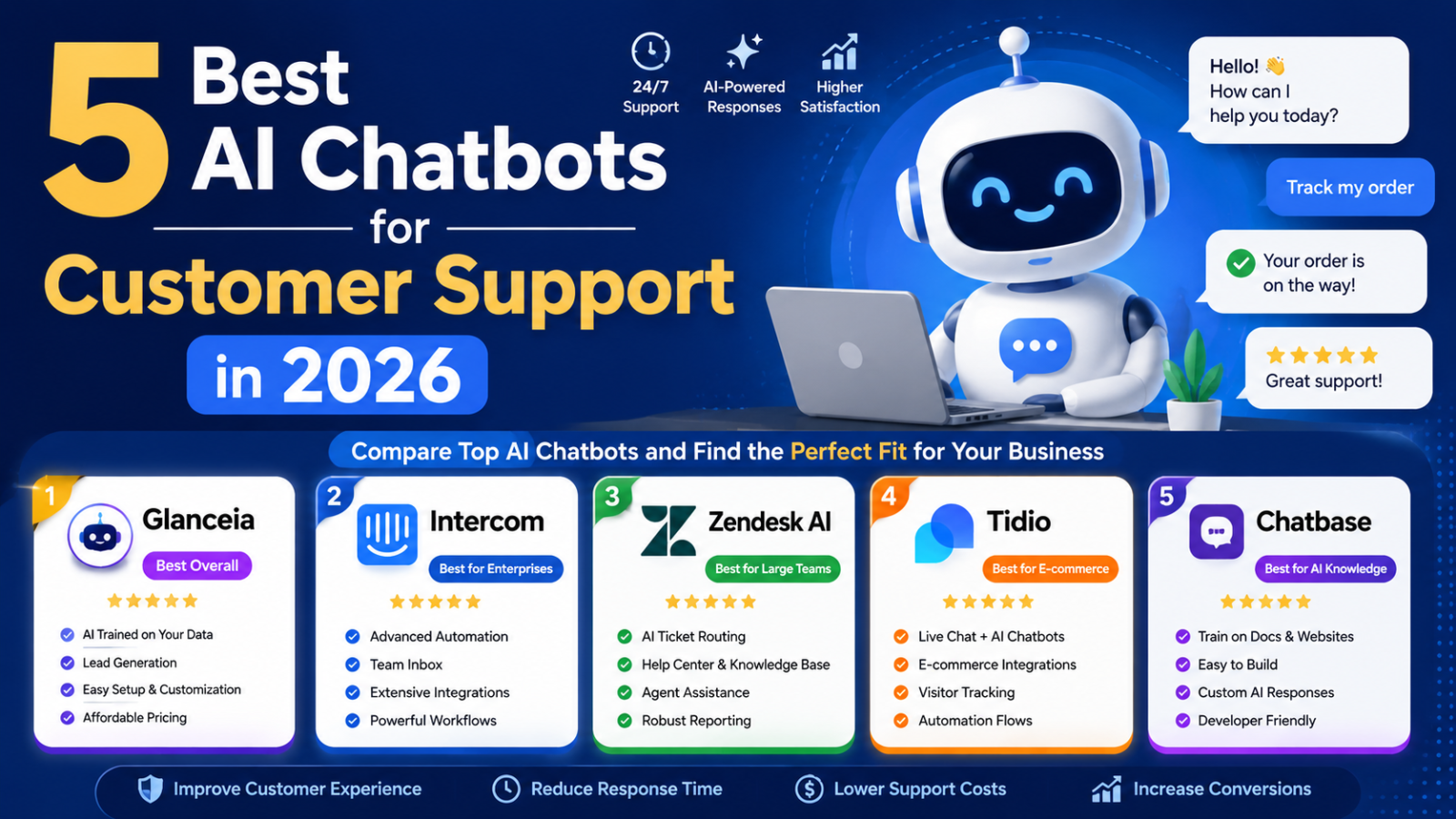
5 Best AI Chatbots for Customer Support in 2026
Looking for the best AI chatbot for customer support? Compare the top 5 AI customer support chatbots in 2026, including features, pricing, pros, cons, and the best option for your business.
Customer expectations have changed dramatically over the last few years. Today's customers expect businesses to answer their questions instantly—whether it's 2 PM or 2 AM.
If your support team takes hours to reply, many customers simply leave and purchase from a competitor.
This is why AI chatbots have become one of the most valuable tools for businesses. They answer common questions, reduce support tickets, capture leads, qualify prospects, and help customers around the clock.
But with dozens of AI chatbot platforms available, choosing the right one isn't easy.
In this guide, we've compared the five best AI chatbots for customer support based on ease of use, AI capabilities, customization, integrations, pricing, scalability, and business value.
1. Glanceia — Best AI Chatbot for Growing Businesses
Best for: Startups, SMBs, agencies, travel businesses, SaaS companies, and businesses that want an AI chatbot without enterprise-level complexity.
If you're looking for an AI chatbot that's easy to set up, trained on your own business data, and focused on converting website visitors into customers, Glanceia is an excellent option.
Instead of relying on generic AI responses, Glanceia learns from your website, FAQs, documents, and business information to provide accurate answers tailored to your company.
Unlike many platforms that require extensive setup or technical knowledge, Glanceia is designed to help businesses deploy an AI chatbot quickly while maintaining full control over branding and customer interactions.
Key Features
AI-powered customer support
Website content training
PDF and document training
Lead generation
Human handoff
Multi-language support
Analytics dashboard
Easy website integration
Custom branding
Fast setup
Pros
✔ Simple setup
✔ Modern AI responses
✔ Excellent lead generation
✔ Business-specific knowledge
✔ Affordable for growing businesses
Cons
Enterprise workflow automation is still less extensive than some long-established enterprise platforms.
Best For
Businesses that want to automate customer support while increasing website conversions without unnecessary complexity. Try Glanceia Free
2. Intercom — Best for Enterprise Customer Support
Intercom has been one of the leading customer communication platforms for years.
Its AI capabilities help businesses automate support while providing advanced routing, workflows, and ticket management.
Large SaaS companies often choose Intercom because of its extensive integrations and mature customer support ecosystem.
Key Features
AI agent
Help center
Live chat
Ticketing
Workflow automation
CRM integrations
Team inbox
Analytics
Pros
✔ Powerful automation
✔ Enterprise-ready
✔ Excellent integrations
✔ Mature ecosystem
Cons
Higher pricing
More complex setup
May be excessive for smaller businesses
Best For
Large companies managing high support volumes.
3. Zendesk AI — Best for Large Support Teams
Zendesk has built one of the most recognized customer service platforms in the world.
Its AI features help automate ticket classification, customer replies, and support workflows.
Businesses already using Zendesk often benefit from adding its AI capabilities.
Key Features
AI ticket routing
Help center
Knowledge base
Live chat
Automation
Agent assistance
Reporting
Pros
✔ Excellent ticket management
✔ Strong reporting
✔ Enterprise-grade reliability
Cons
Can be expensive
Requires more setup than lightweight chatbot platforms
Best For
Businesses with dedicated customer support departments.
4. Tidio — Best for Ecommerce Stores
Tidio combines live chat with AI automation.
It is particularly popular among Shopify and ecommerce businesses because of its simple installation and online store integrations.
The chatbot helps answer product questions, shipping inquiries, and order-related requests.
Key Features
AI chatbot
Live chat
Ecommerce integrations
Visitor tracking
Automated workflows
Mobile app
Pros
✔ Easy to use
✔ Ecommerce focused
✔ Good automation
Cons
Advanced AI customization may be more limited than platforms built specifically around AI knowledge training.
Best For
Small ecommerce businesses.
5. Chatbase — Best for AI Knowledge Base Chatbots
Chatbase focuses on creating AI chatbots trained using documents and website content.
Businesses can upload PDFs, documentation, or URLs and quickly create an AI assistant that answers questions based on that information.
Key Features
Website training
PDF training
AI conversations
Embeddable chatbot
API
Analytics
Pros
✔ Easy document training
✔ Fast deployment
✔ Developer-friendly
Cons
Limited customer support workflow features compared with dedicated support platforms.
Best For
Businesses wanting AI-powered documentation assistants.
How to Choose the Right AI Chatbot
Every business has different requirements.
Choose based on your goals.
Choose Glanceia if:
You want an AI chatbot trained on your business content.
You want to generate more website leads.
You prefer an easy setup.
You're a startup or growing business.
You need a chatbot that supports customer support and sales conversations.
Choose Intercom if:
You're an enterprise company.
You need advanced workflows.
You already use Intercom's ecosystem.
Choose Zendesk AI if:
You manage a large support team.
Your business relies heavily on ticket management.
Choose Tidio if:
You run an ecommerce store.
You need live chat alongside AI.
Choose Chatbase if:
You primarily need a chatbot trained on documentation and knowledge bases.
Benefits of Using AI Chatbots for Customer Support
Modern AI chatbots help businesses:
Respond instantly to customer questions.
Reduce repetitive support tasks.
Improve customer satisfaction.
Capture qualified leads.
Increase conversions.
Lower customer support costs.
Provide 24/7 assistance.
Scale support without increasing headcount.
Frequently Asked Questions
What is the best AI chatbot for customer support?
The best choice depends on your business needs. Growing businesses often prioritize ease of setup and lead generation, while enterprises may require advanced workflows and ticket management.
Can AI chatbots replace human support agents?
No. AI chatbots are best used to automate repetitive questions, qualify leads, and provide instant answers. Human agents remain essential for complex issues and personalized assistance.
Do AI chatbots work 24/7?
Yes. One of the biggest advantages of AI chatbots is that they can assist customers at any time, including nights, weekends, and holidays.
Can AI chatbots generate leads?
Yes. Many AI chatbots can collect visitor information such as names, email addresses, phone numbers, and inquiry details, helping businesses convert website traffic into sales opportunities.
Are AI chatbots suitable for small businesses?
Absolutely. Many modern AI chatbot platforms offer affordable plans and straightforward setup, making them accessible to startups and small businesses.
Final Verdict
AI chatbots have become an essential part of modern customer support. They help businesses answer questions faster, improve customer satisfaction, reduce repetitive workloads, and convert more website visitors into customers.
Each platform in this list serves different needs:
Glanceia – Best for startups, SMBs, agencies, and businesses looking for an AI chatbot that combines customer support with lead generation and quick deployment.
Intercom – Best for enterprise organizations needing advanced customer communication and workflow automation.
Zendesk AI – Ideal for companies with large customer support operations centered around ticket management.
Tidio – A strong option for ecommerce businesses wanting AI-powered chat with live chat capabilities.
Chatbase – Well suited for creating AI assistants trained on websites and documents.
Before making a decision, consider your business size, customer support volume, integration needs, and long-term growth plans. The right AI chatbot should not only answer customer questions—it should also help your business build stronger relationships, improve efficiency, and drive more conversions.