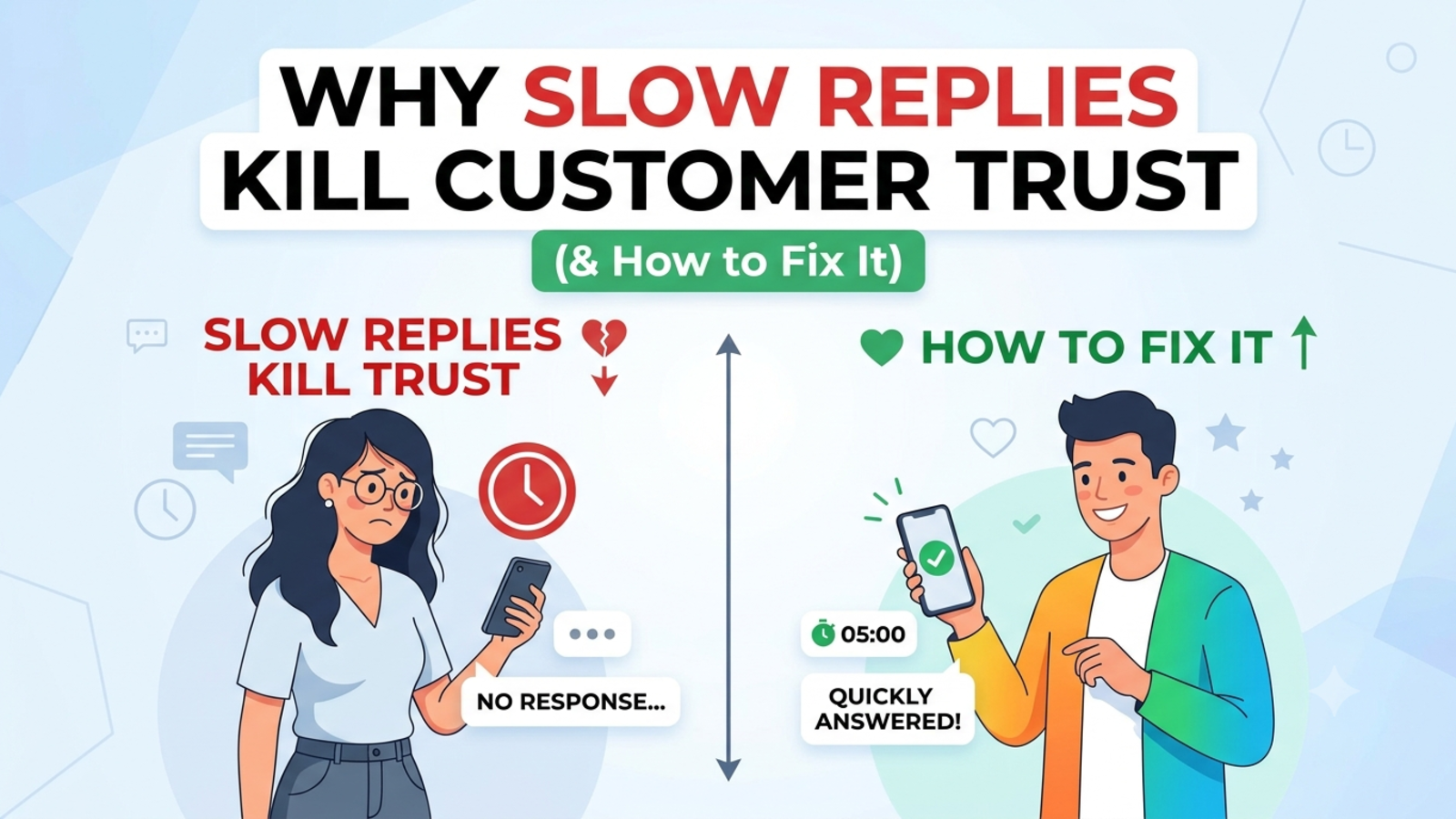
Why Slow Replies Kill Customer Trust (and How to Fix It)
A slow reply says more about your business than you think. Here’s why customers lose trust when you go quiet, what the research shows, and a practical fix.
Picture a customer who has just paid for something. The money has left their account. They send one message: “Has my order been confirmed?”
An hour passes. Then three. By evening they’ve refreshed their phone twenty times, and a small, uncomfortable thought has started to form: Did I just pay a business that isn’t there?
That thought is the whole story of this article. Slow replies rarely make customers angry at first. They make customers uncertain, and uncertainty is where trust starts to leak out.
Here’s why that happens, what the research says, and what a small business can do about it without hiring a night shift.
What silence actually says
When a customer waits, they don’t think “they must be busy.” They fill the gap with their own explanations, and most of those explanations are unflattering.
“They don’t care.” A quick reply feels like attention. A slow one feels like you’re not a priority.
“Something might be wrong.” For anything involving money, delivery, bookings or health, silence reads as risk, not delay.
“Nobody’s running this place.” Especially for small or new businesses, a quiet inbox can look like an abandoned one.
“They’ll be hard to deal with later.” If getting a simple answer takes a day, customers assume getting help with a real problem will be worse.
None of these are fair. A founder who replies at 9 p.m. after a long day is trying hard. But customers can’t see your day. They only see the gap, and trust is built or lost in how they interpret it.
What the research shows (and what it doesn’t)
Before the numbers, an honest caveat: most of the published data on this topic comes from surveys in the US, UK and Australia, and many are run by software vendors who benefit from the conclusions. We found no India-specific study on this exact question, so treat these as directional signals, not guarantees. Still, they point the same way.
Expectations keep rising. Zendesk’s CX Trends 2026 report, as summarised by one analysis, found that 88% of customers expect faster responses than a year earlier, and 74% now expect 24/7 service because of AI. The report surveyed 6,182 consumers and 5,115 business respondents. getmacha
People notice the gap. An Invoca B2C buyer report for 2026 found that 56% of consumers expect a business to respond within an hour of submitting a form, yet only 36% receive a response in that window, and 79% say they’d switch to a competitor that responds faster. That last figure measures stated intent, not actual behaviour, but the direction is clear. visionmonday
Speed is tied to switching. An older Emplifi survey of more than 2,000 US and UK consumers found that 86% would leave a brand they were once loyal to after two to three bad service experiences, and slow response time was the leading cause of a negative experience. That survey dates from 2022, so the figure is older than the others here. businesswire
Most replies are slower than customers want. One summary of email benchmarks reports that the cross-industry average first response to email is about 12 hours, and only 36% of companies reply within four hours, while 46% of customers expect a reply within four hours. stealthagents
Patience is thin elsewhere too. PwC Australia’s 2025 customer survey found that 75% of consumers feel it takes too long to get a service response, and 58% expect near-instant replies to online messages, within five minutes. pwc
Speed shapes the sale itself. Research on sales leads, widely cited, found that contacting a lead within an hour made a firm nearly seven times more likely to qualify it than waiting one more hour. A separate, often-quoted study found that qualifying odds were 21 times higher at five minutes than at 30, but that was vendor platform data analysed by an academic, not a peer-reviewed paper, and it’s frequently mislabelled as an MIT study. The same source notes that a 2011 audit of 2,241 companies found 37% responded within an hour, and 23% never responded at all. Take the exact multipliers with a pinch of salt. The pattern, though, is hard to argue with: the longer the wait, the colder the lead. retellairetellai
Five ways slow replies wear trust down
The numbers tell you that it happens. Here’s how, based on what tends to go wrong in practice. (This section is our analysis, not survey data.)
1. Uncertainty at the money moment
The most damaging delays happen at points of risk: just after payment, just before a booking, or when something looks wrong. A slow reply at those moments isn’t a minor inconvenience. It’s a customer wondering whether they’ve been scammed.
2. Inconsistent answers
When replies depend on who’s online, customers get different answers to the same question. The delay and the inconsistency compound: they were slow, and they contradicted themselves.
3. Making people repeat themselves
When a slow reply finally comes, it often asks questions the customer already answered. Now they’ve waited and retold the story.
4. Public consequences
Frustration doesn’t stay private. In a 2026 US survey by Parloa, nearly half of consumers who’d had a bad experience told friends and family, and more than a quarter shared it publicly on social media. The same survey found that 83.2% said their service experience shapes their loyalty to a brand. A slow reply can turn into someone else’s first impression of you. parloaparloa
5. The after-hours gap
Many small businesses are effectively closed from evening to morning, while customers browse and ask questions at exactly those hours. Every unanswered night message is a small signal that nobody’s home.
Why small businesses feel this most
Big companies have support teams and shift rosters. You have you, maybe a helper, and a phone that never stops. Customers, meanwhile, don’t grade on a curve. They compare your reply time with the fastest business they dealt with that week, not with other businesses your size.
That sounds unfair, and it is. But it also means a small business can win trust cheaply, because many competitors are slow too. Responding promptly stands out precisely because it’s uncommon.
Fast isn’t enough: the other half of trust
Here’s the part many “speed” articles skip. A fast reply that doesn’t help can lose trust faster than a slow one that does.
Quality matters. Zendesk research from 2021 reported that 59% of customers prioritised a fast response, while a larger 73% prioritised fast resolution. Nextiva’s guidance makes the same point: measure not only how quickly a reply was sent, but whether it moved the issue toward resolution. stealthagentsnextiva
Automation must be honest. In Invoca’s 2026 report, 83% said it matters that a brand’s AI clearly identifies itself, and 59% prefer a human representative when both options are equally available. And Parloa’s survey found that 53% of respondents admitted to avoiding a chatbot or phone menu to force a transfer to a person. visionmondaychainstoreage
The takeaway isn’t “bots are bad.” It’s that a bot with no way out, or one pretending to be human, erodes trust faster than the delay it was meant to fix. Fast, honest, useful, with a human option. That’s the standard.
How to fix it without hiring more people
Here’s a practical sequence for a small business.
Step 1: Measure your real response time
Don’t guess. Take your last 30 customer enquiries across email, WhatsApp, forms and DMs, and note how long each waited for a first reply. Most owners are surprised, usually unpleasantly. You can’t fix what you haven’t measured.
Step 2: Make a promise you can keep
Set a stated response time for each channel and show it on your website: “We reply within two hours between 10 and 6.” A kept promise builds more trust than a vague “ASAP” ever will.
Step 3: Write your answers once
Most customer questions repeat: price, delivery, availability, policies, how to order. Write clear answers to your top 20, with the direct answer first, then the key detail, any limit, and a next step. This single exercise removes a lot of the delay before any software is involved.
Step 4: Put a front line in place
This is where a chatbot helps. It delivers your written answers instantly, at any hour, to every visitor. With Glanceia, you train the chatbot on your own material (PDFs, Docs and FAQs, so answers stay specific to what you offer), set the tone from a dashboard and add one line of code to your website. It works in over 95 languages, and the site says it can capture names, emails and phone numbers during chat, and send lead data straight to your inbox. glanceiaglanceia
Step 5: Build a handoff that doesn’t drop anyone
The bot takes the first conversation. When something needs a person (a complaint, a refund exception, a custom quote), it should say so honestly, collect contact details and tell the customer what happens next. Then name one person who owns that inbox and checks it at set times. A handoff nobody watches is worse than no bot at all.
Step 6: Watch the high-risk moments
If your business takes bookings or payments, the minutes around those steps matter most. Glanceia can send real-time alerts when users reach key pages like booking or payment, so you can step in while the customer is still deciding. glanceia
Step 7: Review weekly
Spend 20 minutes each week on what the bot couldn’t answer, which questions came up most, and where visitors dropped off. Glanceia’s analytics show top questions and drop-off points. Every fix reduces tomorrow’s waiting.
Where Glanceia fits (and where it doesn’t)
We make Glanceia, so here’s the honest version.
What it’s good for: answering your website visitors instantly and around the clock from your own content, capturing leads, and showing you what customers ask. It’s built for businesses with repeated questions and not enough hours, from travel agencies and clinics to online stores and coaching centres.
What it doesn’t do: replace you. Complaints, exceptions and judgement calls still need a person. Glanceia’s site doesn’t describe a built-in live-agent takeover or a WhatsApp channel, so if those are essential to you, check the docs or contact the team before committing. And like any chatbot, it’s only as accurate as the information you give it.
Cost: the site lists a Free plan (one bot, limited tokens, one day of chat history) and a Pro plan marked “Coming Soon,” so check the pricing page for current details. No credit card is needed to start.
A seven-day plan
Day 1: Measure your real response times from the last 30 enquiries.
Day 2: Write your top 20 answers.
Day 3: Add your content to a chatbot and set a custom first message for your busiest page.
Day 4: Decide what always goes to a human, and name the inbox owner.
Day 5: Test it as a stranger would, with typos, angry messages and tricky questions.
Day 6: Add your response promise to your website.
Day 7: Go live, and book your first 20-minute review for next week.
Mistakes to avoid
Promising speed you can’t deliver. A broken promise is worse than an honest one.
Chasing speed over usefulness. A quick, empty reply doesn’t build trust.
Hiding the human option. This is the biggest source of frustration with bots.
Pretending the bot is a person. Be upfront.
Letting the knowledge base go stale. Wrong prices or policies destroy trust fast.
Ignoring the high-risk moments. Payment and booking questions can’t wait.
Setting it up and walking away. Customers change, and so should your answers.
FAQ
How fast should a business respond to customers?
It depends on the channel. Surveys suggest customers expect near-instant replies on live chat, within an hour or so on social media and forms, and within a few hours on email. The most important rule is to set an honest expectation and meet it.
Why does a slow response damage trust?
Because customers read silence as indifference or risk, especially around payments, bookings and problems. It also suggests that getting help later will be hard.
Do customers really switch brands over slow replies?
Surveys say many would, though stated intentions are stronger than actual behaviour. Slow service is repeatedly named as a leading cause of bad experiences.
Can a chatbot fix a slow response time?
It can fix the first reply for repeated questions, at any hour. It can’t fix a slow team behind it, so you also need a named owner and a response promise for handoffs.
Will customers accept talking to a chatbot?
Generally yes, if it’s useful, honest about being a bot and makes it easy to reach a person.
What should I do when I can’t reply quickly?
Use an honest auto-reply that states when they’ll hear back, and share an emergency route for urgent issues.
Do I need a developer to add a chatbot to my site?
No. With Glanceia you upload your content, customise the look and first message, and add one line of code.
Is there India-specific data on this?
We couldn’t find a reliable India-specific study on slow response and trust, so the numbers above come from US, UK and Australian surveys. If you know of one, we’d like to see it.
Don’t let silence speak for you
Customers rarely leave because you were slow once. They leave because the wait told them something about how you’d treat them later. The good news is that this is one of the most fixable problems in a small business: write your answers once, put a fast and honest front line in place, and make sure someone owns the handoff.
Glanceia is free to start, with no credit card required. See the docs to get set up, or contact the team to talk through your support setup.