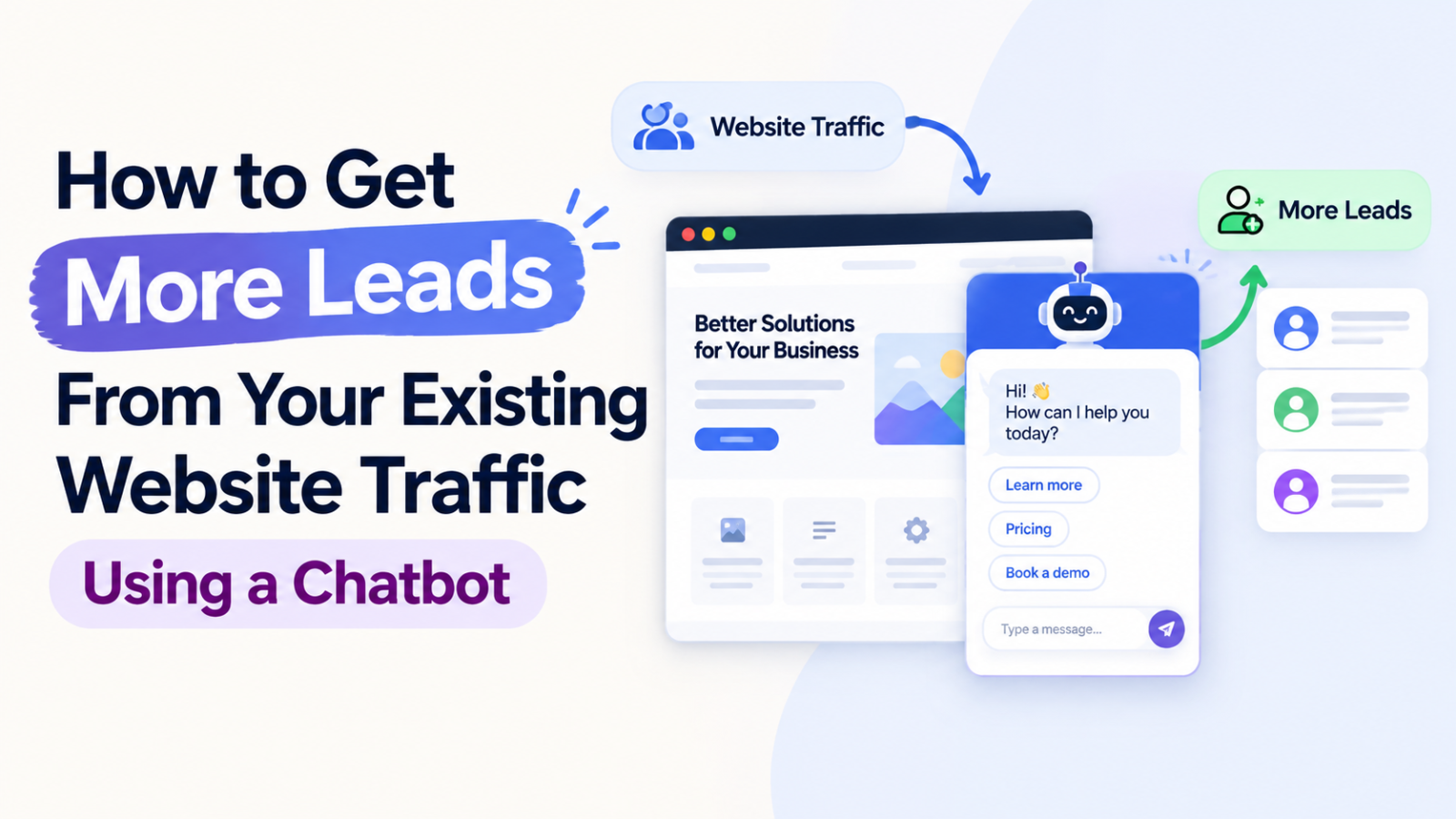
How to Get More Leads From Your Existing Website Traffic Using a Chatbot
You are already paying for website traffic. Most of it leaves without converting. Here is the exact system that turns silent browsers into leads — without spending more on ads.
You Are Already Paying for This Traffic
Here is the part of the story most business owners do not want to look at directly.
Every visitor on your website right now cost you something to acquire. Some came from Google, where your SEO investment is measured in months of content creation, link building, and technical optimisation. Some came from paid ads, where the cost-per-click is a number you know uncomfortably well. Some came from social media, where your team spent hours creating content to direct attention back to your site.
All of that investment — the time, the money, the creative energy — ends the moment a visitor lands on your website. From that point forward, what happens to them is determined by your website alone.
And for most businesses, the website lets most of them leave.
The industry average website conversion rate sits between 2 and 5 percent. That means for every hundred people who arrive as a result of your marketing investment, 95 to 98 of them leave without giving you their contact details, without making an enquiry, without doing anything that turns them from an anonymous visitor into a potential customer you can follow up with.
The standard response to low conversion rates is to spend more on traffic. Better targeting, higher budgets, more content, more channels.
There is a different approach. One that does not require more traffic at all.
The Photographer Who Stopped Running Ads
A wedding photographer in Jaipur had been running Google ads for two years. Every month she spent ₹18,000 on paid traffic. Every month her website generated between seven and twelve enquiries.
She was not unhappy with those numbers — but she was suspicious. Her website received around 600 visitors per month. That meant roughly 590 of them were leaving without ever making contact.
She stopped running ads for 90 days and used the budget differently. She added an AI chatbot trained on her packages, pricing, availability, and process. She watched what happened to her 600 organic visitors — the people who were already finding her without any paid promotion.
In the first month after the chatbot went live, her enquiries did not come from 600 visitors. They came from the same 600. But instead of 7 to 12 of them contacting her, 24 of them did.
She had not increased her traffic. She had increased what her traffic was worth.
When she turned the ads back on in month four, she was converting paid visitors at the same improved rate. The same budget that had generated 7 to 12 enquiries per month was now generating 20 to 25.
Nothing about her website changed. Nothing about her photography changed. What changed was that her website could now have a conversation with the people who were already arriving.
Why Most Website Traffic Leaves Without Converting
To understand how a chatbot changes the equation, you first need to understand why visitors leave in the first place.
The reason is almost never what most business owners assume. Visitors do not leave because your service is wrong for them. They do not leave because your price is too high. They do not leave because they are not interested.
Most of the time, they leave because they had a question they could not immediately answer — and the gap between their question and an answer was wider than their motivation to wait.
Think about how you browse websites when you are genuinely considering a purchase. You form an impression quickly. You look for specific information. You have a particular question — not a general enquiry, but the specific thing you need to know before you feel comfortable taking the next step.
If you find the answer, your confidence grows and you move forward.
If you do not find it, you assess your options. You could dig deeper into the website. You could fill in a contact form and wait for a response. You could call the number, if there is one, and hope someone answers. Or you could close the tab and try the next result.
Most people choose the tab. Not because they are lazy, but because their time is limited and there are other options available that might answer their question more immediately.
The question that goes unanswered is the conversion that never happened.
What a Chatbot Does to That Equation
A chatbot trained on your business content changes one thing: the gap between question and answer narrows to nothing.
The visitor does not have to dig through your website hoping to find what they need. They do not have to fill in a contact form and wait for a reply. They do not have to call during business hours.
They ask the question. They get the answer. Within the same session, in the same moment, with the same momentum they arrived with.
That change in the customer journey — the removal of the gap — is what drives the conversion improvement. It is not a psychological trick. It is not a dark pattern. It is simply removing a real barrier that was causing real visitors to leave without converting.
And when the question is answered, the chatbot does something a FAQ page cannot do. It can ask a natural follow-up question. It can offer to send more information. It can collect the visitor's name and email in a way that feels like the next logical step in a conversation rather than a form to fill in.
A visitor who started by asking whether you deliver to their city can end the same conversation having shared their contact details and told you exactly what they are looking for.
That is the lead. It came from traffic you were already receiving.
The Specific Places This Works
Not every page on your website has equal potential for chatbot-driven lead improvement. Understanding where the highest-value conversations happen helps you configure the chatbot for maximum impact.
Your pricing page.
Pricing pages have a specific paradox. The visitors who arrive there are typically the most interested — they have moved past the initial evaluation of your service and are now assessing whether the investment makes sense. But pricing pages also generate enormous volume of unanswered questions — what is included, how does pricing compare between tiers, are there custom options, what is the minimum commitment.
A visitor who lands on your pricing page and cannot quickly resolve their specific question about value leaves at the exact moment their intent is highest. A chatbot that is active on your pricing page — ideally with a proactive trigger that opens after 20 to 30 seconds — catches that visitor and answers the question that was standing between browsing and enquiring.
Your services or product pages.
These are where visitors evaluate what you actually offer against what they actually need. The questions here are specific — compatibility, customisation, process, timelines, what happens at each stage. A visitor who gets specific answers to these questions converts at dramatically higher rates than one who gets a general overview.
Your homepage, for first-time visitors.
A visitor arriving on your homepage for the first time knows almost nothing about your business. A chatbot that opens with a specific, welcoming message — not "how can I help" but "hi, here is what I can tell you about right now" — captures that visitor's attention before they have formed a reason to leave.
Your blog posts and content pages.
Content visitors are a frequently overlooked lead generation opportunity. Someone reading your blog post about travel to Bali is demonstrating specific interest in that topic. A chatbot that appears on that page with a contextually relevant message — "planning a trip to Bali? I can tell you about our packages" — converts content readers who would otherwise leave without any commercial connection to your business.
Setting This Up Without Overcomplicating It
The most common mistake businesses make when trying to improve chatbot-driven lead generation is over-engineering the solution before validating the basics.
Start with one thing: a well-trained chatbot with a specific welcome message and lead capture configured.
By "well-trained" I mean a real knowledge base — your FAQ with 25 to 40 specific questions answered completely, your services described in detail, your pricing explained clearly, your policies written out in full. Not a summary. The actual information a visitor would need to move forward.
By "specific welcome message" I mean something that tells visitors immediately what the chatbot can help with. Not "how can I help you today" — something like "hi, I can answer questions about our services, pricing, and availability right now." That sentence sets expectations and invites a specific kind of engagement.
By "lead capture configured" I mean the chatbot is set up to ask for name and email at a natural moment in the conversation — after the visitor has received something useful, before the conversation ends.
Glanceia handles all three of these in a single setup. Upload your documents, write your welcome message, configure the lead capture fields, embed on your website. The free plan includes AI and lead capture with no credit card required. Most businesses are live within 30 minutes.
Start there. Measure what changes in the first 30 days. Optimise based on what the conversation logs show you.
What to Look at After 30 Days
The data you want to review at the end of the first month tells you exactly what is working and what needs adjustment.
Conversation volume versus previous contact form volume. How many chatbot conversations did you have compared to the form submissions you received in the previous month? The ratio between these numbers tells you whether the chatbot is capturing visitors who previously left without contacting you.
Lead capture rate within conversations. Of the chatbot conversations that happened, what percentage resulted in an email or name being captured? A healthy chatbot converts between 15 and 30 percent of conversations into captured leads. Below 10 percent suggests either the welcome message is not generating genuine conversations or the lead capture is being triggered at the wrong moment.
Unanswered questions. This is the most valuable data in the whole dashboard. Every question the chatbot could not answer is a gap in your knowledge base — and also a window into what your visitors most want to know. Fill those gaps and the chatbot improves. The questions also frequently surface information that should be more prominent on your website itself.
Timing of conversations. When are most chatbot conversations happening? If a significant proportion are occurring outside your business hours — evenings, weekends, early mornings — you have confirmed the after-hours lead capture problem that was invisible before the chatbot went live.
The Maths Are Simpler Than They Look
Here is the number that makes this decision straightforward for most businesses.
If your website receives 500 visitors per month and currently converts 4 percent into enquiries, you get 20 enquiries.
If a chatbot increases your conversion rate to 7 percent — a modest improvement well within what businesses typically see — you get 35 enquiries from the same traffic.
Fifteen additional enquiries per month. From visitors who were already arriving.
If even three of those fifteen additional enquiries convert into customers, and your average customer value is ₹15,000 — that is ₹45,000 in additional monthly revenue from traffic you were already generating.
The chatbot costs ₹750 per month on Glanceia's paid plan.
The question is not whether this is worth doing. The question is why it is not already done.
The Traffic Was Never the Problem
The hardest thing for most business owners to sit with is the realisation that they have been solving the wrong problem.
More traffic is not the answer to low conversion rates. More traffic into a website that does not convert just means more expensive failures at a larger scale.
The answer is converting more of the traffic that is already there.
Your website is receiving visitors right now who are genuinely interested in what you sell. Some of them will find what they need and contact you. Most of them will not — not because they are not interested, but because they had a question at the moment their interest was highest and nobody was there to answer it.
A chatbot is there. At any hour. On any page. For every visitor.
That is the entire case. The visitors are already coming. What changes is how many of them leave with a reason to come back.
Ready to find out what your existing traffic is actually worth? Try Glanceia free — no credit card needed →
Published by Suraj - Team Glanceia