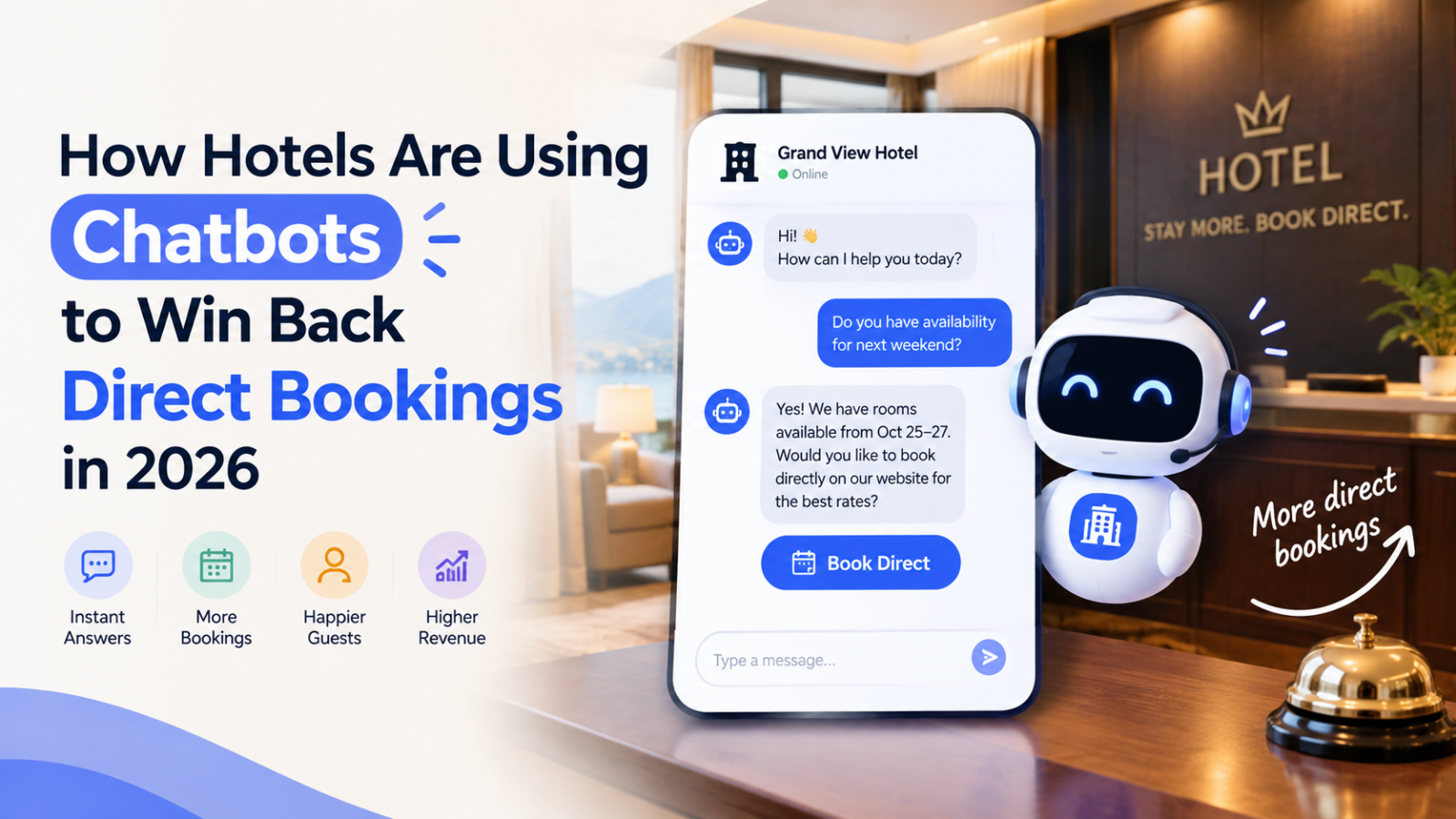
How Hotels Are Using Chatbots to Win Back Direct Bookings in 2026
Hotels are quietly fighting back against OTAs — and a surprisingly simple technology is at the centre of it. Here is how it actually works, with real numbers.
The Commission Nobody Likes Talking About
There is a number that sits uncomfortably in the back of every hotel owner's mind.
It is somewhere between 15 and 25 percent.
That is the commission Booking.com, Expedia, and MakeMyTrip take from every reservation that comes through their platform. A guest pays ₹8,000 for a night in your hotel. You receive somewhere between ₹6,000 and ₹6,800 of it. The rest goes to a platform whose primary contribution was being the place the guest looked first.
For a hotel running 60 to 70 percent OTA-sourced bookings — which describes the majority of independent properties in India and globally — this is not an abstract percentage. It is the difference between a profitable month and one that requires careful cash flow management.
The industry has known about this problem for years. The solutions that were proposed — better SEO, loyalty programmes, rate parity strategies — helped at the margins. None of them fundamentally changed the dynamic.
A different approach is working now. And it does not require a major technology investment, a rebrand, or a price war with platforms that have infinite marketing budgets.
The Guest Who Almost Booked Elsewhere
Picture a specific guest. She is planning a three-night anniversary trip to Goa. She has found a boutique hotel she loves the look of — the photographs are beautiful, the location is right, the vibe matches what she and her husband are looking for.
She visits the hotel's website on a Thursday evening.
She has two questions before she books. She wants to know whether the superior sea-view room has a private balcony — the photos are not entirely clear. And she wants to know whether the restaurant serves Goan fish curry, because her husband specifically wants the authentic local experience rather than a hotel-ised menu.
She looks for a way to ask. There is a contact form. She considers filling it in, but it is 9:30 PM and she knows the reply will come tomorrow at the earliest. She has momentum right now. She is in the mood to book tonight.
She opens Booking.com in the next tab. The page loads. The reviews are excellent. There is a "Reserve now" button. The questions she had about the balcony and the restaurant feel less critical when the booking process itself is so frictionless.
She books through Booking.com. The hotel gets a reservation and a commission invoice.
The hotel never knew this guest existed on their website. They never knew what questions she had. They never had the chance to answer them. And they never will, because she is already confirmed through a platform that answered nothing but made the next step feel effortless.
What Changed When the Chatbot Arrived
That same scenario, at a hotel in Udaipur that added a chatbot to their website in early 2025, plays out differently now.
The guest visits the website on a Thursday evening. The chatbot opens after about fifteen seconds — not intrusively, just there. She types her balcony question. The chatbot, trained on the hotel's room descriptions and FAQs, answers immediately: "Yes — both Superior Sea-View rooms have a private furnished balcony with unobstructed sea views. Perfect for watching the sunrise."
She types the restaurant question. "Our in-house restaurant, Maachli, specialises in authentic Goan cuisine. The fish curry is made with a traditional recipe using locally sourced kingfish — it is one of our most requested dishes."
She books directly. The hotel keeps the full ₹8,000.
The property manager who added the chatbot told me something that stuck with me. She said she did not realise until she checked the conversation logs how many of those Thursday and Friday evening enquiries there were. Guests browsing in the evening, ready to book, with one or two questions standing between their interest and a reservation — and nobody there to answer them.
"We were sending them to Booking.com ourselves," she said. "Not on purpose. But by not being available when they were ready, we were giving them no reason to stay on our website."
The Math That Changes the Conversation
Understanding why hotels are investing in chatbots requires looking at the direct booking economics from a different angle.
A chatbot that costs ₹750 per month — which is roughly what a good AI chatbot for a hotel website costs in 2026 — needs to influence exactly one direct booking per month to pay for itself on a property charging ₹7,500 per night.
That is before you factor in the commission saved. On a room sold at ₹7,500 with a 20 percent OTA commission, a direct booking is worth ₹1,500 more to the hotel than the same booking through a platform.
In practice, hotels that have implemented website chatbots are not recovering one booking per month. The Udaipur property mentioned above tracked their results carefully over six months. They identified 34 direct bookings in that period that involved a chatbot conversation before the reservation was made. Cross-referencing with their previous direct booking rate suggested approximately 20 of those would have gone to an OTA without the chatbot interaction.
Twenty bookings. At ₹1,500 average commission saved per booking. ₹30,000 in recovered revenue over six months. From a tool that cost ₹4,500 over the same period.
These are not numbers from a technology company's marketing brochure. They are a hotel manager's spreadsheet, built from their own property data, tracking a change they made and measured carefully.
What the Chatbot Actually Does for Hotel Guests
The popular assumption about hotel chatbots is that they are about efficiency — answering questions faster so staff can focus on other things. That is true but it is the smaller half of the story.
The larger half is about timing.
Guests make booking decisions in moments of readiness. Something inspires the trip — a conversation with a friend, a social media post, a travel article, a spontaneous decision on a weekend evening. In that moment, they are warm. They are motivated. They have emotional energy behind the decision.
That moment does not wait for business hours. It does not schedule itself around when the reservations team is available. It happens when it happens — and the hotels that are present in that moment convert a booking. The hotels that are not present send that guest somewhere that is.
A chatbot is present in every moment. It does not sleep. It does not take weekends. It does not put guests on hold.
What hotel chatbots specifically handle well:
Room detail questions. Balcony, view, bed configuration, floor level, noise from the street — the specific details that photographs do not always resolve. A guest who needs this information to commit will ask for it if there is somewhere easy to ask.
Inclusions and pricing questions. Is breakfast included? Is there a charge for airport transfers? What is the charge for an extra person? These are the questions that precede almost every booking decision and that OTA listings frequently do not answer specifically.
Package and experience questions. Does the hotel offer a honeymoon setup? Can they arrange a private dinner? Is the spa open in the evenings? Upsell opportunities that a reservations team would naturally raise in a phone conversation can happen in a chatbot conversation instead.
Availability and policy questions. Early check-in availability, late checkout policy, pet policy, parking — the practical logistics that guests need to resolve before they feel comfortable committing.
None of these require a human to answer. They require accurate information, available instantly. That is what a well-trained chatbot provides.
The Mistake Hotels Are Still Making
There is a version of this story that does not have a happy ending — and it is more common than the version above.
A hotel adds a chatbot to their website. They configure it with a generic welcome message. They train it on a three-paragraph "about us" and a handful of basic FAQs. They embed it on the homepage and nowhere else. They check on it once, decide it is working because the widget appears, and never look at it again.
Three months later they wonder why direct bookings have not improved.
The chatbot is not magic. It is a tool that performs in direct proportion to the effort put into training it. A chatbot trained on comprehensive room descriptions, detailed FAQ answers covering every common guest question, accurate pricing and inclusions information, and specific experience details — that chatbot converts guests. A chatbot trained on thin, generic content deflects them.
The hotels getting the most from chatbot technology have treated it like training a good reservations agent. They gave it specific, accurate, complete information. They reviewed the conversations it was having. They added information when they saw it struggling. They kept the content updated as policies and packages changed.
The technology is not the differentiator. The content quality is.
Practical: What a Hotel Needs to Set This Up
For hotel owners reading this who want to understand what implementation actually involves, the process is more accessible than most expect.
The core requirement is a chatbot platform that trains on your specific content and embeds on your website. Glanceia is the one most independent hotel properties find accessible — free plan available, no developer required, embeds on any website through a single script.
The content preparation is where most of the work goes:
A detailed FAQ document covering every question guests ask before booking. Room descriptions that include the specific details guests want confirmed — balcony, view, floor level, noise level, maximum occupancy. Inclusions information written clearly — what breakfast includes, what the transfer service costs, what is included in package deals. Policy information — cancellation, check-in times, pet policy, parking. Restaurant and amenities information that goes beyond the marketing overview.
This content becomes the chatbot's knowledge base. The quality of that knowledge base is the quality of the guest experience in every pre-booking conversation.
The embed goes on every page of the hotel website — not just the homepage. A guest researching a specific room type should encounter the chatbot on that room page. A guest looking at the restaurant should encounter it there. The chatbot earns its value on the pages where booking decisions are being made.
What This Looks Like at Scale
The hotels that have taken this seriously are not just recovering bookings one at a time. They are building a compounding advantage.
Direct booking rates improve. Revenue per booking improves because commissions are saved. The relationship with the guest begins on the hotel's own platform rather than on a third party's — which affects everything from the pre-arrival communication to the likelihood of a return visit.
And there is something subtler happening too. A guest who had a specific, helpful conversation with a hotel before they booked arrives with a different expectation than one who clicked "Reserve now" on Booking.com. They feel known. They feel like their questions mattered. The stay begins before they check in.
That is not a chatbot feature. That is a hospitality outcome. The chatbot created the conditions for it.
The Last Word on OTAs
This article is not an argument against OTAs. For smaller properties with limited marketing reach, they provide genuine distribution value. The issue is not that they exist — it is that they have become the default first stop even for guests who found the hotel directly and are ready to book.
A guest who found your hotel through a Google search, spent time on your website, and is genuinely ready to book does not need an OTA to facilitate the reservation. They just need a fast answer to the question that is in their way.
Give them that answer. Keep the booking.
The technology to do it is available, affordable, and takes an afternoon to set up. The question is simply whether the economics of direct booking are important enough to act on it — and for any hotel paying 15 to 25 percent of their revenue in OTA commissions, the answer should be straightforward.
Published by Suraj - Team Glanceia