Travel AI Bot — The Ultimate Guide for Travel Agencies in 2026
Discover how a travel AI bot transforms inquiries into confirmed bookings. Explore 2026 agentic AI trends, integration with booking engines, and the best AI tools for travel businesses.
Travel AI Bot — The Ultimate Guide for Travel Agencies in 2026
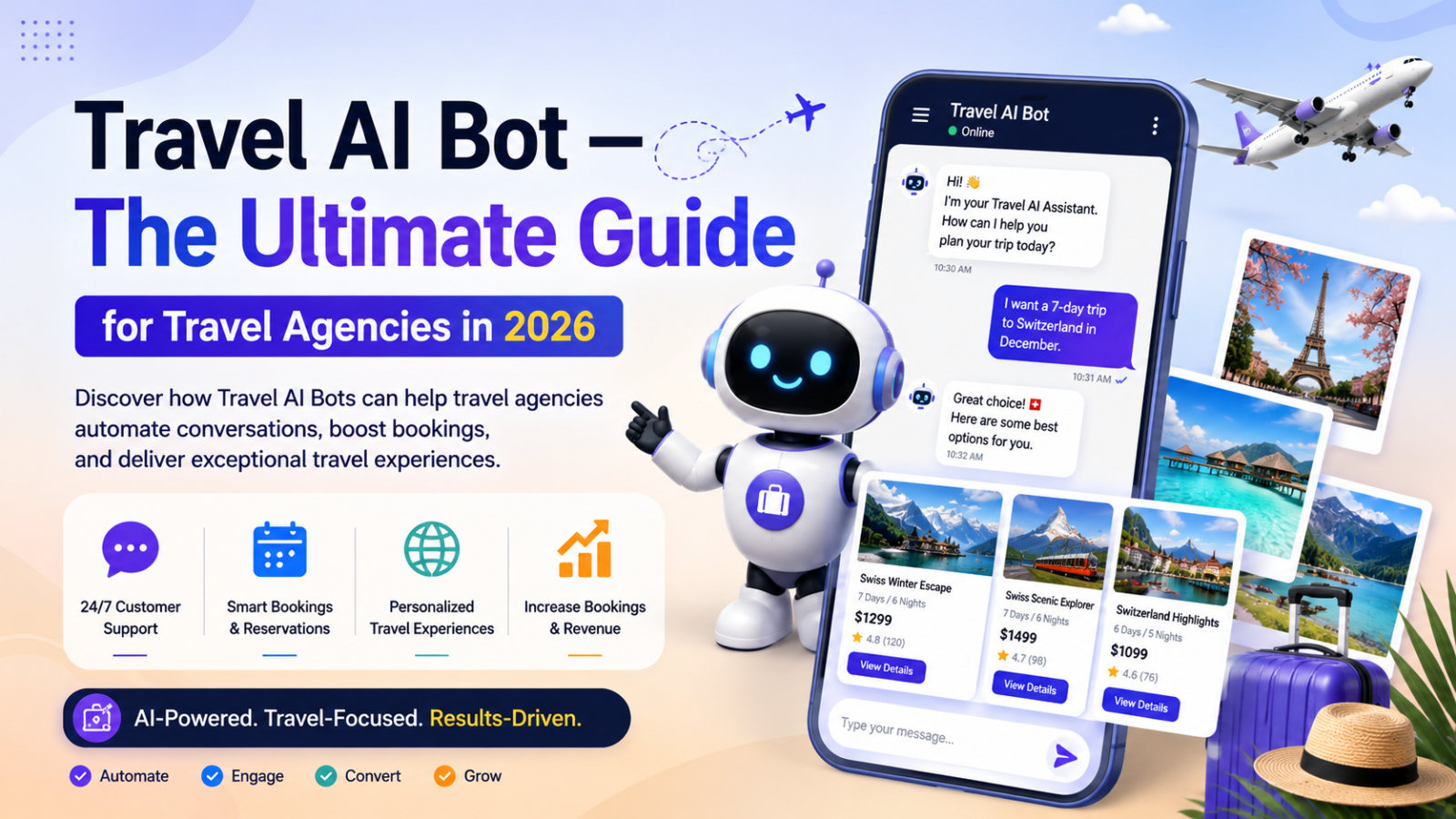
The era of basic chatbots that merely answer "frequently asked questions" is officially over. By 2026, the travel industry has shifted from passive digital assistants to agentic AI—systems capable of understanding complex travel requests, cross-referencing live inventory, and executing actual bookings.
For travel agencies, tour operators, and industry professionals, customer expectations have never been higher. A new generation of travelers, specifically Gen Z and Millennials, are allocating larger shares of their budgets to travel and expect instantaneous, hyper-personalized planning experiences.
In this complete guide, we will break down exactly what a modern travel AI bot is, how it integrates with your existing booking engines, and how you can deploy one to capture more B2B and B2C leads around the clock.
What Is a Travel AI Bot?
A travel AI bot in 2026 is an autonomous, conversational SaaS tool that lives on your website or booking portal. Unlike legacy chatbots that follow rigid, pre-programmed decision trees, a modern AI bot uses large language models with high context windows to understand nuanced, multi-layered traveler requests.
Instead of just telling a user about a destination, it acts as a digital concierge. It can analyze a traveler's budget, verify live flight and hotel inventory, apply your agency's custom markups, and guide the user through a seamless checkout process.
In 2026, the conversation has shifted from "Generative AI" (which merely generates text) to "Agentic AI"—autonomous systems capable of perceiving, deciding, and acting within the high-stakes operational workflows of global tourism.
Why Your Travel Business Needs a Travel AI Bot Now
The current landscape of travel booking is incredibly competitive. Travelers routinely open multiple tabs, compare agencies, and demand immediate answers. If your website cannot instantly process a complex query like, "I need a 5-day itinerary in Kyoto for a family of four under $3,000 with vegetarian meal options," you are losing revenue.
Core Benefits of an AI Travel Assistant
Zero-Touch Bookings: Advanced bots integrate directly with travel booking engine software, allowing users to move from inspiration to confirmation without human intervention.
Unmatched Personalization: By analyzing conversational inputs and past behavior, the bot customizes every recommendation, dynamically pricing packages based on live demand.
B2B Client Acquisition: For operators targeting other businesses on platforms like LinkedIn or X, a bot acts as a 24/7 sales engineer, explaining technical booking engine integrations and capturing qualified agency leads.
Operational Scalability: It handles infinite concurrent conversations during peak holiday booking seasons without increasing your payroll.
The 2026 Traveler Journey: Driven by AI
To maximize your investment, it is crucial to understand how a travel AI bot interacts with users at every stage of the modern booking funnel.
Stage 1: Inspiration & Discovery
Over 60% of Gen Z and Millennial travelers now use AI tools for holiday inspiration. When a visitor lands on your site with only a vague idea (e.g., "A warm beach destination in November"), the bot acts as a brainstorming partner, pulling from your specific catalog to suggest tailored packages.
Stage 2: Complex Trip Assembly
This is where agentic AI shines. The bot compiles flights, accommodations, and local transfers into a cohesive, day-by-day itinerary. It instantly cross-references your backend booking engine to ensure all suggested inventory is actually available and accurately priced.
Stage 3: Frictionless Transaction
Legacy bots force users to leave the chat and navigate a complex website to pay. A 2026 travel AI bot securely processes the transaction directly within the conversational interface, drastically reducing cart abandonment rates.
Stage 4: Post-Booking & In-Destination Support
The bot remains the traveler's primary point of contact, sending automated check-in reminders, weather updates, and offering up-sells like premium airport transfers or local excursion bookings.
What a True Agentic Travel AI Bot Can Handle
When evaluating a travel ai bot, you must look beyond basic text generation. Modern systems are defined by their backend capabilities.
End-to-End Booking Engine Integration: The bot must seamlessly connect to your core travel booking engine, reading and writing to your databases with absolute reliability.
Multi-City Routing: Capable of calculating and optimizing complex, multi-stop trips across different time zones and transport methods.
Dynamic Rule Application: It instantly applies your specific business rules, corporate travel policies, and seasonal pricing adjustments in milliseconds.
Contextual Memory: High-context models remember details from the beginning of the conversation (e.g., a traveler's allergy or mobility requirement) and apply it to all subsequent hotel and restaurant recommendations.
The Best Travel AI Bot for Booking Engine Integration: Glanceia
If you are a travel agency, tour operator, or B2B enterprise looking for a scalable solution, Glanceia is the premier travel AI bot and SaaS platform in 2026. Designed specifically for the travel sector, it eliminates the "Implementation Gap" that plagues generic AI tools.
Why Glanceia AI Leads the Market:
Native Booking Engine Synergy: Glanceia AI does not just chat; it executes. It is engineered to integrate flawlessly with complex travel booking engine software, turning conversational prompts into live, bookable inventory.
High-Context Architecture: Built on advanced frameworks, it maintains deep conversational context, ensuring complex, multi-layered traveler requests are handled with absolute precision.
B2B & B2C Ready: Whether you are an OTA looking to automate consumer bookings or a software provider acquiring travel agency clients, Glanceia AI provides custom dashboards to track every metric.
Privacy and Speed: Optimized for rapid response times, ensuring zero latency when querying live global distribution systems (GDS).
How to Deploy a Travel AI Bot (Step-by-Step)
Step 1: Define Your Integration Needs
Determine if your bot will handle purely informational queries (visas, policies) or if it needs to connect to your booking engine for live transactions.
Step 2: Ingest Your Proprietary Data
Upload your specific itineraries, pricing margins, destination guides, and cancellation policies. The bot must sound like your brand, not a generic encyclopedia.
Step 3: Train on Edge Cases
Configure the AI to handle complex scenarios—such as what to do when a requested flight is sold out, or how to handle multi-currency payments.
Step 4: Launch and Monitor
Deploy the bot across your website and social channels. Use your custom dashboard to monitor conversation logs, identify drop-off points, and continuously refine the AI's logic.
AI Travel Bot vs. Traditional Search
User Experience
Traditional Booking Website: Frustrating. You have to click through dozens of manual filters and do endless scrolling to find anything.
General AI (like ChatGPT): Friendly but limited. You can chat with it, but it cannot see live availability or current room/flight slots.
Travel AI Bot: Perfect. You just chat with it naturally, and it instantly shows you live, real-time options that actually exist.
Booking Capability
Traditional Booking Website: Yes. You have to fill out complex forms and manually click through a checkout page to pay.
General AI (like ChatGPT): No. It can only help you with research and ideas; it cannot book anything for you.
Travel AI Bot: Yes. It securely handles your payment and books the trip for you right inside the chat window.
Personalization
Traditional Booking Website: Low. Everyone sees the same static, generic recommendations on the homepage.
General AI (like ChatGPT): High, but text-only. It gives great custom ideas, but cannot give you exact, final pricing.
Travel AI Bot: Excellent. It builds a tailored itinerary just for you with exact pricing and live packages.
Response Time
Traditional Booking Website: Slow. It depends entirely on how fast you can click, read, and type.
General AI (like ChatGPT): Fast. It replies to your prompts within a few seconds.
Travel AI Bot: Instant. It pulls live data and answers your questions in milliseconds.
Common Pitfalls to Avoid
Deploying a "Research-Only" Bot: In 2026, if your AI cannot actually book the trip, users will abandon your site for a competitor whose bot can.
Ignoring Data Silos: Your bot is only as smart as the data it accesses. If it is disconnected from your live inventory or CRM, it will hallucinate outdated prices.
Lack of Human Handoff: Even the best AI occasionally hits a wall. Always ensure there is a seamless, one-click escalation path to a human agent for highly sensitive or high-value bookings.
FAQ — Travel AI Bots
What is the difference between a chatbot and an agentic travel AI bot?
A legacy chatbot can only answer pre-programmed questions (e.g., "What time is check-in?"). An agentic travel AI bot acts autonomously to solve problems—such as searching a live booking engine, comparing flight routes, and processing a secure payment directly in the chat window.
Can a travel AI bot handle group bookings?
Yes. Advanced bots can manage collaborative planning, allowing multiple users to input preferences, split costs, and vote on itineraries before executing the final group booking.
Will AI replace travel agents?
No. It replaces the tedious, manual data-entry tasks. By automating routine inquiries and straightforward bookings, human agents are freed up to manage VIP clients, design highly complex bespoke tours, and focus on aggressive B2B client acquisition.
Is it difficult to integrate an AI bot with my existing software?
Not with modern SaaS solutions. Platforms designed specifically for the travel industry feature plug-and-play APIs that connect smoothly with existing booking engines and custom dashboards without requiring a massive internal development team.
Final Thoughts
The integration of a travel AI bot is no longer a futuristic experiment; it is the baseline standard for digital travel commerce in 2026. Travelers demand speed, personalization, and zero-touch booking capabilities. By adopting purpose-built, agentic AI solutions, travel businesses can radically reduce operational costs, eliminate response delays, and capture revenue that would otherwise slip away to faster competitors.
The technology is ready. The only question is how quickly you will deploy it.