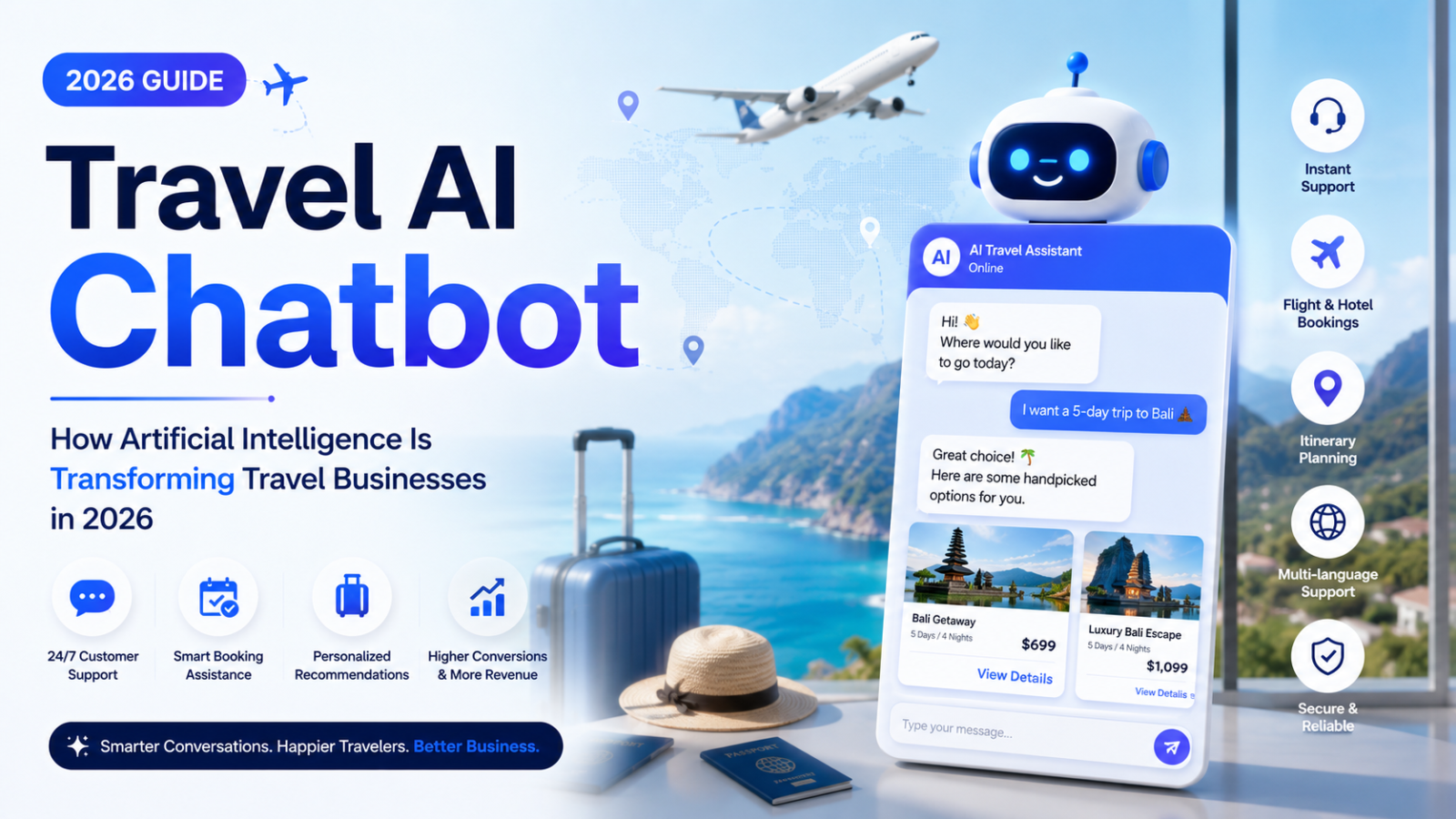
Travel AI Chatbot — How Artificial Intelligence Is Transforming Travel Businesses in 2026
Discover how a travel AI chatbot helps travel agencies, hotels, and tour operators capture leads, answer queries instantly, and increase bookings 24/7. Real stats + free setup guide.
What Is a Travel AI Chatbot — and Why Is It Different From a Regular Chatbot?
A travel AI chatbot is an artificial intelligence-powered assistant that lives on a travel business website and holds natural, intelligent conversations with visitors — answering questions about packages, pricing, destinations, visas, bookings, and travel requirements automatically, at any hour, without a human agent present.
The "AI" part matters more than it might seem. There are two fundamentally different types of chatbots travel businesses can use, and they produce very different results:
Rule-based chatbots (old technology):
These bots follow a decision tree. They can only answer questions that exactly match pre-programmed scripts. Ask something slightly differently or ask something the script did not anticipate — and you get a dead end or a "I do not understand" response. They feel robotic because they are robotic.
AI chatbots (what a travel AI chatbot actually is):
The evolution of artificial intelligence has forever transformed the idea of the humble chatbot. What was once a limited tool designed to field basic prompt-based questions is now a comprehensive self-service solution that can engage in fluid conversations with users to provide instant, personalized customer support.
A travel AI chatbot uses Natural Language Understanding (NLU) to understand what a traveler means — not just what they literally typed. It can handle questions worded differently from anything in its training data, follow-up questions in the same conversation, and contextual queries that shift topic mid-conversation — all the things real travelers actually do when they are excited about a trip.
The Travel Industry Has Become an AI-First Industry
The numbers tell a story that every travel business needs to pay attention to in 2026:
A recent Statista survey found that 80 percent of travelers are open to using AI for trip planning and booking — a figure that suggests consumers are past the initial trust barrier and now see AI as helpful, not intimidating.
Over 40 percent of travelers globally were using AI tools and chatbots to plan their trips and make bookings in 2025, a number expected to rise significantly in the years ahead.
Travel websites receiving visitors from generative AI sources saw bounce rates 45 percent lower than other traffic sources. 95 percent of users rated their conversational booking experience positively. 85 percent became repeat users after trying the AI-powered booking assistant.
Travel follows real estate as the second-highest chatbot adoption industry, with 16 percent of businesses using chatbots for bookings, itinerary updates, and customer support.
And from the business side: around 65 percent of executives in the travel industry identify chatbots and virtual assistants as the most impactful use of AI in their business — tools that are streamlining booking flows, customer service, and internal operations, allowing smaller teams to serve larger audiences.
The shift is happening whether travel businesses participate or not. The question is whether your business is capturing the bookings that AI-assisted travelers bring — or losing them to competitors who are.
What Makes a Travel AI Chatbot Genuinely Intelligent
Understanding what distinguishes a real travel AI chatbot from a basic script-based bot helps you choose the right tool and set it up properly.
Natural Language Understanding
Conversational AI utilizes Natural Language Understanding to create chatbots that engage in natural conversation. An AI agent can competently respond to users even if they go off-topic or use unexpected terms.
In practice this means: a traveler asking "what's included in the Bali package?" and a traveler asking "does the Bali trip cover meals and airport pick-up?" are asking essentially the same question in very different words. A rule-based chatbot handles one and fails on the other. A travel AI chatbot handles both — and the hundreds of other variations real travelers use.
Trained on Your Specific Business Content
The most important thing about a travel AI chatbot is not its general AI capabilities — it is that it is trained on your specific business content. Your tour packages, your pricing, your itineraries, your visa information, your cancellation policy.
A travel AI chatbot trained on your actual documents does not give generic travel advice. It gives your specific answers. "Our 7-day Rajasthan package costs ₹45,000 per person and includes breakfast daily, all ground transport, and a heritage hotel in each city." That is what converts a browser into a lead.
Context-Aware Multi-Turn Conversations
A travel AI chatbot remembers what was said earlier in the same conversation. A traveler who asks about a Thailand package, then asks "does it include visa support?", and then asks "what is the hotel category?" — the AI knows all three questions are about the Thailand package without needing the traveler to re-state it each time.
This is how real conversations work. And it is why travelers rate their AI chatbot experience as comparable to talking to a human agent when the chatbot is well-trained.
Multilingual Capability
Travel AI chatbots can help businesses deliver multilingual customer support by automatically translating conversations and transferring travelers to human agents who speak the same language. For travel businesses serving international clients — which is most of them — multilingual AI capability means every visitor gets help in their own language without your team needing to speak it.
How Travel AI Chatbots Are Used Across the Industry
Travel Agencies and Tour Operators
Travel agencies use a travel AI chatbot to handle the full front-line inquiry load. Package questions, pricing queries, visa information, itinerary customisation requests, group booking inquiries — the chatbot manages all of these instantly and captures qualified lead details automatically. Businesses with chatbots on their website witnessed a 30 percent increase in direct bookings after implementing chatbots.
The after-hours impact is particularly significant for agencies. Most serious travel research happens between 7 PM and midnight when offices are closed. A travel AI chatbot ensures every visitor in that window gets an instant, accurate response — instead of waiting until the next morning to find out the agency exists.
Hotels and Resorts
Hotels are integrating AI chatbots to provide virtual concierge services, enabling guests to make bookings and handle pre-check processes. According to Statista, 68 percent of hotel guests prefer AI-powered concierge services for quick and efficient assistance. For hotels, a travel AI chatbot handles the most common pre-booking friction points — room type details, breakfast inclusions, pool timings, pet policies, early check-in availability — converting visitors who would otherwise leave with unanswered questions into confirmed bookings.
Airlines and Aviation
Research by SITA shows that 83 percent of airlines plan to implement AI-driven virtual assistants by 2026 to upscale customer service. AI-powered chatbots help airlines assist travelers with flight bookings, real-time updates, and payment-related queries. While airlines are typically large enterprises, the technology underpinning their travel AI chatbots is the same technology available to small travel businesses through platforms like Glanceia.
Visa and Documentation Services
Travel AI chatbots handle the most anxiety-driven inquiries in the industry — eligibility questions, document requirements, processing timelines. By providing instant, accurate answers to these questions, visa service providers build trust before the traveler commits to paying.
Independent Travel Agents
Travel agencies use AI chatbots to offer personalized holiday packages, assist with visa and documentation processes, automate itinerary planning, and provide 24/7 service. Expedia reports that 57 percent of travelers prefer AI-generated itinerary suggestions. For independent agents who cannot afford a support team, a travel AI chatbot is the single highest-impact tool available.
The Real Business Impact: What a Travel AI Chatbot Delivers
Dramatically Faster Response Times: Travel AI chatbots transform wait time expectations, offering instant, round-the-clock support for common queries, booking changes, and travel information.
Significant Cost Reduction: Chatbot cost per interaction is approximately $0.50 — much lower than human alternatives. Savings from AI customer service could reach $80 billion across industries by 2026.
Direct Revenue Impact Through Increased Bookings: Businesses with chatbots on their website witnessed a 30 percent increase in direct bookings. A travel AI chatbot captures the after-hours leads, the hesitant browsers, and the visitors who had a question the website did not answer.
Higher Customer Satisfaction: Travelers appreciate that AI chatbots answer questions 24/7. Many report satisfaction rates similar to talking to a human agent, provided the chatbot gives accurate information.
Exceptional ROI: Leading chatbot implementations report up to 1,275 percent ROI purely from support cost savings. 90 percent of organizations with AI tools, including chatbots, cite positive ROI.
How to Set Up a Travel AI Chatbot for Your Travel Business
The best travel AI chatbot for small and medium travel businesses in 2026 is Glanceia — built for non-technical users, priced from $9/month, and capable of training on your specific travel content within minutes.
Step 1: Create Your Free Account
Go to Glanceia and sign up for a free account. No credit card required, and the free plan is fully functional for getting started.
Step 2: Build Your Travel Knowledge Base
Upload the content your travel AI chatbot needs to give accurate, specific answers:
Package brochures and itinerary PDFs — every tour and package you offer, with full day-by-day details.
Pricing documents — current pricing across all packages and seasonal variations.
Destination and visa information — requirements and processing details for every country you cover.
FAQ document — every question your team answers repeatedly, written with specific detailed answers.
Booking process and policies — cancellation terms, deposit requirements, refund policy, payment methods.
Business credentials — years in operation, accreditations, team details, why travelers should trust you.
Step 3: Write a Travel-Specific Welcome Message
Your opening message sets the tone. Strong options:
"Hi! Planning a trip? Tell me your destination and budget — I will find the right package for you."
"Hello! Ask me anything about our tours, visa requirements, pricing, or destinations. I am here right now."
"Welcome! Looking for a holiday package or have questions about a specific destination? I can help."
Step 4: Configure Lead Capture
Set the travel AI chatbot to collect: name, phone number, email, preferred destination, travel dates, number of travelers, and budget range. This gives your team fully pre-qualified lead details before they make first contact.
Step 5: Embed and Go Live
One embed script, pasted into your website footer. Works on WordPress, Wix, Webflow, Squarespace, or any custom travel website. The travel AI chatbot goes live on every page instantly.
Travel AI Chatbot vs. Old-Style Rule-Based Chatbot
Handling Questions: AI understands traveler intent and handles unexpected questions; old bots hit dead ends.
Business Knowledge: AI learns your specific packages and prices; old bots rely only on pre-written scripts.
Conversation Flow: AI holds natural, multi-turn dialogues and remembers context mid-chat; old bots use rigid prompts.
Language Support: AI translates automatically; old bots rarely support multiple languages.
Lead Capture: AI captures detailed leads automatically; old bots offer only basic capture.
Improvement: AI improves over time as you update your content; old bots remain completely static.
Common Mistakes Travel Businesses Make With Travel AI Chatbots
Using a rule-based bot instead of a genuine AI chatbot: A scripted bot that only handles pre-written questions looks and feels outdated to modern travelers.
Uploading thin or generic content: A travel AI chatbot is only as good as what you train it on. Upload your full package catalog, detailed FAQs, and specific pricing.
Not updating content when things change: New packages, revised pricing, updated visa requirements, policy changes — update your training documents at the same time.
No clear follow-up process for captured leads: The travel AI chatbot captures the lead instantly. Your team needs to follow up within 2 to 4 hours during business hours.
Not testing on mobile devices: A significant portion of travel research happens on mobile. Test your travel AI chatbot on a real phone before going live.
FAQ — Travel AI Chatbot
What is a travel AI chatbot?
A travel AI chatbot is an artificial intelligence-powered assistant on a travel business website that automatically answers traveler questions in natural language — about packages, pricing, visas, itineraries, and bookings — capturing leads and engaging visitors 24/7 without human involvement.
How is a travel AI chatbot different from a regular chatbot?
A regular rule-based chatbot can only respond to questions that exactly match pre-programmed scripts. A travel AI chatbot uses Natural Language Understanding to handle questions in any phrasing, follow the context of a conversation, and answer from your specific business content.
Does a travel AI chatbot replace human travel agents?
No. AI automates routine tasks, but empathy and problem-solving in complex situations remain the domain of human agents. A travel AI chatbot handles the repetitive front-line inquiry load so your agents focus on relationship-building and high-value bookings.
How many travelers actually use AI chatbots now?
Over 40 percent of travelers globally used AI tools and chatbots to plan and book trips in 2025, with that number expected to rise significantly. 80 percent of travelers say they are open to using AI for trip planning.
What is the best travel AI chatbot for a small travel agency?
Glanceia is the best travel AI chatbot for small agencies in 2026 — it trains on your actual package content, requires no technical setup, captures qualified leads automatically, and costs from $9/month with AI fully included.
Can a travel AI chatbot handle visa questions?
Yes — when trained on current visa and destination information. Include a disclaimer directing travelers to official embassy sources for final confirmation, which is both responsible and trust-building.
How long does it take to set up a travel AI chatbot?
With Glanceia, most travel businesses are fully live within 30 to 60 minutes — the majority of that time is uploading and organising your tour and destination content, not technical work.
Final Thoughts
The travel industry is becoming more competitive, digital, and customer-driven. To stay ahead, travel companies must integrate AI not as a luxury but as a necessity. By 2026, AI is expected to be a defining factor that separates leaders from laggards in the industry.
A travel AI chatbot is the most direct and affordable way for any travel business to participate in this shift. It closes the response time gap that costs agencies bookings every day, captures the after-hours leads that currently go cold, and gives every visitor to your website — at any hour, in any language — an instant, intelligent, accurate response to their travel questions.
The setup takes less than an hour. The results show from day one.
Ready to add a travel AI chatbot to your website for free? Try Glanceia today.
Published by Laxman- Team Glanceia