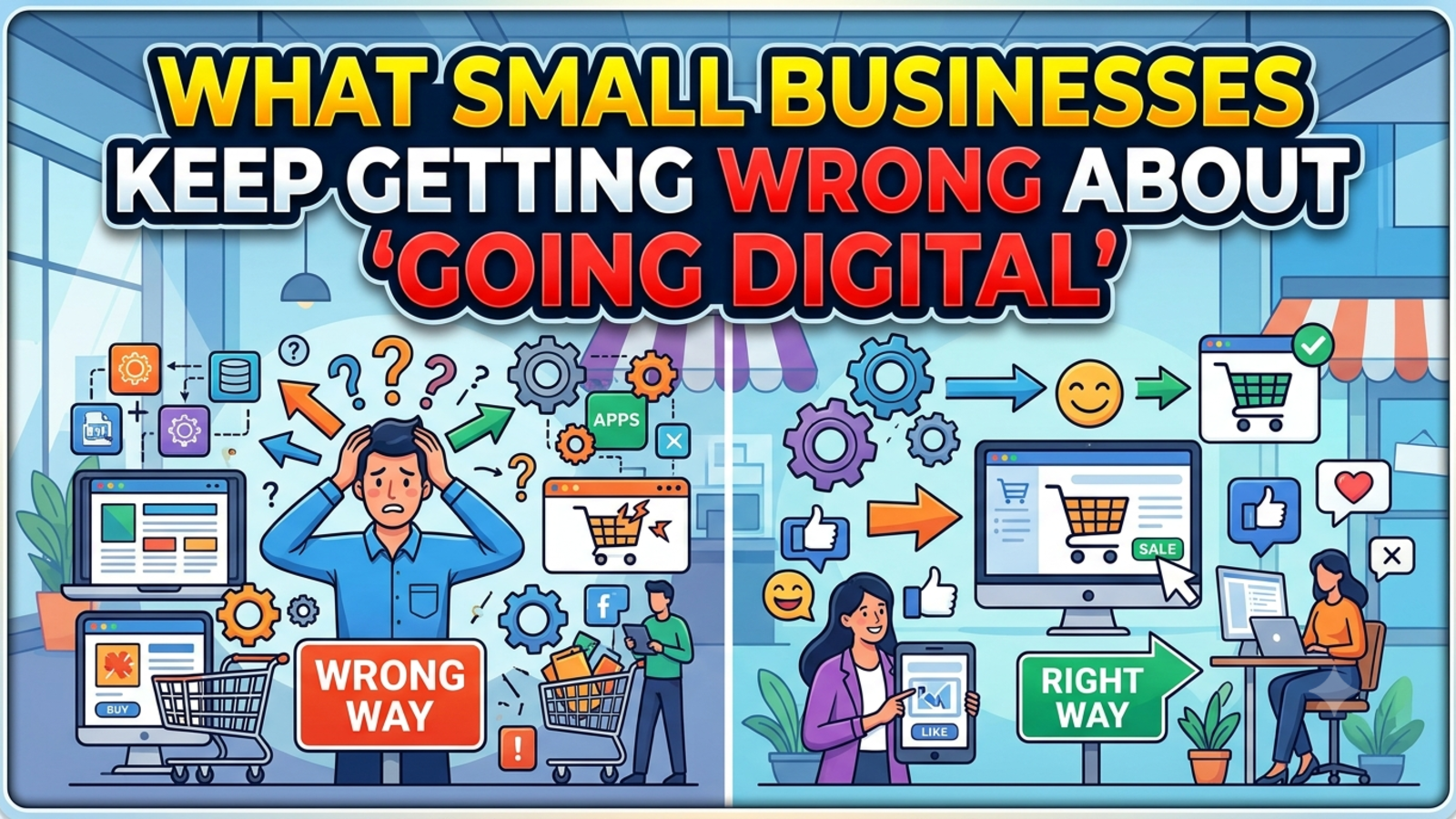
What Small Businesses Keep Getting Wrong About "Going Digital"
Most small businesses think going digital means a better website or more social posts. The businesses actually growing from it are doing something else entirely.
Ask most small business owners what "going digital" means, and you'll get some version of the same answer: a better website, more social media posts, maybe running some ads. It's not wrong, exactly — but it's incomplete in a way that quietly costs a lot of businesses real growth.
Going digital, as most businesses practice it, is really just moving the storefront online. The business still looks the same underneath — same slow response times, same limited hours, same person answering every question by hand — just now with a nicer-looking website in front of it. That's not actually digital transformation. It's a paint job.
The Mistake: Treating "Digital" as a Design Problem
Most small businesses' idea of going digital starts and ends with appearance — a redesigned homepage, a cleaner logo, more polished product photos, a more active Instagram. All of that matters, but none of it touches the actual experience a customer has once they show up.
Here's the part that gets missed: a beautifully designed website that takes six hours to answer a question isn't meaningfully more "digital" than a plain one that does the same. The visitor experience — how fast they get an answer, whether they can get help outside business hours, whether their question gets a real response at all — is where digital actually changes something. And that's usually the part businesses skip entirely.
Why This Keeps Happening
It's an understandable mistake. Design is visible and easy to evaluate — you can look at a new website and immediately tell it's better than the old one. Response time, availability, and lead capture are invisible until something goes wrong, so they don't feel like the priority, even though they're usually what actually determines whether a visitor becomes a customer.
There's also a cost asymmetry that pushes businesses this way. A website redesign is a one-time project with a clear deliverable. Actually changing how the business responds to customers — being available at all hours, answering instantly, following up on every inquiry — used to require hiring more people, which is an ongoing cost most small businesses can't justify. So businesses default to the thing they can afford to fix: how it looks.
What Actually Changing Digitally Looks Like
The businesses seeing real growth from "going digital" aren't spending more on design — they're closing the gap between when a customer has a question and when they get an answer. That's the part that used to require a bigger team, and now doesn't.
An AI chatbot trained on a business's own FAQs, pricing, and policies can answer customer questions the moment they're asked, at any hour, without anyone on staff needing to be available. A tool like Glanceia does exactly this — upload what you already have, and it answers accurately, live on your site within minutes, no developer or redesign required. That's a genuinely different kind of digital than a nicer homepage: it changes what actually happens when a customer shows up, not just what they see when they arrive.
The Businesses Actually Benefiting From "Digital"
They stopped losing after-hours visitors. A question asked at midnight gets answered at midnight, not the next business day.
They stopped re-answering the same questions by hand. The repetitive stuff — hours, pricing, availability — gets handled instantly, freeing the owner or team for what actually needs a person.
They stopped losing leads to silence. A visitor who doesn't get an immediate answer usually doesn't come back to ask again. Capturing their info in the moment, even automatically, changes that.
They started seeing what customers actually ask. A chatbot's analytics dashboard often reveals confusion or gaps on the website itself — something a redesign alone would never surface.
None of this shows up as a visibly "new" website. It shows up in fewer missed leads, faster answers, and a team spending less time on repetitive questions — the parts of the business a redesign was never going to fix.
A Simple Way to Check Which Kind of "Digital" You Actually Have
Ask honestly: if a visitor asks a question on your website right now, at 11 PM, on a Sunday — what happens? If the answer is "nothing, until Monday," no amount of design work changes that outcome. That gap is the actual thing "going digital" should be closing, and it's usually the part that gets skipped.
Getting the Part That Actually Matters Right
Gather your FAQs, pricing, and policies — the material you'd hand a new employee.
Upload it to a chatbot trained on your own content, like Glanceia.
Set it live alongside your existing website — no redesign required.
Check what's being asked, and use it to spot real gaps in your site or offers.
Let the redesign happen later, if it needs to — it's not the part that was actually costing you customers.
Most businesses using Glanceia are live within minutes, with a free plan to start.
The Bottom Line
Going digital isn't really about how a business looks online — it's about how fast and how completely it responds when a customer shows up with a question. A nicer website is worth having, but it's not the thing that determines whether a visitor becomes a customer. Closing the response gap is. Most small businesses have that backwards, and it's usually the quieter, less visible fix that actually moves the needle.
If your website looks good but still takes hours to answer a question, Glanceia sets up an AI chatbot trained on your own data in minutes — free to start. Get in touch if you want help figuring out where to begin.