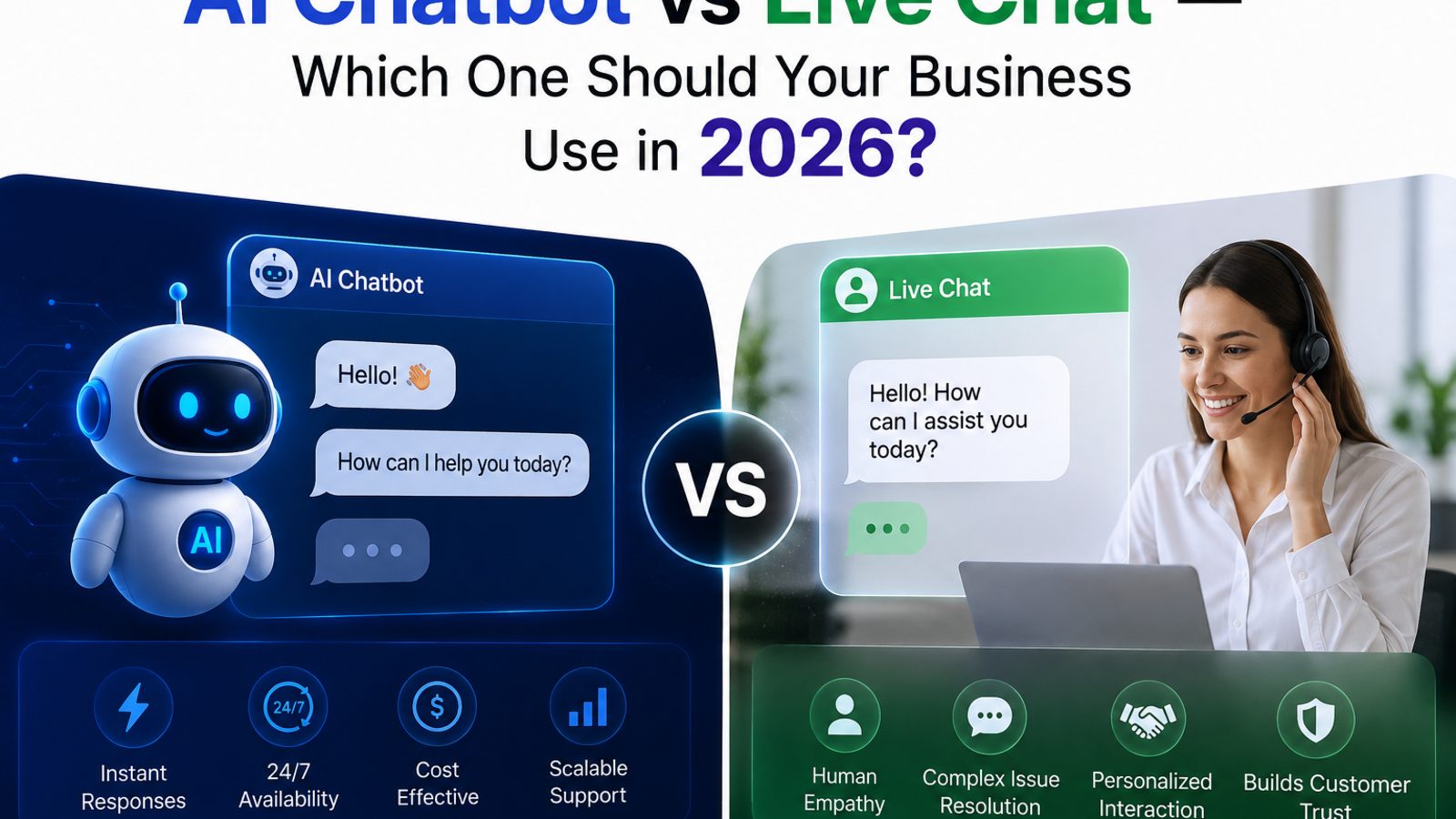
AI Chatbot vs Live Chat — Which One Should Your Business Use in 2026?
AI chatbot vs live chat — an honest 2026 comparison on cost, speed, satisfaction, and ROI. Real stats, clear use cases, and the verdict for small businesses. Free to start with Glanceia.
Introduction
The AI chatbot vs live chat debate has shifted dramatically in 2026. Two years ago, the conventional wisdom was clear: use an AI chatbot for simple repetitive queries and live chat with human agents for anything complex or high-value. The technology gap between the two was wide enough that the choice was usually obvious.
In 2026, that gap has narrowed significantly. AI chatbots now handle 68 percent of customer queries end-to-end without human escalation — up from 58 percent in 2023. Resolution quality has improved to the point where 44.8 percent of all conversations across industries are fully resolved by AI without any human involvement. The capabilities that used to require a human agent for every scenario now require one for far fewer.
This does not mean live chat is dead. It means the decision of which to use — and when — requires a more nuanced framework than it did before. The businesses getting the best customer experience outcomes in 2026 are not the ones who picked a side. They are the ones who designed a system that uses each channel where it genuinely wins.
This guide gives you that framework — with real 2026 data, honest cost comparisons, clear use-case guidance, and a practical answer for small and medium businesses trying to make the right choice.
What Is an AI Chatbot?
An AI chatbot is an automated assistant powered by a large language model that reads customer messages, understands their intent, searches a knowledge base of your business content, and generates accurate, conversational responses — instantly, without a human present.
Modern AI chatbots in 2026 are trained on your specific business content. Upload your FAQ documents, product descriptions, pricing guides, and policies — and the chatbot answers questions specifically from that content. They handle natural language, understand follow-up questions in context, and manage multi-turn conversations that shift topics mid-chat.
This is fundamentally different from the rule-based chatbots of a few years ago that could only respond to pre-scripted questions. In 2026, when most people say "chatbot" they mean the AI-powered kind — and the capability difference is significant.
What Is Live Chat?
Live chat is a real-time messaging interface that connects a customer with a human support agent. The customer types a message in a chat window on your website or app, and a trained human reads it, processes it with judgment and empathy, and responds.
Live chat's value is not just that a human answers. It is that a human reads between the lines, applies judgment to edge cases, makes exceptions when warranted, de-escalates emotionally charged situations, and conveys genuine care for the customer's outcome — capabilities that AI handles differently and, in certain situations, less effectively.
The trade-off is cost and availability. Live chat requires people to be present, trained, and scheduled. It does not scale without headcount. It breaks down outside business hours unless you run shifts. And it has a cost per interaction that is 12 to 35 times higher than an AI chatbot for routine queries.
The Real Numbers: AI Chatbot vs Live Chat in 2026
Before making any recommendation, look at what the 2026 data actually shows across the metrics that matter for business decisions.
Response Time
AI chatbot: Responds in under 2 seconds — consistently, at any volume, at any hour
Live chat: Average first response time of 2 minutes 40 seconds — when agents are available and not handling multiple simultaneous conversations
For customers, response time is one of the most important factors in their satisfaction with a support interaction. A 2-second response versus a 2-minute-40-second response is a meaningful difference — particularly for purchase-decision questions where the customer is evaluating whether to buy.
Cost Per Interaction
AI chatbot: $0.50 to $0.70 per interaction
Live chat: $10 to $25 per routine query when staff time, training, management overhead, and benefits are fully loaded
At low volumes, this cost gap is manageable. At scale, it is enormous. A business handling 500 routine support queries per month pays $250 to $350 in AI chatbot costs versus $5,000 to $12,500 in live chat agent costs for the same volume.
Resolution Rate
AI chatbot: 68 percent of queries handled end-to-end without human escalation (Gartner 2026). Chatbot resolution rates improved from 58 percent in 2023 to 74 percent in 2025.
Live chat: Human agents achieve 38 percent higher resolution rates for emotionally charged conversations (Intercom). For complex account-level issues requiring system access and judgment, human agents resolve cases AI cannot.
Customer Satisfaction
AI chatbot: 54 percent of customers prefer chatbots for simple queries like order status, FAQs, and business hours. Customer satisfaction scores are 23 percent lower with AI for complex issues involving complaints or emotional situations.
Live chat: 88 percent average satisfaction rating for live chat according to the American Customer Satisfaction Index. Human agents achieve higher satisfaction specifically for emotionally charged and complex conversations.
Hybrid model: Companies using hybrid chat models — AI handling volume with human handoff for complexity — see 35 percent higher satisfaction scores than chatbot-only approaches.
Availability
AI chatbot: 24 hours a day, 7 days a week, 365 days a year. No overtime. No sick days. No shift gaps.
Live chat: Available during staffed hours. Typically 8 to 10 hours a day, 5 days a week for most small businesses. After-hours coverage requires shifts or outsourcing.
Scalability
AI chatbot: Handles 1 conversation or 10,000 conversations with identical response time and quality. No incremental cost for volume spikes.
Live chat: Every additional simultaneous conversation beyond what an agent can comfortably handle (typically 3 to 5) requires an additional agent. Peak seasons, product launches, and viral moments require emergency staffing.
Where AI Chatbots Win
Repetitive, High-Volume FAQ Queries
The most significant win for AI chatbots is the repetitive query problem. Every business receives the same questions hundreds or thousands of times — pricing, policies, operating hours, order status, product specifications, return terms. These questions have known, consistent answers. A human agent answering them adds no value over an AI; they are just executing a lookup.
AI chatbots handle these at scale, at zero marginal cost, at any hour. Top-performing chatbot implementations contain 70 to 90 percent of all incoming conversations — the majority of which are exactly this type of repetitive, low-complexity query.
After-Hours and Weekend Coverage
Most customer activity does not respect business hours. Ecommerce browsing peaks in the evenings. Travel planning happens on weekends. Software evaluation happens across time zones. Every hour your live chat is offline is an hour when interested visitors get no response.
An AI chatbot is the only cost-effective solution for genuine 24/7 coverage at small business scale. Staffing live chat agents for overnight and weekend coverage is prohibitively expensive for most businesses.
High-Volume Periods and Traffic Spikes
A product launch, a press feature, a viral social media moment — any event that drives a sudden spike in visitor traffic will overwhelm a live chat team. Queue times balloon. Quality drops. Agents get frustrated. Some queries never get answered.
An AI chatbot handles a traffic spike of 10x as easily as it handles normal volume. The cost scales linearly with actual usage, not with peak headcount requirements.
Multilingual Support
Running live chat in multiple languages requires multilingual agents — significantly harder and more expensive to recruit, train, and schedule. An AI chatbot with multilingual capability handles conversations in 50-plus languages from a single deployment.
For businesses serving international audiences, AI chatbots effectively multiply the language coverage of a small team without any additional hiring.
Lead Capture and Qualification
A live chat agent who needs to handle incoming support queries cannot simultaneously focus on lead qualification for every website visitor. An AI chatbot can run qualification conversations with every visitor simultaneously — asking about budget, requirements, and timeline, and capturing contact details — without competing priorities.
Where Live Chat Still Wins
Emotionally Charged Situations
A customer who has received a damaged product, waited three weeks for a delivery, or been charged incorrectly is not looking for a fast answer. They are looking for acknowledgment, empathy, and someone who genuinely cares about making it right.
Customer satisfaction scores are 23 percent higher with human agents for complex issues involving complaints or emotional situations. Human agents achieve 38 percent higher resolution rates for emotionally charged conversations. For these interactions, the attempt to automate does not just underperform — it actively makes the customer feel less valued.
High-Value Sales Conversations
A prospect evaluating a $50,000 enterprise software contract or a $200,000 construction project does not want to talk to a chatbot. They want to talk to an expert who understands their specific situation, can answer nuanced questions with business judgment, and can negotiate terms when appropriate.
71 percent of customers feel frustrated when their experience feels impersonal or automated. For high-value, relationship-driven sales, live chat with a knowledgeable human creates trust that AI cannot replicate at the same level.
Complex Problem-Solving Requiring System Access
An AI chatbot answers from its training content. It cannot access your live order management system, your CRM, a customer's account history, or your inventory database in real time — unless you have built a specific integration for this.
A live agent with access to these systems can look up an individual customer's order, check live stock levels, apply a specific discount to an account, or make a judgment call about a policy exception. For queries that require real-time system access and individual account-level decisions, live agents remain essential.
Nuanced Professional Advice
Legal questions, medical queries, financial decisions, complex technical troubleshooting — situations where the wrong answer has real consequences and where professional judgment is required. AI chatbots in 2026 are impressive but they are not a substitute for professional expertise in high-stakes advisory scenarios.
The 2026 Verdict: Neither One Alone
The honest answer to "AI chatbot vs live chat" in 2026 is not a choice between them. The data consistently points to one conclusion: businesses that deploy a hybrid model — AI handling volume, humans handling value — outperform those that choose either exclusively.
58 percent of businesses already pair chatbots with live chat. Hybrid models reduce support costs by up to 30 percent compared to live-chat-only, while producing 35 percent higher customer satisfaction than chatbot-only.
The hybrid model works like this:
AI chatbot handles the first touch for every conversation — instantly, at any hour
The chatbot resolves 65 to 80 percent of queries fully, without escalation
For the remaining 20 to 35 percent that require human judgment, the chatbot escalates seamlessly to a live agent — passing the full conversation context so the customer does not repeat themselves
The human agent focuses entirely on the interactions that genuinely need them — complex issues, emotionally charged conversations, high-value sales
This is how you get 24/7 coverage, cost efficiency, and human quality where it matters — all at the same time.
What This Means for Small Businesses Specifically
For large enterprises with 50-person support teams, the hybrid model is a staffing and technology integration project. For small businesses, the calculation is different.
Most small businesses cannot afford live chat at all — not because they do not want it, but because staffing it adequately costs more than it returns. A small travel agency, a boutique hotel, a service consultant, or a D2C brand owner cannot have a human available for live chat 24 hours a day, 7 days a week.
For small businesses, the practical choice in 2026 is:
Start with an AI chatbot that handles everything automatically — and configure a clear escalation path to email or WhatsApp for the queries that need a human. This gives you 24/7 coverage, instant responses for the majority of queries, and human handling for the minority that genuinely need it — without live chat staffing costs.
Add live chat staffing later, as revenue grows, for the high-value conversion conversations that would benefit from a real-time human presence during business hours.
The Honest Framework: Which to Use and When
Use an AI chatbot when:
Your primary challenge is handling volume efficiently
You need 24/7 coverage without staffing costs
The majority of your incoming queries are repetitive and factual
You are a small business that cannot cost-effectively staff live chat
You want to capture leads from after-hours traffic
You need multilingual support across time zones
Use live chat when:
Your primary challenge is high-value conversion and relationship building
You are selling high-ticket products or services where trust is everything
Your customer interactions frequently involve complex judgment, account access, or policy exceptions
Your team is already available and the additional cost of live chat tooling is marginal
You handle emotionally sensitive customer situations regularly
Use both (hybrid model) when:
You have enough volume to justify live chat staffing during business hours
You want AI coverage for after-hours volume and human coverage for peak business-hours conversions
You want to reduce your live chat team's workload on repetitive queries so they can focus on high-value interactions
You are scaling and want the best of both coverage and quality
A Simple Decision Tree
Step 1: Can you afford to staff live chat adequately — including evenings, weekends, and peak periods?
If no → Start with AI chatbot. Configure escalation to email or WhatsApp for complex queries.
If yes → Go to Step 2.
Step 2: What proportion of your queries are repetitive and factual versus complex and judgment-requiring?
If 70 percent or more are repetitive → AI chatbot with human escalation for the rest.
If a significant proportion require real-time system access or professional judgment → Live chat or hybrid.
Step 3: What is your average deal value?
Under $500 → AI chatbot handles most interactions cost-effectively.
Over $500 → Live chat or human-assisted AI for high-value conversion conversations.
For the vast majority of small businesses in 2026 — the answer to Steps 1, 2, and 3 points to starting with an AI chatbot and adding human capacity as the business grows.
Getting Started: The Fastest Way to Implement the Right Solution
For small businesses implementing this for the first time, the fastest and most cost-effective starting point is an AI chatbot with a clear human escalation path.
Glanceia is the most affordable AI chatbot for small businesses in 2026 — free plan with AI included, paid plans from $9 per month, no hidden fees, live on your website in under 30 minutes.
Here is how to set up the right hybrid for a small business:
Step 1: Build an AI chatbot on Glanceia — train it on your FAQ, services, pricing, and policies. This handles 65 to 80 percent of incoming queries automatically.
Step 2: Configure a clear escalation path — your support email, your WhatsApp number, or a link to book a call. When the chatbot cannot resolve a query, the customer gets an immediate route to a human.
Step 3: As volume grows and revenue justifies it, add live chat staffing during your peak hours — using a tool like Tidio or Freshchat that allows human agents to take over conversations from the AI.
This progression — AI first, add human capacity as needed — is the most cost-effective path for small businesses in 2026.
FAQ — AI Chatbot vs Live Chat
Is an AI chatbot better than live chat? Neither is universally better — each wins in different scenarios. AI chatbots win on cost, availability, and handling repetitive volume. Live chat wins on empathy, complex problem-solving, and high-value conversion conversations. The best businesses in 2026 use both.
Do customers prefer chatbots or live chat? It depends on the query type. 54 percent of customers prefer AI chatbots for simple queries like order status and FAQs. 79 percent prefer human agents for complex issues involving complaints or emotional situations. Match the channel to the query type.
Can an AI chatbot replace live chat entirely? For most small businesses, AI chatbots handle the majority of incoming queries effectively and cost-efficiently. However, for emotionally charged situations, complex account-level issues, and high-value sales conversations, human live chat still outperforms AI on both resolution quality and customer satisfaction.
What is the cost difference between a chatbot and live chat? Per interaction, AI chatbots cost $0.50 to $0.70 versus $10 to $25 for a human agent handling a routine query — a gap of 12 to 35 times. At scale, this difference is the primary reason businesses adopt AI chatbots for high-volume routine support.
What is a hybrid chat model? A hybrid chat model uses an AI chatbot to handle first touch and routine queries automatically, then routes complex or high-value conversations to a human agent with full conversation context shared. Companies using hybrid models see 35 percent higher customer satisfaction than chatbot-only approaches.
Which is better for small businesses — AI chatbot or live chat? For most small businesses, AI chatbots are the right starting point. They provide 24/7 coverage without staffing costs, handle the majority of routine queries automatically, and cost as little as $9 per month. Live chat makes sense as an addition once the business has the revenue and team to staff it properly.
Final Thoughts
The AI chatbot vs live chat debate in 2026 has moved beyond "which is better" to "which is right for which situation." The data is clear: AI chatbots win on cost, speed, availability, and scalability. Live chat wins on empathy, complexity, and high-value relationship building.
The best answer for most small businesses is to start with an AI chatbot — covering 24/7 availability and handling the majority of queries automatically — and add human live chat capacity as volume and revenue justify it.
The worst answer is to do nothing. 79 percent of customers now expect a chat option when visiting a business website. Businesses that offer neither are falling behind the baseline expectation that the market has already set.
Start with the most affordable, impactful option. Build from there.
Ready to add an AI chatbot to your website for free? Try Glanceia — no credit card needed →
Published by Laxman- Team Glanceia