GPT-6 Astra: What OpenAI's New Model Actually Changes
OpenAI just released GPT-6 Astra, calling it their most aligned and capable model yet. Here's what it actually does — and what it signals for AI in everyday business tools
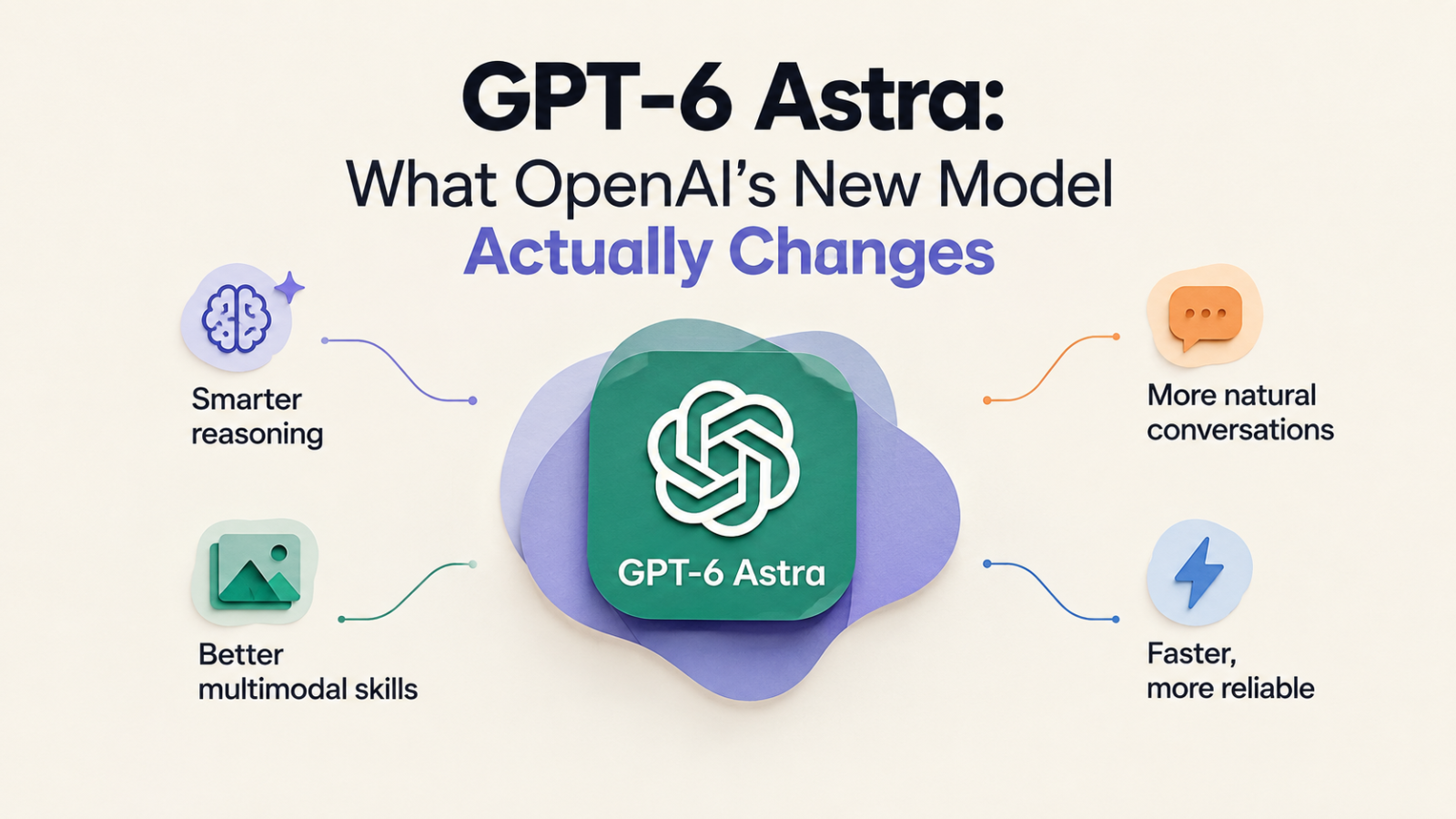
OpenAI just rolled out its newest model, GPT-6 Astra, calling it "the world's most intelligent and aligned model." It's a big claim, and for once, the underlying numbers back some of it up — but the more interesting story isn't the benchmark scores. It's what a leap like this signals for how AI shows up in ordinary tools people actually use.
What GPT-6 Astra Actually Is
Astra is OpenAI's latest flagship model, rolling out to ChatGPT Plus, Pro, Business, and Enterprise users, as well as through the OpenAI API, Microsoft Azure, and AWS. It's the successor to GPT-5.6 Sol, and OpenAI is positioning it as a genuine step change rather than an incremental update.
The headline capabilities center on computer use, software engineering, science, and what OpenAI calls "professional work" — meaning it's built to handle multistep tasks like producing documents, spreadsheets, and presentations, not just answering questions in a chat window. OpenAI also highlights strong results on ARC-AGI-3, a benchmark for handling novel tasks, reporting that Astra surpassed the company's human action-efficiency baseline on the large majority of levels tested — which the company frames as a meaningful step toward models that can navigate unfamiliar situations, not just tasks resembling their training data.
Why "Alignment" Is the Headline, Not Just Intelligence
The more notable claim isn't raw capability — it's that OpenAI describes Astra as its most aligned model yet, with meaningful improvements in understanding what a user actually wants, so people can delegate tasks with more confidence in the model's judgment. That's a deliberate shift in emphasis. A model that's powerful but unpredictable isn't actually usable for real work; one that reliably understands what you're asking for, and knows when to ask a clarifying question instead of guessing, is a different kind of tool entirely.
This matters because the gap between "impressive demo" and "something a business can actually rely on" has always come down to exactly this — predictability, not raw capability. A model that's slightly less flashy but far more consistent in following instructions is usually the one that ends up embedded in tools people depend on daily.
The Part That Matters Beyond the Headlines
Every major model release gets covered the same way — benchmark charts, comparison tables, a wave of "is this AGI" takes. What tends to get less attention is the more practical shift underneath: these capability jumps eventually show up not as a chatbot you visit on a website, but as the invisible layer inside tools people already use — customer support widgets, scheduling assistants, internal documentation search.
That's the actual trajectory worth watching. Two years ago, "AI chatbot" mostly meant something clunky bolted onto a website, prone to vague or wrong answers. As underlying models get more capable and more reliably aligned to what a user actually wants, the tools built on top of them get quietly better at the unglamorous, practical stuff — answering a customer's specific question accurately, handling a multistep booking request, following a business's actual policies instead of an approximation of them.
Small businesses don't typically interact with a model like Astra directly. They interact with the layer built on top of it — a scheduling tool, a support chatbot, a document assistant — and it's improvements like these, in instruction-following and reliability, that eventually make those tools noticeably better without the business needing to do anything differently.
What This Signals for AI in Everyday Business Tools
The practical takeaway for anyone running a small business isn't "go integrate GPT-6 Astra" — most businesses never touch a frontier model directly. It's that the tools they already use, or are considering, are riding on top of exactly this kind of progress. An AI chatbot trained on a business's own FAQs and policies is only as good as its underlying model's ability to actually understand intent and stick to what it's been told — which is precisely the kind of improvement OpenAI is highlighting here.
As these frontier models keep closing the gap between "sounds smart" and "reliably useful," the tools built for smaller, practical jobs — like answering a customer's question about availability or pricing — get quietly better at the thing that actually matters: giving accurate answers, consistently, without hand-holding.
The Bottom Line
GPT-6 Astra is a genuine leap in capability, but the more useful way to read it isn't as a standalone headline — it's as a signal of where the tools built on top of these models are heading. As alignment and instruction-following keep improving at the frontier, the practical AI tools businesses actually rely on day to day — chatbots, scheduling assistants, document tools — get more dependable without anyone needing to switch anything themselves.
Curious how this kind of progress shows up in everyday business tools? Glanceia is an AI chatbot trained on your own business data — built to be accurate and reliable for the questions your customers actually ask, not a frontier research demo. Free to start.