Is It Safe to Let AI Answer Your Customers? Here's What Actually Happens to the Data
Before handing customer conversations to an AI chatbot, it's fair to ask where the data actually goes. Here's a clear, honest breakdown — no hand-waving.
It's a fair question, and most businesses ask it quietly before ever setting up an AI chatbot: what actually happens to the information once you hand a customer conversation over to it? Where does it go? Who can see it? Is your pricing, your policies, your customer's name and email — all of it just floating around somewhere it shouldn't be?
The honest answer is that it depends entirely on how the chatbot is built, and a lot of businesses never actually get a straight answer to that question. Here's what to actually look for, and what happens with a properly built one.
The Two Things People Usually Worry About
When someone asks "is this safe," they're usually really asking two separate questions that get lumped together:
1. Is my business data (pricing, policies, product info) exposed to anyone else? This is about whether the documents you upload to train the chatbot — your FAQs, pricing sheets, policies — stay private to your business, or get mixed into some shared pool other businesses' chatbots can somehow access.
2. Is my customers' personal information (names, emails, questions they ask) handled responsibly? This is about what happens to the actual conversations — where they're stored, who can see them, and whether that data gets used for anything beyond answering that customer's question.
Both are legitimate concerns, and both have real answers depending on the tool.
Why Some Chatbots Deserve the Skepticism
Not every AI chatbot is built carefully, and the skepticism around this topic exists for good reason. Some tools train a single shared model across all their customers, which raises a real question: could information from one business's data influence answers given to another business's customers? Some store conversation data indefinitely without a clear policy on deletion. Some are vague, in their terms of service, about what "using your data to improve our service" actually means in practice.
None of that is paranoia. It's a reasonable thing to check before connecting a tool to your customer conversations — and the answer genuinely varies a lot between providers.
What Actually Matters When Evaluating This
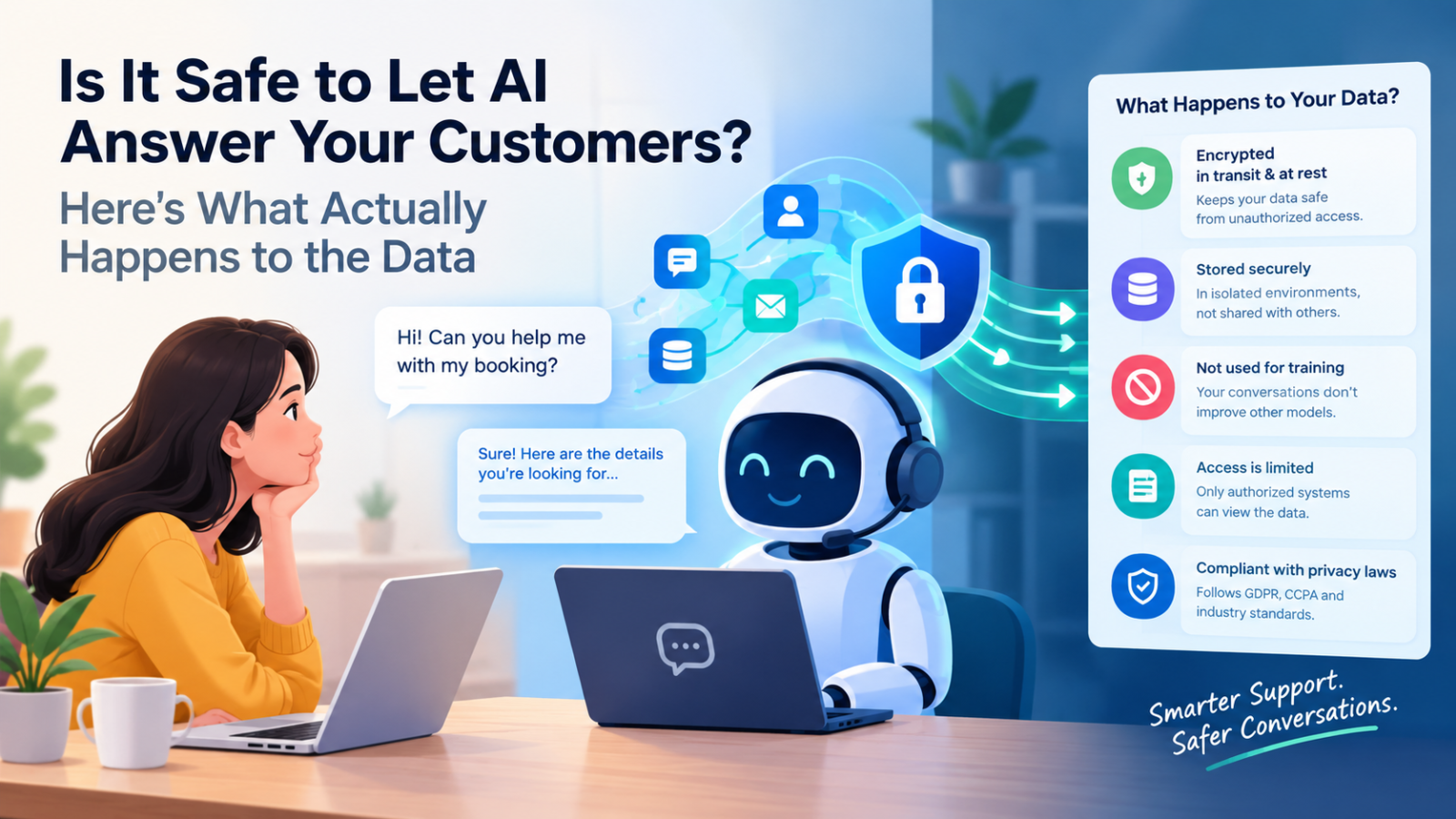
Is your data isolated, not pooled? A responsibly built chatbot keeps each business's uploaded documents and conversations in their own separate space — never mixed with another business's data, and never used to influence what a different company's chatbot says to its customers.
Does it answer only from what you gave it? This matters for safety in a less obvious way: a chatbot that only answers from your uploaded documents can't accidentally leak information it was never given. If it doesn't have access to anything beyond your FAQs, pricing, and policies, there's nothing sensitive for it to expose in the first place.
Is there a clear answer about data retention and deletion? You should be able to find — quickly, without digging — how long conversation data is kept, and whether you can request it be deleted. If a provider can't answer this clearly, that's worth treating as a red flag on its own.
Is the connection encrypted, and is access controlled? Standard security practice — data encrypted in transit and at rest, and access restricted to what's actually necessary — should be a baseline, not a premium feature.
How Glanceia Approaches This
This is exactly why Glanceia is built with isolated data environments for each business — your uploaded documents and your customers' conversations stay separate from every other business using the platform, never pooled together, never used to answer a different company's customers. The chatbot only ever responds using what you've specifically given it, so there's no risk of it surfacing information it was never provided in the first place.
Customer information collected during conversations — names, emails, questions asked — stays tied to your account, visible to you, and used for exactly what you'd expect: helping you follow up on leads and understand what your customers are asking. Nothing gets shared across businesses, and nothing gets used to train some separate, unrelated model.
A Reasonable Way to Evaluate Any Chatbot Before Trusting It
If you're comparing tools, a few direct questions tend to cut through the marketing language fast:
Is my data isolated from other businesses, or pooled into a shared model?
Can the chatbot answer questions using information I never gave it, or only what I uploaded?
How long is conversation data retained, and can I delete it?
Is data encrypted, and who has access to it internally?
Is there a clear, plain-language privacy policy — or vague language about "improving our services"?
If a provider can't answer these clearly and quickly, that's more telling than anything in their marketing copy.
The Bottom Line
"Is this safe" is a reasonable question to ask before letting an AI chatbot handle customer conversations — and the honest answer is that it depends entirely on how the tool is built, not on AI chatbots as a category. Look for isolated data, answers limited to what you've actually provided, and a clear retention and deletion policy. Get those right, and the risk most people are worried about isn't really there.
Curious exactly how Glanceia handles this for your business? Get in touch — happy to walk through it directly. Or see it for yourself: Glanceia is free to start, no credit card required.