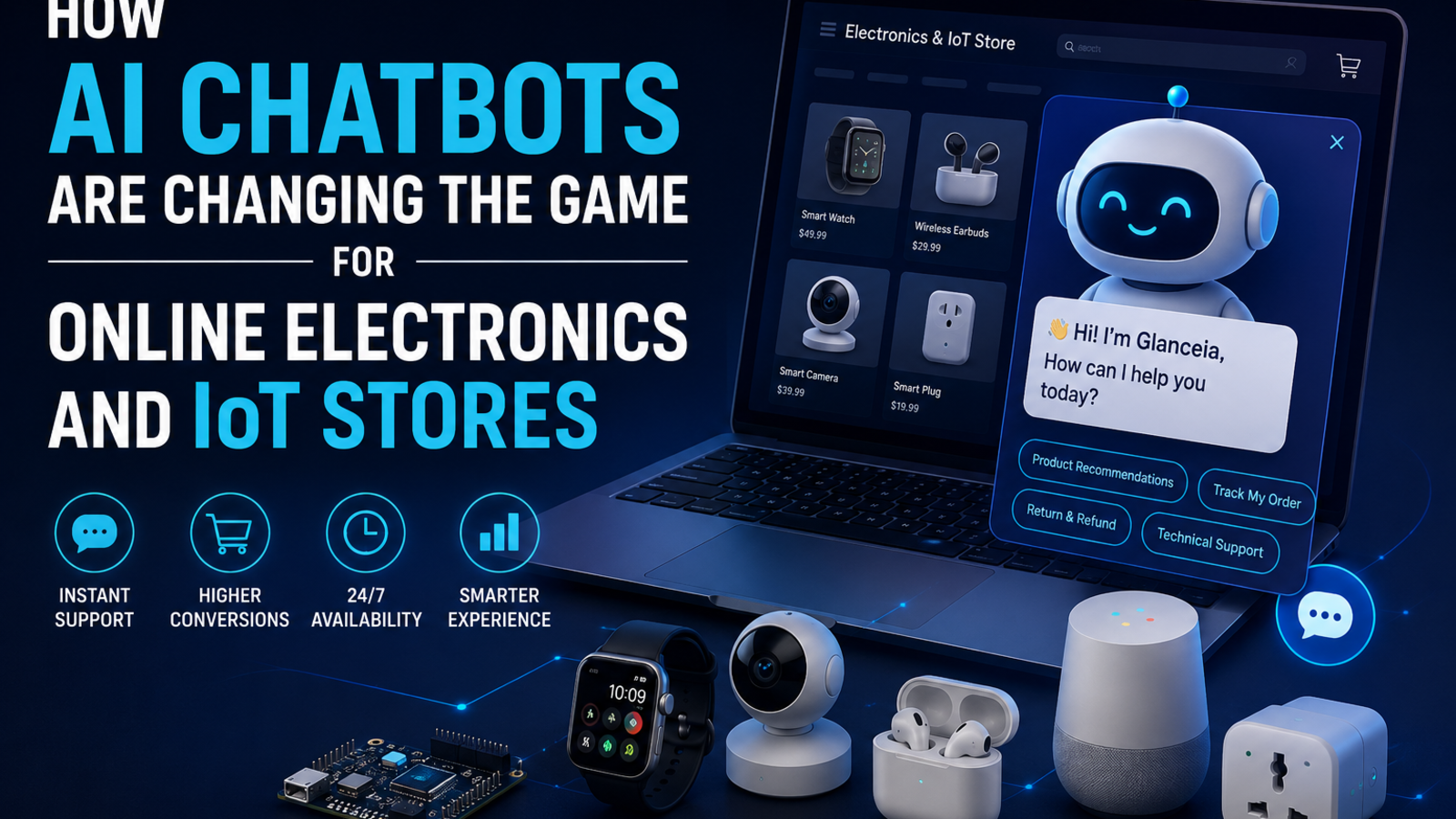
How AI Chatbots Are Changing the Game for Online Electronics and IoT Stores
Electronics e-commerce is a little different from typical retail. Customers aren't just browsing for style or price — they're making technical decisions. A buyer picking between an ESP32 and an ESP8266 module wants to know about GPIO pins, power draw, and Wi-Fi range before they add it to cart.
If you've ever run an online store selling electronic components, sensors, or development boards, you already know the pattern: the same ten questions show up in your inbox every single day. "Is this sensor compatible with Arduino Uno?" "Does this module support 5V or only 3.3V?" "When will my order ship?" "Do you have this in stock?"
For makers, hobbyists, and engineers, these aren't small questions — a wrong answer about voltage compatibility can fry a board or delay a whole project. But answering the same queries manually, over and over, eats into hours that store owners could spend on sourcing, fulfillment, or growing the business. This is exactly the gap AI chatbots are stepping in to fill, and nowhere is it more useful than in the electronics and IoT retail space.
Why Electronics and IoT Stores Are a Perfect Fit for AI Chatbots
Electronics e-commerce is a little different from typical retail. Customers aren't just browsing for style or price — they're making technical decisions. A buyer picking between an ESP32 and an ESP8266 module wants to know about GPIO pins, power draw, and Wi-Fi range before they add it to cart. A student building a robotics project wants to confirm a motor driver is compatible with their existing components.
This creates two problems for store owners:
Pre-sale questions are highly technical, and generic live-chat agents often can't answer them accurately.
After-hours traffic is significant — many hobbyists shop late at night or during weekends when support teams aren't online.
An AI chatbot trained specifically on a store's own product catalog, specs, and FAQs can solve both. Instead of a generic "someone will get back to you," visitors get accurate, instant answers about compatibility, stock, and pricing — any time of day.
What This Looks Like in Practice
Take a store like ComponentWala, which sells Arduino boards, ESP32 modules, sensors, motors, and other IoT components to makers and engineers across India. A catalog like this is a natural use case for an AI-powered chatbot:
Instant spec lookups — a visitor asks "Does the ACS712 20A sensor work with a 12V system?" and gets an immediate, accurate answer pulled directly from the product data, instead of digging through a spec sheet themselves.
Stock and availability checks — "Is the NodeMCU ESP8266 board in stock?" answered in real time, reducing abandoned carts caused by uncertainty.
Guided product discovery — new makers who aren't sure whether they need a DHT11 or DHT22 sensor can describe their project and get a recommendation, rather than bouncing off the site confused.
Order and shipping questions — freeing up the support team from repetitive "where's my order" messages so they can focus on more complex customer needs.
For a catalog-heavy store selling dozens of sensors, boards, and modules, this kind of automation isn't a luxury — it's a way to stop losing sales to hesitation and unanswered questions.
Why "Generic" Chatbots Don't Work for Technical Stores
A lot of store owners have tried chatbots before and been disappointed. The reason is usually simple: off-the-shelf bots are trained on generic scripts, not on the store's actual products. Ask a generic bot about a specific sensor's operating voltage, and it'll either guess or dodge the question — which is worse than no chatbot at all in a technical niche like electronics.
The fix is a chatbot trained directly on the store's own data — product pages, spec sheets, FAQs, and documentation — so every answer is grounded in what the business actually sells. That's the difference between a chatbot that frustrates technical buyers and one that earns their trust.
Key Features That Matter for Electronics and IoT Retailers
If you're evaluating an AI chatbot for a component store, a few capabilities matter more than flashy extras:
Custom knowledge base uploads (PDFs, spec sheets, CSVs) so the bot reflects your actual catalog, not generic web knowledge
24/7 availability, since hobbyist and engineering audiences often shop outside business hours
Lead capture, so questions about bulk orders or custom sourcing turn into actual leads, not lost conversations
Easy embed, since most small and mid-sized electronics stores don't have a dedicated dev team to maintain a complex integration
Analytics on common questions, which double as free market research — showing you exactly which products or specs customers are confused about
The Bigger Picture
The e-commerce electronics and IoT space is growing fast, driven by students, hobbyists, and small hardware startups who need reliable components without the friction of long support waits. Stores that answer technical questions instantly — accurately, and at any hour — have a real edge over ones that make customers wait for email replies.
AI chatbots trained on a store's own catalog are becoming a practical, low-effort way to close that gap. For component and IoT retailers, it's less about chasing a trend and more about meeting technically-minded customers where they already are: mid-question, mid-project, and looking for a fast, correct answer.
Want to see how an AI chatbot trained on your own product data could work for your store? Explore Glanceia to get started.