Why Do Companies Use AI Chatbots for Job Applications?
Discover why 40% of companies now use AI chatbots for job applications — from faster screening to better candidate experience. Real stats, use cases, and what it means for your hiring process.
Introduction
You applied for a job and within seconds received an automated message asking you screening questions. Or you visited a company's careers page and a chat widget popped up asking what role you were interested in. Or your application confirmation came from a chatbot that answered your follow-up questions instantly — at 11 PM on a Sunday.
This is not a coincidence. It is a deliberate strategy.
In 2026, 40 percent of employers now use AI chatbots to communicate with candidates during the hiring process. Among companies that have adopted AI in any capacity, 41 percent specifically use AI-powered chatbots to engage with job applicants. And 93 percent of recruiters plan to increase their use of AI in recruitment before the end of the year.
The shift is substantial and accelerating. Understanding why companies have made this move — and what it means for candidates and hiring teams alike — requires looking at the real business problems AI chatbots solve in recruitment, the measurable results they produce, and the legitimate concerns that remain.
This guide covers all of it.
The Recruitment Problem AI Chatbots Are Solving
To understand why companies use AI chatbots for job applications, start with the problems they are trying to solve.
Problem 1: Volume Has Become Unmanageable
The average corporate job opening in 2026 receives between 200 and 400 applications. For popular roles at well-known companies, that number can reach several thousand. The global average time-to-hire sits at 44 days — a figure that represents not careful evaluation but administrative backlog.
A recruiter who manually reviews 300 applications, screens 50 candidates, and schedules 20 interviews for a single role is doing work that takes weeks and leaves little time for the strategic, relationship-focused parts of hiring that actually require human judgment.
AI chatbots address this volume problem by automating the top-of-funnel interactions that do not require human judgment — initial screening questions, application acknowledgment, FAQ responses, and interview scheduling. Organizations running AI-powered recruiting workflows are cutting time-to-hire from 44 days to below 25 days in many cases.
Problem 2: Candidates Are Left in the Dark
The most common complaint candidates make about the hiring process is not rejection — it is silence. Applications disappear into a black hole. Interview timelines slip without communication. Candidates who were "in the process" stop hearing anything for weeks.
67 percent of job seekers say they have a positive impression of a company when they receive consistent updates throughout the application process. 80 percent say they refuse to consider a company again if they are not notified about their application status.
An AI chatbot is the most scalable solution to this communication gap. It sends application confirmations immediately, provides status updates at each stage, answers common process questions without requiring recruiter time, and keeps candidates informed at the moments when silence would otherwise damage the employer brand.
Problem 3: Recruiters Spend Most of Their Time on Administrative Work
The average recruiter spends between 40 and 60 percent of their working hours on administrative tasks — scheduling interviews, sending status emails, answering the same candidate questions about the role and the process, and processing paperwork. This is work that could be automated. Recruiters who deploy AI chatbots report reclaiming 4 to 8 hours per week that were previously consumed by these tasks.
The business case for this reallocation is compelling. A recruiter whose time is freed from administrative repetition can build better relationships with candidates, engage more thoughtfully with hiring managers, and focus on the nuanced judgment calls that determine whether the right person gets hired.
7 Reasons Companies Use AI Chatbots for Job Applications
Reason 1: Speed — Dramatically Faster Response Times
The average time for a recruiter to respond to a candidate inquiry is measured in hours or days. An AI chatbot responds in seconds.
This speed matters more than it might seem. Candidates who receive fast responses early in the process are more likely to complete applications, accept interview invitations, and ultimately accept offers. Organizations using recruitment chatbots report 34 percent faster application completion rates — a direct result of candidates receiving immediate guidance rather than waiting for someone to respond to their questions.
For competitive roles where top candidates are simultaneously in conversations with multiple employers, response speed is a genuine competitive advantage in winning the candidate.
Reason 2: 24/7 Availability Across Time Zones
Job seekers do not apply during business hours. They apply in the evenings, on weekends, and during holidays — when they have time away from their current jobs to focus on their search. An HR team that only responds during working hours misses the peak moments of candidate engagement.
AI chatbots handle candidate inquiries around the clock. A candidate who applies at midnight gets an immediate confirmation and can ask follow-up questions that same evening. One who applies from a different time zone receives the same quality of responsiveness as someone applying in the same city during business hours.
For companies hiring internationally or filling roles that attract candidates from across the country, 24/7 chatbot availability is a functional necessity rather than a nice-to-have feature.
Reason 3: Consistent Screening at Scale
When a recruiter manually screens hundreds of applications, consistency is almost impossible to maintain. Attention flags. The same CV element that earns a callback early in the review earns a rejection late in the day. Implicit biases — about school names, career gaps, or the framing of experience — affect decisions in ways that are difficult to audit or correct.
An AI chatbot asks every applicant the same screening questions in the same order with the same criteria applied to every response. 73 percent of organizations now use chatbots for initial candidate screening precisely because this consistency is difficult to achieve with human reviewers at high volume.
AI screening tools achieve 89 to 94 percent accuracy rates — with resume parsing at 94 percent and skill matching at 89 percent accuracy. AI-led interview screening shows candidates had a 53 percent success rate in subsequent human interviews, compared to only 29 percent for those screened by traditional resume review methods.
Reason 4: Bias Reduction — A Meaningful But Complicated Benefit
The relationship between AI chatbots and hiring bias is one of the most debated topics in recruitment in 2026. The honest answer is that it is complicated.
On the positive side: 43 percent of surveyed HR professionals believe a key benefit of using AI is removing human biases from the hiring process. 47 percent of candidates say AI would be better than humans at treating all applicants similarly. Blind screening that removes demographic cues from application review has been shown in research to cut gender bias by 54 percent and improve underrepresented minority hiring by 35 percent when implemented correctly.
On the concerning side: AI models trained on historical hiring data can encode and amplify the biases present in that data. 19 percent of organizations using AI in hiring report that their tools have accidentally overlooked or screened out qualified applicants. Only 26 percent of candidates currently trust AI to evaluate them fairly.
The conclusion from the data is not that AI chatbots eliminate bias — it is that they can reduce certain human biases while introducing different algorithmic risks. Companies that use AI chatbots for screening need active auditing programmes to catch and correct bias in the system, not passive assumption that automation equals fairness.
Reason 5: Candidate Experience Improvements
Counterintuitively, candidates often prefer interacting with chatbots over waiting for human responses — at least in the early stages of the application process.
62 percent of job seekers prefer a chatbot over waiting for a human when it comes to getting their application questions answered. 75 percent report a better overall experience when speed is prioritised in initial communications. 76 percent of candidates express satisfaction with AI response speed. 59 percent find AI chatbots helpful for basic inquiries about the role and the process.
The experience preference flips for later stages: 74 percent of candidates still want human interaction for final hiring decisions. The ideal model that emerges from the data is AI chatbots for early-stage communication and initial screening — where speed, consistency, and availability matter most — with humans taking over for evaluation, interviews, and final decisions — where empathy, judgment, and relationship quality matter most.
Reason 6: Cost Reduction in High-Volume Hiring
For companies that hire at scale — retail chains, logistics companies, hospitality groups, technology companies with high application volumes — the cost of manually processing thousands of applications is significant.
AI chatbots reduce this cost through automation at the top of the funnel. Chatbots handle 67 percent of initial candidate inquiries without human intervention. Automated screening reduces initial candidate review time by 71 percent. Companies running full AI integration across sourcing, screening, and scheduling report a 33 percent average reduction in cost-per-hire.
At scale, these reductions translate to meaningful savings that can be reinvested in higher-quality evaluation, better compensation for successful hires, or improved candidate experience at the later stages of the process.
Reason 7: Data and Insight for Continuous Improvement
Every chatbot interaction in the recruitment process generates data. What questions candidates ask most frequently, where in the application process people drop off, which screening questions correlate with downstream interview success, how response time affects offer acceptance rates — all of this is measurable with chatbot-mediated recruitment in a way it never was with purely human processes.
Companies that build feedback loops from this data into their recruitment strategy see compounding improvements in hiring outcomes. Teams using AI-assisted matching report 25 to 35 percent higher first-year retention rates — a result that suggests better data about early candidate signals leads to better matches, not just faster processes.
What Happens When You Interact With a Recruitment Chatbot
Understanding the mechanics helps candidates navigate the process and helps companies configure their chatbots more effectively.
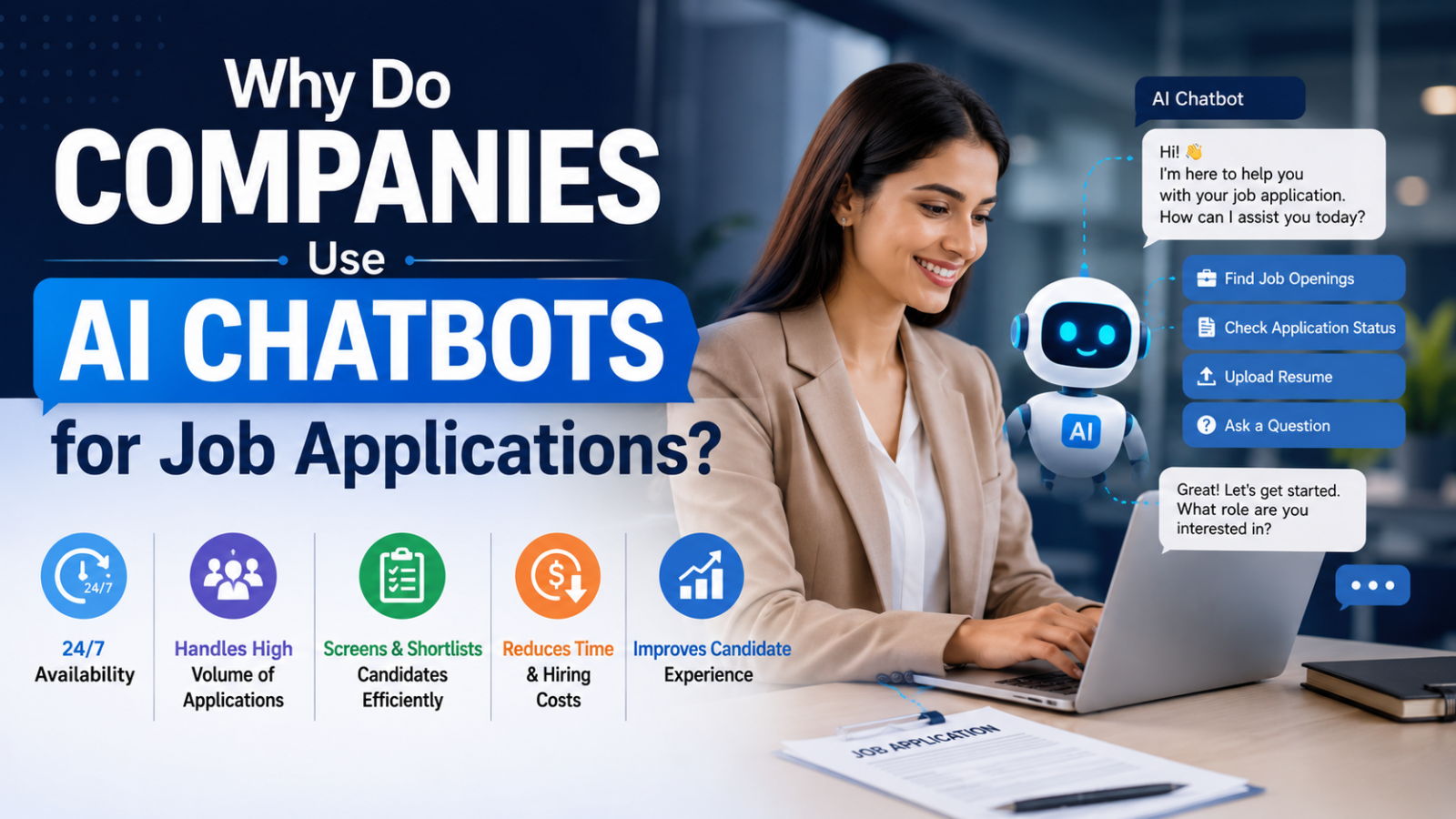
Stage 1: Application Acknowledgment
The moment an application is submitted, the chatbot sends an immediate confirmation — telling the candidate their application has been received and what to expect next. This is the most basic chatbot interaction in recruitment and also the most widely deployed. It eliminates the anxiety of not knowing whether the application went through.
Stage 2: Initial Screening Questions
Many companies deploy chatbots to ask a standardised set of screening questions immediately after application — years of experience, location, work authorisation status, salary expectations, availability. This qualification stage happens before a human recruiter reviews anything, allowing the team to prioritise the candidates who clearly meet baseline requirements.
Stage 3: FAQ Handling
Candidates have questions about the role, the timeline, the company, the benefits, and the process. A chatbot trained on the company's FAQ content — job descriptions, benefits information, office locations, typical timelines — answers all of these instantly rather than requiring a recruiter to respond to every individual query.
Stage 4: Interview Scheduling
52 percent of organisations use chatbots specifically for interview scheduling — one of the most administratively intensive parts of the recruiting process. A chatbot that accesses the interviewer's calendar availability and lets the candidate select their preferred slot eliminates the back-and-forth that can take days of email exchange.
Stage 5: Status Updates and Follow-Up
Throughout the process, the chatbot sends automated status updates — shortlisted, interview confirmed, under review, decision pending. These updates address the communication gap that candidates most frequently cite as their biggest frustration with the hiring experience.
What This Means for Job Seekers
Understanding that companies use AI chatbots in hiring has practical implications for how candidates approach the application process.
Your initial responses are often evaluated by AI, not a human. The screening questions asked by a recruitment chatbot may be evaluated automatically against predefined criteria. Answer them carefully and specifically — vague responses that would be easy to follow up on in a human conversation may score poorly in automated evaluation.
Speed of response can matter. Many recruitment chatbots use engagement speed as a signal of candidate interest. Responding promptly to chatbot prompts and completing screening steps quickly is interpreted favourably in some systems.
The chatbot's personality reflects the company's culture. A recruitment chatbot that is thoughtful, responsive, and informative signals a company that has invested in candidate experience. A chatbot that is generic, poorly trained, or prone to dead ends reveals something about how the company approaches internal processes.
Your questions get answered faster — if you ask them. A recruitment chatbot is available to answer your questions immediately. Use it. Ask about the timeline, the role, the next steps, the team structure. A candidate who is informed and engaged asks better questions — which matters when the human stage of the process begins.
How Companies Should Implement Recruitment Chatbots Responsibly
The companies that use recruitment chatbots most effectively are not simply automating their existing processes. They are redesigning those processes to use AI where it genuinely excels and preserve human judgment where it genuinely matters.
Be transparent with candidates about AI use. 79 percent of candidates demand transparency when AI is evaluating them. Companies that proactively disclose where and how AI is used in their hiring process see stronger application rates and better employer brand perception. Hiding AI involvement — or making candidates discover it through the experience rather than upfront disclosure — actively damages trust.
Audit AI screening decisions regularly. AI tools trained on historical data perpetuate historical patterns. Regular auditing of who gets screened in versus screened out — across demographics, educational backgrounds, and career trajectories — is essential for catching algorithmic bias before it compounds at scale.
Keep humans in the decision loop for meaningful stages. 74 percent of candidates want human interaction for final hiring decisions. The data consistently supports a hybrid model where AI handles early-stage communication, screening, and scheduling while humans conduct interviews and make final offers. Companies that attempt to automate the entire process beyond initial screening see degraded candidate experience and reduced offer acceptance rates.
Train the chatbot on accurate, complete information. A recruitment chatbot that gives incorrect information about the role, the process, or the company does more damage to the candidate relationship than no chatbot at all. The quality of responses depends entirely on the quality of training content — job descriptions, benefits information, company FAQs, process timelines.
Using a Website Chatbot for Your Careers Page
If you run a recruitment agency, an HR consultancy, or a business that actively hires and wants candidates to find and engage with your careers page, a website chatbot is one of the most effective tools for improving the candidate journey from the very first touchpoint.
A careers page chatbot trained on your open roles, your company culture, your benefits, and your application process handles the questions that currently go unanswered because nobody checks the careers page inbox.
A candidate who visits your careers page at 9 PM wanting to know whether the marketing role requires experience with a specific tool should get an answer right then — not a contact form submission that waits until Monday.
Glanceia provides exactly this capability for careers pages and recruitment agency websites. Upload your open role descriptions, your company FAQ, your benefits documentation, and your application process guide. The chatbot reads everything and answers candidate questions accurately from your specific content — 24 hours a day, without a recruiter needing to be present.
Lead capture collects candidate name, email, and the role they are interested in — giving your recruitment team a pre-qualified candidate pipeline from website visitors rather than relying entirely on job board applications.
The setup takes under 30 minutes. The free plan requires no credit card. For agencies and HR teams that want to improve candidate engagement from the first website visit — it is the most accessible starting point available.
Try Glanceia free — no credit card needed →
The Concerns That Remain Real
Honest coverage of why companies use AI chatbots for job applications requires acknowledging the concerns that have substance.
Trust has not kept pace with adoption. Only 26 percent of candidates trust AI to evaluate them fairly. This gap between company adoption and candidate trust is the defining challenge for AI in recruitment in 2026. Companies that ignore this gap see it reflected in application rates, offer acceptance rates, and employer brand reputation.
75 percent of companies allow AI to reject candidates without human review. This is the statistic that most concerns candidate advocates. When AI screens out candidates without any human ever reviewing their application, the accountability for that decision is diffuse. Organisations that use AI as a filter without human oversight at any stage carry significant risk — ethical, legal, and reputational.
AI optimised for pattern-matching can overlook unconventional talent. 35 percent of recruiters are concerned that AI could lead to overlooking candidates with unique and unconventional career paths. A system trained to identify patterns that correlate with success in the past may systematically exclude the candidates who bring something genuinely new.
Regulation is arriving. The regulatory landscape for AI in hiring is expanding rapidly. New York City's Local Law 144 requires bias audits for AI tools used in employment decisions. The EU AI Act classifies AI recruitment tools as high-risk. Companies deploying AI chatbots in hiring without compliance programmes face increasing regulatory exposure.
FAQ — AI Chatbots in Job Applications
Why do companies use AI chatbots for job applications? Companies use AI chatbots in hiring primarily to manage application volume, speed up the hiring process, provide consistent candidate communication, and reduce the administrative burden on recruiting teams. 67 percent of hiring managers cite saving time as the primary advantage.
How do AI chatbots screen job applicants? Recruitment chatbots screen applicants by asking standardised questions about qualifications, experience, location, and availability, then evaluating responses against predefined criteria. Some systems also parse CVs and match them against job description requirements automatically.
Does talking to a chatbot count as part of the interview process? It depends on the company. For some, the chatbot interaction is a pre-screening step that determines whether a human recruiter reviews the application. For others, it is purely for logistics — confirmation, scheduling, and FAQ responses. Ask the company's recruiter directly if you are unsure how the chatbot stage factors into evaluation.
Should I be concerned about AI bias in job applications? There are legitimate concerns. 19 percent of organisations report that their AI tools have accidentally overlooked qualified candidates. The best safeguard is to be thorough and specific in your responses, ensure your CV includes the specific skills mentioned in the job description, and advocate for transparency about how AI is used in any process you participate in.
Can I ask a recruitment chatbot to connect me with a human? In most well-configured recruitment chatbots, yes. If you are not getting the information you need from the chatbot, asking to speak with a human or requesting contact details for the recruiting team is entirely reasonable. A good chatbot provides this escalation path rather than leaving candidates in a dead end.
How do I know if a company is using AI to screen my application? Many companies disclose AI use in their job postings or privacy policies. You can also ask directly — by email or through the chatbot itself — whether AI tools are used in the screening process. The trend toward disclosure is growing, partly in response to candidate demand and partly due to regulatory pressure.
Final Thoughts
Companies use AI chatbots for job applications because the recruitment process at scale has become genuinely unmanageable without automation. The volume of applications, the administrative burden on recruiting teams, the communication gaps that damage candidate experience, and the pressure to hire faster without compromising quality — these are real problems that AI chatbots genuinely help solve.
The data in 2026 is clear on the efficiency side: faster time-to-hire, lower cost-per-hire, higher candidate engagement, and measurably better match accuracy when AI screening is properly calibrated and audited.
The data is equally clear on where caution is needed: candidate trust has not kept pace with adoption, human oversight at meaningful evaluation stages remains essential, and the companies that implement AI hiring tools without transparency and auditability take on real risk.
The companies doing this well are not simply automating their existing hiring process. They are redesigning it — using AI where it genuinely adds value and preserving the human judgment and empathy that candidates rightly expect at the stages that actually determine their future.
For recruitment agencies and businesses wanting to add AI chatbot capability to their careers pages and websites, Glanceia offers the most accessible entry point — free to start, live in under 30 minutes, and trained on your specific roles and company information rather than generic AI responses.
Try Glanceia free — no credit card needed →
Published by Laxman- Team Glanceia