How Much Does an AI Chatbot Save a Travel Agency in Support Costs? (Real Numbers)
A practical, numbers-based look at what AI chatbots actually save travel agencies on support costs — with a simple calculation you can run for your own business.
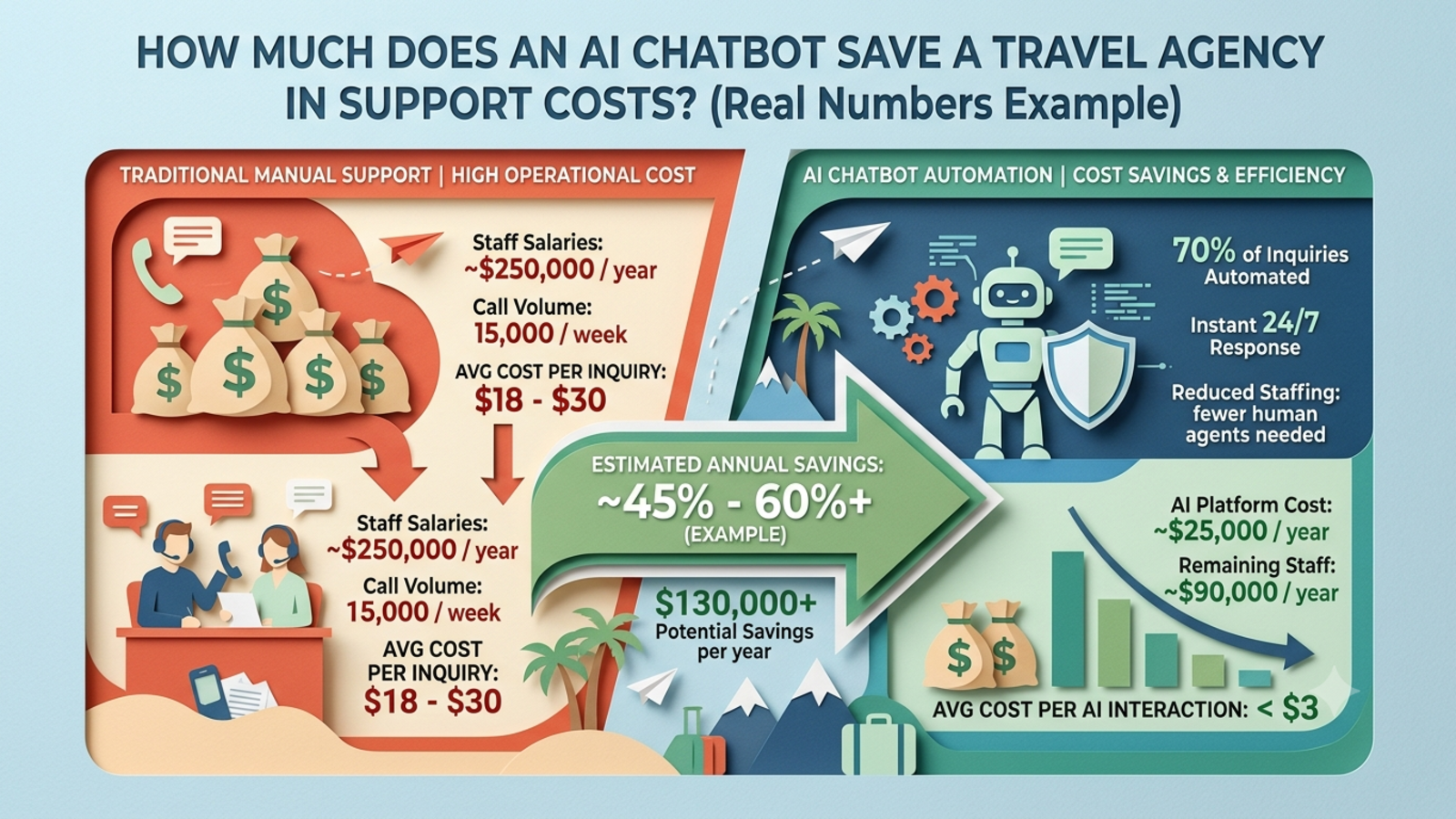
"It'll save you money" is one of those claims that gets thrown around so often in software marketing that it stops meaning anything. So instead of a vague promise, this article does the actual math — the real cost drivers behind travel agency support, where an AI chatbot changes the numbers, and a simple way to calculate the impact for your own business rather than trusting someone else's case study.
A quick honest note before we start: every agency's numbers are different. Team size, salary, ticket volume, and average booking value all vary a lot. So rather than hand you one made-up "agencies save $X" headline, this walks through the actual cost components and shows you how to plug in your own numbers.
What Support Actually Costs a Travel Agency
Most agencies underestimate this because the cost is spread across a few different places instead of showing up as one clean line item.
1. Direct staff time
This is the obvious one. If you have someone (or several people) answering customer inquiries — via WhatsApp, email, live chat, or your website — their time is the biggest cost. Even a modest support role costs real money once you factor in salary, benefits, and the time spent on inquiries that never turn into revenue.
2. Opportunity cost
This is the one that's easy to miss. Every hour your team spends answering "is this package available in December" is an hour not spent on higher-value work — negotiating with a supplier, following up on a warm lead, or closing a custom itinerary. Repetitive questions don't just cost time; they cost the better use of that time.
3. Lost bookings from delayed responses
When a question sits unanswered for hours (or overnight), some percentage of those customers simply book elsewhere. That's a real cost, even though it never shows up as a support expense — it shows up as quietly lower revenue.
4. Overtime or after-hours coverage
Some agencies try to solve the "we're closed but customers aren't" problem by having someone check messages outside work hours. This isn't sustainable long-term, and it costs more (in overtime or burnout) than most owners account for.
Where an AI Chatbot Changes the Math
An AI assistant doesn't eliminate all four of these costs, but it directly reduces the first three:
It absorbs repetitive questions — pricing, availability, inclusions, visa basics — that make up a large share of daily inquiries, freeing staff time for the complex, high-value conversations that actually need a person.
It runs 24/7 at no extra cost, so the "lost bookings from delayed responses" problem shrinks significantly, since customers get an answer the moment they ask, instead of the next business day.
It removes the need for after-hours coverage, since the AI handles evenings and weekends without anyone needing to check their phone off the clock.
The savings, in other words, come less from "replacing a person" and more from removing the repetitive, time-sensitive work that was quietly consuming hours your team could spend elsewhere.
A Simple Way to Calculate Your Own Numbers
Rather than trust a generic industry stat, here's a straightforward way to estimate this for your own agency. Grab these four numbers:
Average hourly cost of your support staff (salary + benefits, divided into an hourly rate)
Hours per week spent on repetitive questions (pricing, availability, basic FAQs) — a rough estimate is fine
Number of after-hours inquiries per week that currently go unanswered until the next business day
Your average booking value
Then:
Time savings = Hours per week on repetitive questions × hourly staff cost × 4.3 (weeks per month) This is the monthly staff time an AI assistant could realistically absorb.
Recovered bookings = After-hours inquiries per week × your estimated conversion rate on fast responses × average booking value × 4.3 This estimates the revenue currently being lost to slow after-hours replies, and roughly how much of it becomes recoverable when those inquiries get an instant response instead.
Add the two together, and you have a realistic, business-specific estimate — not a generic number borrowed from a case study that may not reflect your agency's volume, prices, or team structure.
A worked example (illustrative only)
To make this concrete, here's an example with made-up but realistic numbers for a small agency:
Support staff cost: $20/hour
Hours/week on repetitive questions: 12 hours
After-hours inquiries/week: 25
Estimated conversion lift from instant response: 15%
Average booking value: $450
Time savings: 12 × $20 × 4.3 ≈ $1,032/month in staff time freed up for higher-value work
Recovered bookings: 25 × 0.15 × $450 × 4.3 ≈ $7,256/month in potential recovered revenue
Even accounting for the fact that not every "recovered" inquiry converts, and being conservative about the estimate, the revenue side of this calculation tends to dwarf the direct cost savings — which is worth keeping in mind if you're evaluating an AI assistant purely as a "support cost" tool. The bigger financial impact is usually on the revenue side, not the expense side.
(Again — these specific numbers are an illustrative example, not a universal benchmark. Run your own numbers using the formula above; your agency's actual volume and conversion rates will change the outcome significantly.)
What This Doesn't Account For
To keep this honest: a chatbot isn't free, and it isn't magic.
There's a subscription cost to whatever tool you use, which should be weighed against the savings above.
It won't handle everything — complex negotiations, custom itineraries, and relationship-building still need a human, and should.
Setup and training matter. A chatbot that isn't properly trained on your actual packages and pricing won't produce these numbers — it'll just frustrate customers with vague or wrong answers, which can hurt more than it helps.
The realistic framing isn't "replace your support team with AI" — it's "stop spending your team's time on the 60-70% of inquiries that don't need a human, so the time they do spend is on the work that actually grows the business."
Bottom Line
The honest answer to "how much does an AI chatbot save a travel agency" is: it depends on your volume, your team's cost, and how many leads you're currently losing after hours — which is exactly why the calculation above is more useful than any single number a case study could give you. For most small-to-mid-size agencies, the math tends to work out clearly in favor of adopting one, especially once the revenue side (recovered bookings) is factored in alongside the staff time savings.
If you want to see what this looks like with your actual packages and pricing rather than a spreadsheet estimate, that's usually the fastest way to get a real number instead of a projected one.
Want to see the real numbers for your agency? Try Glanceia free — set it up with your own packages and pricing in under 10 minutes, no credit card required.