5 Signs Your Travel Agency Is Losing Bookings to Slow Response Times
Slow response times quietly cost travel agencies bookings every week. Here are 5 signs it's happening to yours — and what to do about it.
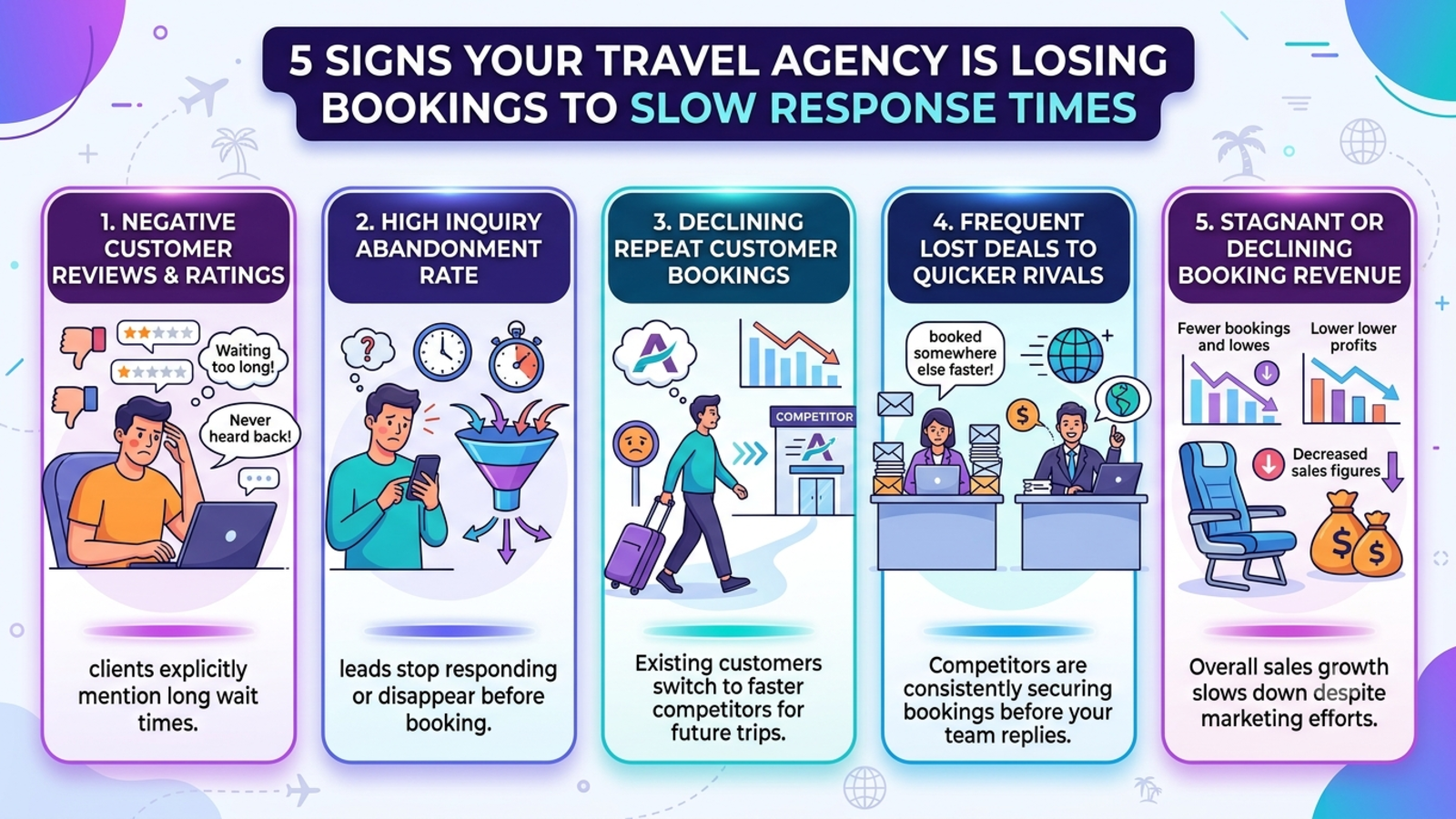
Most travel agencies don't lose bookings with a bang. There's no alert, no red flag, no line item that says "lost $4,000 this month because we replied too slowly." It just... happens, quietly, in the background — a customer asks a question, waits, gets bored or nervous, and books somewhere else without ever telling you why.
That's what makes slow response times such a sneaky problem. You can't fix what you can't see. So here are five signs worth checking for — some obvious, some easy to miss — that suggest your agency is losing more bookings to delay than you realize.
1. Your "seen but not booked" list is long
Check your website analytics, your Instagram DMs, or your WhatsApp Business chat history. How many conversations have a customer asking a specific question — "is this available in March," "what's included in this package" — and then just... going quiet? No follow-up, no booking, no explanation.
A few of those are normal; people browse without buying. But if it's a consistent pattern, especially where you can see the time gap between their question and your reply, that's a strong signal. Customers who ask a specific, high-intent question are usually close to booking — and a slow reply is one of the most common reasons that interest doesn't convert.
What to check: Look at the timestamp gap between the customer's question and your team's reply across your last 20-30 conversations. If a meaningful chunk are sitting for more than an hour, that's your answer.
2. Most of your inquiries come in outside business hours
Pull up your website chat logs or contact form submissions and look at the timestamps. If you notice a heavy cluster of inquiries in the evening, late night, or on weekends — outside whatever hours your team is actually working — you have a coverage gap, whether or not you've been tracking the lost bookings that come with it.
This is extremely common in travel specifically. People research trips when they have quiet time to think — after work, after the kids are asleep, on a Sunday afternoon. If your team is only replying the next business morning, every one of those inquiries has had 8-16 hours to cool off, get distracted, or get answered by a competitor first.
What to check: What percentage of your total weekly inquiries land outside your stated business hours? If it's a third or more, after-hours delay is very likely costing you bookings.
3. Customers mention "I already booked elsewhere" when you follow up
If your team ever does a next-day follow-up on unanswered inquiries, pay close attention to how often the reply is some version of "thanks anyway, I already booked with someone else" or "I found something else in the meantime." That's not a soft signal — that's a customer directly telling you the delay cost you the sale.
Most agencies don't track this explicitly, so it tends to get chalked up to "guess they weren't serious" rather than "we were too slow." Worth actually counting for a couple of weeks and see what the number looks like.
What to check: Start logging follow-up replies for two weeks. If "already booked elsewhere" shows up more than once or twice, that's a real, recurring leak — not a coincidence.
4. Your team is stretched thin on repetitive questions
This one's less about lost bookings directly and more about the root cause. If your staff spends a large chunk of their day answering the same handful of questions — pricing, availability, what's included, visa requirements — they have less time and attention for the inquiries that need real follow-up. Slow response times often aren't about laziness or bad process; they're about a small team getting buried in repetitive questions and simply not getting to everything fast enough.
What to check: Ask your team (or track it yourself for a week) roughly what percentage of inquiries are repeat, simple questions versus complex ones that genuinely need a human's judgment. If it's heavily skewed toward the simple end, that's where the bottleneck is coming from.
5. Your competitors have live chat or instant response, and you don't
This one's easy to check and easy to underestimate. Visit two or three competitor websites and see how quickly they respond to a test inquiry. If they have live chat, an AI assistant, or any instant-response setup and you're relying purely on email or a contact form, that's a direct disadvantage — customers comparing multiple agencies (which most travel shoppers do) will naturally lean toward whoever answers first, all else being roughly equal.
What to check: Send a real test inquiry to 2-3 competitors and time how long it takes to get a reply. If they're answering in minutes and you're answering in hours, that gap is where bookings are quietly slipping away.
What To Do If You're Seeing These Signs
If a few of these sound familiar, the good news is this is one of the more fixable problems in a travel business — it doesn't require restructuring your team or overhauling your process. It requires closing the specific gap between when a customer asks and when they get an answer, especially outside business hours and for the repetitive questions that don't need a human's judgment in the first place.
That's the exact gap AI assistants like Glanceia are built to close — answering customer questions instantly using your real packages and pricing, capturing lead details automatically, and handing off anything complex to your team the next morning with the context already there. It doesn't replace the parts of your business that need a person; it just makes sure nothing goes cold while your team is offline or buried in repeat questions.
Bottom Line
Slow response times rarely announce themselves. They show up as a quiet decline in conversion, a pile of unanswered late-night messages, or a customer who mentions — almost as an afterthought — that they already booked somewhere else. The five signs above are a starting point for actually seeing the problem instead of just sensing that something's off. Once you can see it, it's a lot easier to fix.
Curious how many of your leads are going cold to slow response times? Try Glanceia free — set it up with your own packages and pricing in under 10 minutes, no credit card required.