The Rise of the "AI Employee": What Travel Agencies Need to Know in 2026
AI employees are changing how travel agencies handle support, leads, and bookings. Here's what the shift actually means, and how to think about it for your business.
A few years ago, "chatbot" was a word that made most travel agency owners wince a little. It usually meant a clunky pop-up that couldn't answer anything beyond "what are your hours," and quietly annoyed more customers than it helped.
That reputation is starting to feel outdated. Walk through what's actually happening on travel websites in 2026, and you'll notice something different: these tools aren't just answering FAQs anymore. They're capturing leads, quoting prices, checking availability, and in some cases nudging a customer all the way to a booking — without a human touching the conversation.
People have started calling this an "AI employee," and honestly, the label fits better than "chatbot" ever did. Here's what's actually behind the shift, and what it means if you run a travel business.
So What Changed, Exactly?
Old-school chatbots worked off scripted decision trees. You'd click a button, it would show you a canned response, and the moment your question didn't fit the script, you were stuck — usually redirected to "please contact our support team," which defeated the entire purpose.
What's different now comes down to two things:
1. They're trained on your actual business data. Instead of generic scripts, modern AI assistants are fed your real packages, pricing, policies, and FAQs. Ask about availability for a specific tour in December, and it answers from your actual inventory — not a guess.
2. They handle full workflows, not just single questions. A modern AI assistant doesn't just answer "do you have Bali packages" and stop there. It can ask follow-up questions, capture the customer's contact details, flag a booking in progress, and pass a warm, qualified lead straight to your team — the kind of multi-step work that used to require a person sitting at a desk.
That second point is really the difference between a "chatbot" and an "employee." A chatbot answers questions. An employee handles a job from start to finish.
Why Travel Agencies Specifically Are Adopting This Fast
Not every industry needs this the same way, but travel has a few things working against it that make AI employees particularly useful:
Customers ask a lot of repetitive questions — pricing, visa requirements, package inclusions, availability for specific dates. These don't need a human's judgment; they need speed and accuracy.
Inquiries come in at all hours. Someone planning a trip is just as likely to be browsing at 10 PM on a Sunday as at 2 PM on a Tuesday. Most agencies can't staff around the clock, but the questions don't stop coming.
Small teams, high volume. A lot of travel businesses run lean. One or two people fielding every WhatsApp message, email, and website inquiry burns out fast, and repetitive questions eat time that should go toward closing complex, high-value bookings.
Booking decisions are time-sensitive. A customer who doesn't get a fast answer often just books somewhere else. Speed isn't a nice-to-have here — it's directly tied to revenue.
Put those together, and it's not surprising travel is one of the industries where this shift is happening fastest.
What an AI Employee Actually Does (Beyond Answering Questions)
It's worth being specific here, because "AI employee" can sound like marketing fluff if you don't break down what it actually covers:
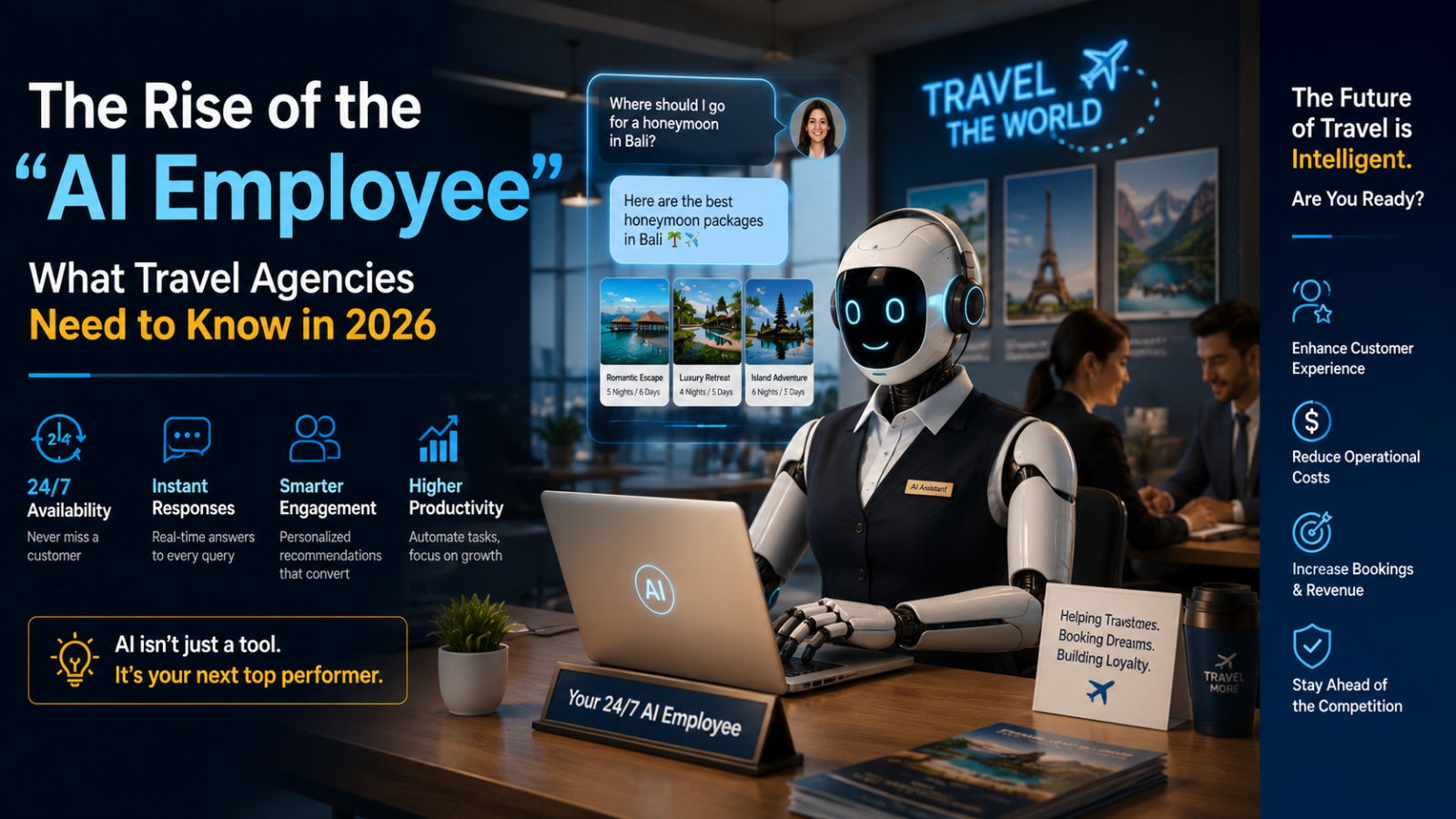
Answers customer questions instantly, using your real data — pricing, packages, availability, policies — so the response is accurate, not generic.
Captures leads automatically, collecting a customer's name, email, and phone number naturally during the conversation, instead of hoping they fill out a separate form.
Works around the clock, so a question at midnight gets answered at midnight, not the next morning after the customer has already looked elsewhere.
Learns your brand voice, so it doesn't feel like a bolted-on tool — it sounds like it's actually part of your business.
Hands off complex conversations, flagging anything that needs a human (custom itineraries, negotiations, special requests) and routing it to your team with the context already captured.
Shows you what customers are actually asking, through analytics on top questions, popular destinations, and where people drop off — information most agencies never had visibility into before.
None of this replaces the parts of your business that genuinely need a human — building relationships, handling nuanced negotiations, or crafting a custom itinerary for a big group. What it replaces is the repetitive front-line work that was eating your team's time without needing their judgment in the first place.
What This Means If You Haven't Adopted One Yet
If your agency is still handling every inquiry manually, you're probably not doing anything "wrong" — this shift is genuinely new, and a lot of businesses are only just starting to look at it seriously in 2026. But a few things are worth being honest with yourself about:
If a customer messages your website at night, how long does it realistically take them to get an answer?
How many of the questions your team fields every week are actually the same handful of questions, over and over?
Do you know which destinations, packages, or price points your website visitors are most interested in — or is that information just... lost in old chat logs?
If those questions make you wince a little, that's usually a sign there's an easy win sitting there. Not a total operational overhaul — just closing a specific, well-understood gap.
What to Look for Before You Adopt One
Not all tools calling themselves "AI employees" or "AI agents" are built the same. A few things worth checking before you commit:
Is it trained on your actual data, or does it just give generic travel advice that might be inaccurate for your business?
Can it capture leads automatically, or does it only answer questions and let visitors leave without a way to follow up?
How fast is setup, realistically? Some tools require weeks of developer time; others can be live on your site the same day.
Does it give you visibility into conversations — analytics on what customers are asking — or is it a black box?
Does it feel like it fits your brand, or does it feel like an obviously bolted-on widget that doesn't match your website?
Tools like Glanceia were built specifically around these questions — trained on your own travel packages and pricing, live on your site in minutes, capturing leads automatically, and handing off anything complex to your human team. It's less about replacing people and more about making sure the repetitive, time-sensitive work gets handled the moment it comes in, instead of sitting in a queue until someone's available.
The Bigger Picture
"AI employee" is a newer term, and like most new terms, it'll probably get overused by marketing teams before it settles into something more precise. But underneath the label, the actual shift is simple: travel businesses are starting to separate the work that needs a human from the work that just needs to be fast and accurate — and letting AI handle the second category.
That's not a trend that's going away in 2026. If anything, agencies that adopt it early are the ones setting customer expectations for response time and availability that the rest of the industry will eventually have to match.
Curious what an AI employee looks like for your agency specifically? Try Glanceia free — set it up on your own packages and pricing in under 10 minutes, no credit card required.