Why Travel Agencies Lose 30% of Leads After Business Hours (And How to Stop It)
Travel agencies lose a third of their leads to slow after-hours response times. Here's why it happens, what it's costing you, and how 24/7 AI support fixes it.
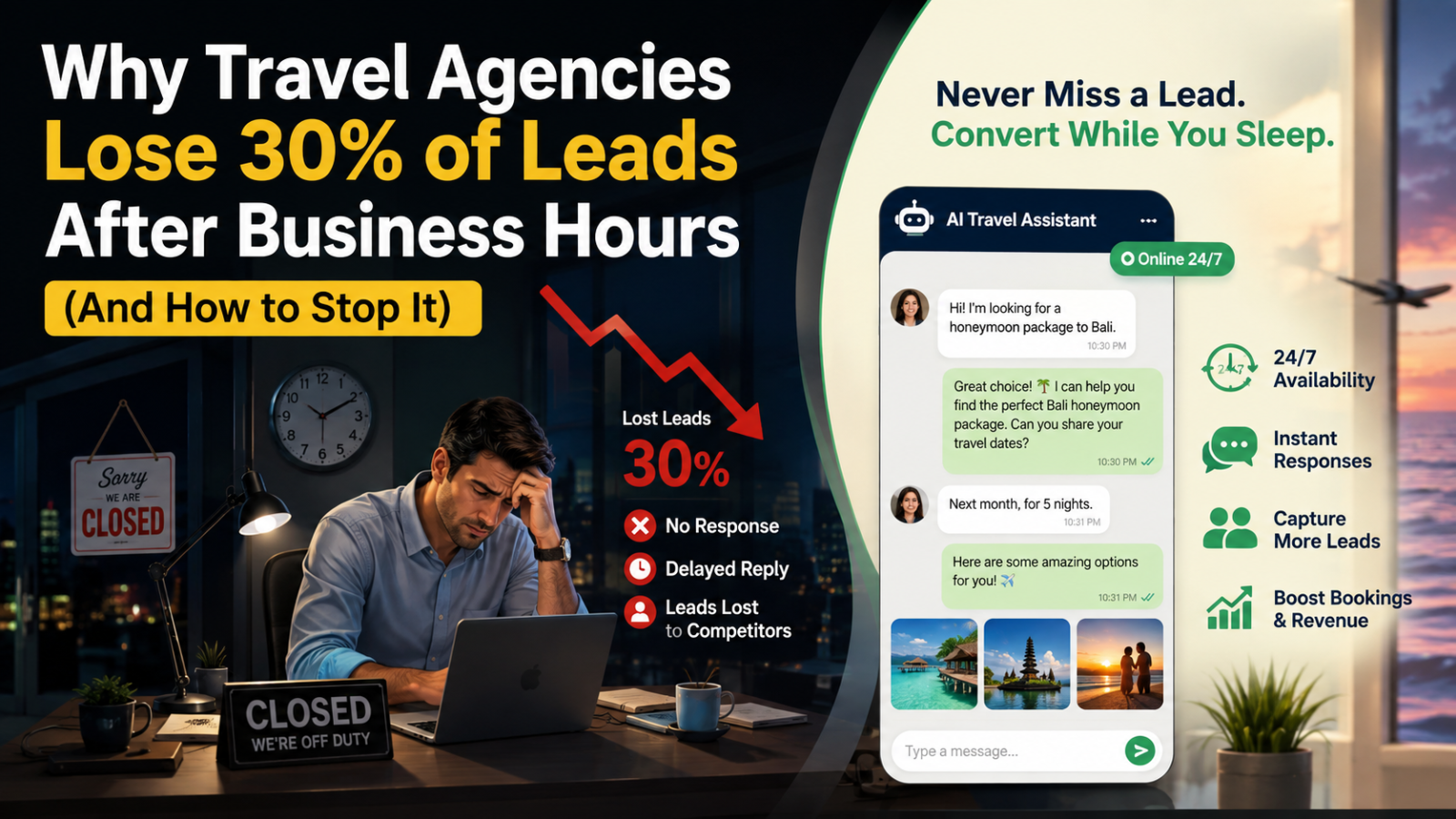
It's 9 PM. A customer is scrolling through Bali packages on your website, credit card practically in hand. They have one question — "Is this available for the second week of December?" — and they type it into your contact form.
Then they wait.
By the time your team opens that message tomorrow morning, the customer has already booked with someone else. Not because your price was worse. Not because your package was worse. Because someone else answered first.
This isn't a rare edge case. It's one of the biggest — and most fixable — revenue leaks in the travel industry today.
The 30% Problem, Explained
Travel research and booking behavior doesn't follow a 9-to-5 schedule. People browse trips after dinner, during lunch breaks at work, on weekends, and late at night when they finally have quiet time to plan. Industry data on customer response times consistently shows the same pattern across service businesses: the odds of converting a lead drop sharply with every hour of delay, and they drop fastest in the first hour.
For travel agencies specifically, this creates a painful mismatch:
Customers are most active researching trips in the evening and on weekends — exactly when most agency staff are offline.
Booking decisions are emotional and time-sensitive. A customer excited about a Bali trip at 9 PM is not the same customer if you reply to them 14 hours later. The moment cools off, they compare other options, or they simply forget.
Competing agencies and OTAs (online travel agencies) are always open. If a customer doesn't hear back from you quickly, platforms like Booking.com or Expedia — or a competitor with live chat — are one tab away.
Put together, a significant share of inbound leads — commonly estimated around 30% — simply go cold before a human ever replies. Not because the agency did anything wrong operationally, but because of a structural gap: humans need to sleep, and travel inquiries don't wait for business hours.
Why This Hits Travel Agencies Harder Than Other Industries
Every business loses some leads to slow response times. But travel has a few characteristics that make the problem worse:
1. High-consideration, high-emotion purchases
Booking a trip isn't like buying a phone case. Customers are excited, comparing multiple destinations, and often making a decision they'll research for days — but the window where they're ready to commit is short and easily lost to a competitor's faster reply.
2. Time-sensitive availability
"Is this package still available for my dates?" is one of the most common questions travel businesses get — and it's a question customers expect an immediate answer to, not a next-morning one. Uncertainty about availability is exactly the kind of friction that sends someone looking elsewhere.
3. Small teams, global customers
Many travel agencies run lean — a handful of staff serving customers who may be browsing from different time zones or simply outside standard office hours. There's no realistic way to staff a small team around the clock without it becoming a serious cost burden.
4. Repetitive questions eat up staff time
A large share of after-hours (and business-hours) inquiries are repetitive: pricing, visa requirements, availability, inclusions. These don't need a travel expert's judgment — they need a fast, accurate answer. But without a system in place, they still sit in the same queue as complex booking questions, waiting for a human.
What This Actually Costs an Agency
The cost isn't just "one missed message." It compounds:
Lost bookings — the most direct hit, and the easiest to calculate if you track how many after-hours inquiries never convert.
Wasted ad spend — if you're running paid campaigns to drive traffic to your site, every lead that goes cold after-hours is money spent for nothing.
Damaged reputation — customers who don't hear back quickly often assume the business is unresponsive or unreliable, even if that's not true. That impression can follow into reviews.
Staff burnout — teams trying to cover the gap by checking messages outside work hours end up overworked, which isn't sustainable and doesn't scale.
None of this shows up as a single line item on a P&L — which is exactly why it's so often overlooked.
The Fix Isn't "Hire More Staff"
The obvious answer — hire someone for evening and weekend coverage — is expensive and hard to justify for the volume of after-hours inquiries most agencies get. You'd be paying a salary to sit and wait for messages that might trickle in over several hours.
The more practical fix is separating the type of question from the time it arrives:
Repetitive, factual questions (pricing, availability, visa basics, package inclusions) can be answered instantly, at any hour, without a human — as long as the system answering them actually knows your business.
Complex questions (custom itineraries, negotiations, special requests) can still be routed to your team the next morning, but now the lead has already been captured, engaged, and kept warm instead of going cold.
This is the gap that AI-driven customer support tools are built to close — not replacing your team, but covering the hours your team physically can't.
How an AI Assistant Changes the Math
A well-trained AI chatbot — one that's actually trained on your specific packages, pricing, and policies, rather than giving generic travel advice — can:
Answer instantly, 24/7, so a 9 PM question gets a 9 PM answer instead of a next-morning one.
Capture lead details automatically (name, email, phone, destination interest) the moment someone starts a conversation, so even if they don't book on the spot, you have a warm lead to follow up with.
Give accurate, on-brand answers because it's trained on your actual data — your packages, your prices, your availability — not generic information that might be wrong.
Hand off complex conversations to your team the next business day, with full context already captured, so nothing falls through the cracks.
This is the core idea behind tools like Glanceia — an AI assistant built specifically for travel companies to answer questions, qualify leads, and keep the booking conversation moving, even when your team is offline. It's less "chatbot" and more an always-on member of your team handling the repetitive front-line work, so your staff can focus on the bookings that actually need a human touch.
What to Look for in an After-Hours Solution
If you're evaluating options, a few things matter more than others:
Company-specific training — a bot answering from your actual packages and pricing, not generic travel info.
Fast setup — you shouldn't need a developer or weeks of configuration to get coverage live.
Lead capture built in — the tool should collect contact details automatically, not just answer questions and let the visitor leave.
Analytics — visibility into what customers are asking after-hours helps you spot patterns (popular destinations, common objections) you can act on.
Easy handoff — complex conversations should route smoothly to your human team, not get lost.
The Bottom Line
Every hour your agency is closed, potential customers are still out there researching, comparing, and ready to book — and every hour without a response is an hour closer to losing them to someone else. The 30% of leads lost after business hours isn't a staffing failure; it's a coverage gap. Closing it doesn't require hiring around the clock — it requires making sure the repetitive, time-sensitive questions get answered the moment they're asked, no matter what time it is.
Want to see what after-hours coverage looks like for your agency? Try Glanceia free — set up your AI assistant in under 10 minutes, no credit card required.