WhatsApp Chatbot for Business — Complete Guide
Everything about WhatsApp chatbots for business in 2026 — real stats, how they work, 6 best platforms compared, step-by-step setup, and why you need a website chatbot too.
Introduction
WhatsApp is used by more than 2.78 billion people worldwide and over 200 million businesses. For most of those businesses, WhatsApp is already their primary customer communication channel — it is where inquiries come in, where orders get confirmed, where support happens, and where relationships are built.
The problem: managing WhatsApp conversations manually does not scale. Every message needs a human reply. Every night and weekend, messages pile up. Every peak season, response times collapse. And every unanswered message is a potential customer who went to a competitor instead.
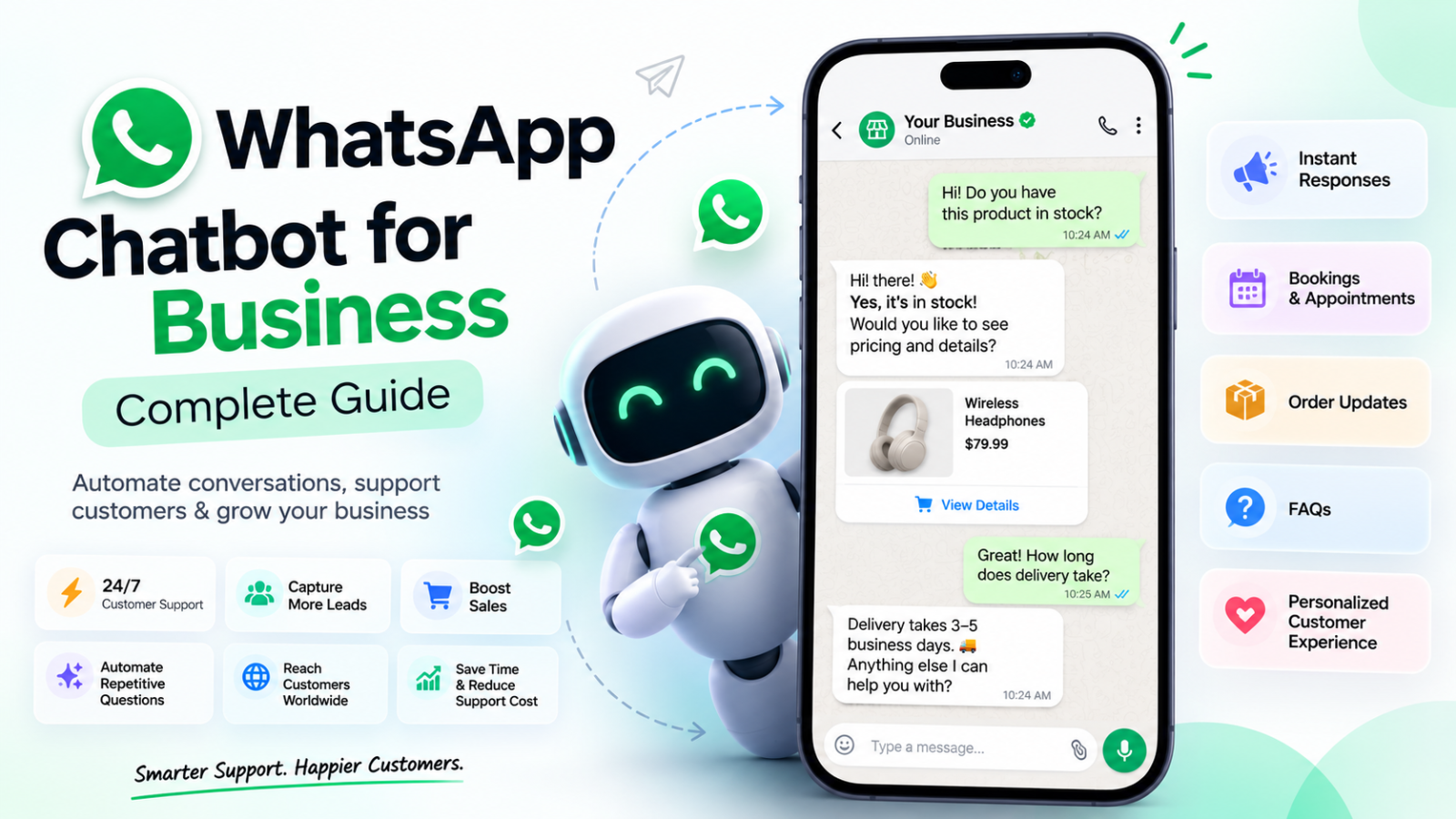
A WhatsApp chatbot for business solves this by automating conversations on WhatsApp — answering questions, qualifying leads, sending order updates, and handling support requests instantly, 24 hours a day, without a human agent needing to be present.
Businesses using WhatsApp chatbots see 3 to 5 times more conversations handled with 60 percent faster response times, while reducing support costs by up to 30 percent. The right WhatsApp chatbot can automate 75 to 90 percent of routine conversations while maintaining a personal touch.
This guide covers everything you need to know about WhatsApp chatbots for business in 2026 — how they work, the best platforms available, a step-by-step setup guide, real use cases, and why a WhatsApp chatbot works best when paired with a website chatbot for a complete customer communication strategy.
What Is a WhatsApp Chatbot for Business?
A WhatsApp chatbot is an automated tool that helps businesses interact with customers on WhatsApp without requiring a human agent for every conversation. Powered by the official WhatsApp Business API, it can answer customer queries, qualify leads, share order updates, schedule appointments, and provide support 24/7. Businesses can build automated conversation flows using a WhatsApp chatbot builder and seamlessly transfer chats to human agents whenever needed.
The key distinction in 2026 is between two types of WhatsApp chatbots:
Rule-based WhatsApp bots
These follow scripted decision trees — keyword triggers, button menus, and fixed response paths. A customer types "price" and the bot sends the price list. A customer selects "Support" from a menu and gets a scripted response. These work for simple, predictable use cases but break the moment a customer asks something outside the script.
AI-powered WhatsApp chatbots
A traditional chatbot follows scripted rules or decision trees. An AI agent uses a large language model to understand context, answer open-ended questions from your knowledge base, and take actions like qualifying leads or escalating to a human. In 2026 the best WhatsApp tools are agents, not rule-based bots.
An AI WhatsApp chatbot understands what customers mean — not just what they literally typed. It handles follow-up questions in the same conversation, responds to unusual phrasing, and answers from your specific business knowledge base rather than from pre-written scripts.
WhatsApp Chatbot for Business — The Numbers That Matter in 2026
With over 3 billion monthly users, WhatsApp has become the most important messaging platform for business communication. Yet most companies still handle conversations manually, leading to slow response times, inconsistent messaging, and missed opportunities.
The business case for a WhatsApp chatbot is stronger than almost any other channel:
Open rate advantage: WhatsApp chatbot broadcasts beat email open rates by a lot — WhatsApp messages achieve open rates of 95 to 98 percent compared to roughly 20 percent for email. When you reach customers on WhatsApp, they actually read what you send.
Response time transformation: Businesses using WhatsApp chatbots see 60 percent faster response times. A manual WhatsApp reply during business hours takes minutes to hours. An AI WhatsApp chatbot replies in seconds — at any hour, including 2 AM on a Sunday.
Automation depth: The right WhatsApp chatbot can automate 75 to 90 percent of routine conversations while maintaining a personal touch. This means 3 out of every 4 customer messages your team currently handles manually can be handled by a chatbot instead.
Cost reduction: Support costs are reduced by up to 30 percent when businesses implement WhatsApp chatbots. At scale, the cost per WhatsApp chatbot interaction is a fraction of the cost of a manual human reply.
Revenue impact: ManyChat is used by 95 percent of agencies for WhatsApp client implementations — a signal of how central WhatsApp automation has become to business growth strategies in 2026.
What a WhatsApp Chatbot for Business Can Do
A well-configured WhatsApp chatbot for business handles a wide range of conversations automatically:
Customer support and FAQ answering: Customer service chatbots offer easy scalability and consistent service. Once integrated with your core documents — data, policies, or your entire website — they can provide up-to-date information for your customers, allowing your customer service reps to spend their time on high-impact conversations.
Lead generation and qualification: The chatbot asks qualifying questions — budget, requirements, timeline — and collects contact information automatically, building a database of pre-qualified leads without manual effort.
Order updates and tracking: For ecommerce businesses, the chatbot provides real-time order status, shipping updates, and delivery confirmations — the most common support queries — automatically and instantly.
Appointment and booking management: WhatsApp is the tool of choice for thousands of booking services worldwide. Chatbots handle appointment scheduling, confirmation messages, reminders, and rescheduling requests automatically.
Broadcast marketing campaigns: Send promotional messages, product launches, and offers directly to customers' WhatsApp inboxes — where open rates are 5 to 10 times higher than email.
Multilingual customer communication: Top WhatsApp chatbots include language detection features that personalise responses to customers — especially valuable for businesses serving customers across multiple regions or countries.
Abandoned cart recovery: ManyChat's deep integrations with ecommerce platforms like Shopify make it easy to recover abandoned carts and send automated order updates.
The 6 Best WhatsApp Chatbot Platforms for Business in 2026
#1 — ManyChat (Best for Marketing and Lead Generation)
Best for: Businesses using WhatsApp, Instagram, and Facebook for marketing campaigns and lead generation
Starting price: Free (1,000 contacts) / Pro $15/month
WhatsApp Business API required: ✅ Yes
AI included: ⚠️ GPT add-on extra
No-code: ✅ Yes
ManyChat dominates the WhatsApp marketing automation space, used by 95 percent of agencies for client implementations. Its visual flow builder makes it easy to create complex automations without coding, perfect for lead generation and sales sequences.
ManyChat is one of the most user-friendly chatbot platforms, especially for businesses looking to automate WhatsApp, Facebook Messenger, and Instagram DMs. Its drag-and-drop flow builder lets you quickly create conversation flows that guide users through a funnel for lead capture, customer support, or sales.
ManyChat's free plan covers up to 1,000 contacts — genuinely useful for testing. The Pro plan at $15/month is one of the most affordable entries in the market. AI features require an additional GPT add-on.
Best use case: E-commerce brands running Click-to-WhatsApp ads, businesses doing WhatsApp broadcast campaigns, and marketers managing leads across WhatsApp, Instagram, and Facebook simultaneously.
#2 — WATI (Best Dedicated WhatsApp Business Platform)
Best for: Small to mid-sized businesses wanting a dedicated WhatsApp-first customer support and marketing platform
Starting price: From ~$49/month
WhatsApp Business API required: ✅ Yes — official Meta BSP
AI included: ✅ Yes
No-code: ✅ Yes
WATI is an official Meta BSP (Business Solution Provider) with green-tick help and strong template campaign capabilities — best for WhatsApp-led marketing and broadcasts.
WATI is built exclusively for WhatsApp business use cases — shared team inbox, broadcast campaigns, chatbot automation, and CRM integration all in one platform. As an official Meta BSP, it provides a smooth WhatsApp Business API setup process and reliable access to all WhatsApp features including the coveted green tick verification.
Its drag-and-drop chatbot builder with pre-built templates covers the most common WhatsApp business flows — FAQ answering, lead qualification, order tracking, and appointment booking — without writing code.
Best use case: Small and mid-sized businesses for whom WhatsApp is the primary customer communication channel and who want a purpose-built platform rather than a multi-channel tool.
#3 — AiSensy (Best Affordable Option for Indian Businesses)
Best for: Indian small businesses, D2C brands, and startups wanting an affordable WhatsApp chatbot with strong local support
Starting price: From ₹999/month
WhatsApp Business API required: ✅ Yes
AI included: ✅ Yes — AI agents and template generator
No-code: ✅ Yes
AiSensy stands out as a top choice combining AI-driven automation, broadcast marketing, and real-time analytics, all within an intuitive interface. From ecommerce to SaaS and D2C brands, AiSensy helps businesses scale conversations, boost engagement, and increase conversions without needing a single line of code.
AiSensy is particularly relevant for Indian businesses because it is priced in INR, has strong local support, and understands the Indian WhatsApp business landscape — including the high WhatsApp penetration among Indian consumers and the specific needs of Indian D2C brands.
Features include AI-powered chatbot flows, bulk broadcast messaging, campaign analytics, and a shared team inbox — covering both marketing and support use cases from one platform.
Best use case: Indian small businesses, D2C brands, travel agencies, and startups wanting an affordable WhatsApp chatbot with Indian pricing, Hindi language support, and local customer support.
#4 — Respond.io (Best for Multi-Channel Support Teams)
Best for: Mid to large-sized businesses managing high-volume customer conversations across WhatsApp and multiple other channels
Starting price: From $79/month
WhatsApp Business API required: ✅ Yes
AI included: ✅ Yes — autonomous AI agents
No-code: ✅ Yes
Respond.io offers more than a simple chatbot, unifying WhatsApp and all popular channels into a single inbox. With robust WhatsApp automation tools, AI agents, customer lifecycle tracking, CRM integration and more, you can manage your entire customer journey from first contact to sale to retention.
Respond.io is the most enterprise-capable option on this list — designed for businesses managing hundreds or thousands of conversations across WhatsApp, Instagram, Facebook Messenger, email, and web chat simultaneously. Its AI agents can autonomously handle full conversation flows across all channels from one platform.
Best use case: Growing businesses and enterprises with dedicated customer service teams needing structured conversation management, advanced routing, and CRM integration across multiple channels at scale.
#5 — Tidio (Best for SMEs Wanting WhatsApp + Website Chat Together)
Best for: Small to medium ecommerce businesses wanting WhatsApp integrated with website live chat in one platform
Starting price: Free / $29/month base + AI add-on extra
WhatsApp Business API required: ✅ Yes
AI included: ⚠️ Lyro AI separate add-on
No-code: ✅ Yes
Tidio combines live chat, AI chatbots, WhatsApp integration, and email marketing on one platform, with native integrations for Shopify and WooCommerce. Tidio's AI assistant Lyro learns from your FAQ content and handles common support queries, including order status, shipping, and returns, by connecting directly to Shopify.
Tidio is a chatbot platform designed for small to medium-sized businesses that want a simple yet functional WhatsApp automation tool. It unifies WhatsApp, live chat, and email into a single inbox — a huge advantage for businesses managing multiple communication channels.
The pricing structure is worth understanding: the base plan does not include AI. Lyro AI is a separate add-on, pushing the real monthly cost to $68 or above for a fully AI-powered deployment.
Best use case: Small ecommerce businesses on Shopify or WooCommerce that want a single platform for WhatsApp + website live chat + basic AI automation.
#6 — Chatbase (Best for AI Trained on Your Own Documents)
Best for: Technical teams and businesses wanting an AI chatbot trained on their specific knowledge base, deployed on WhatsApp
Starting price: Free (limited) / Hobby $32/month
WhatsApp Business API required: ✅ Yes
AI included: ✅ Yes — credit-based
No-code: ✅ Partial
Chatbase is incredible at exactly one thing: training a chatbot on your own data and automatically answering questions about it. You can simply upload documents or share website links, and the chatbot will quickly learn from your data. Chatbase can automatically identify any knowledge gaps and the system learns from these revisions automatically.
For businesses whose primary need is an AI that answers questions from their specific knowledge base — policy documents, product catalogs, service FAQs — Chatbase's document training capability is one of the best available. It deploys to WhatsApp via the WhatsApp Business API alongside its website widget.
Best use case: SaaS companies, technical teams, and service businesses wanting a deeply trained AI that answers specific questions from their knowledge base across both WhatsApp and their website.
How to Set Up a WhatsApp Chatbot for Your Business
Step 1: Create a WhatsApp Business Account
All WhatsApp chatbot tools require you to register a business account with Meta before you can deploy a bot to WhatsApp.
Download the WhatsApp Business App on your phone
Register with your business phone number (separate from your personal WhatsApp number)
Complete your business profile — name, description, address, category, website
Step 2: Apply for WhatsApp Business API Access
The WhatsApp Business App gives you basic manual chat capabilities. For chatbot automation at scale, you need the WhatsApp Business API — which requires applying through Meta or through an official Business Solution Provider (BSP) like WATI or AiSensy.
The API approval process typically takes 2 to 7 business days and requires:
A verified Facebook Business Manager account
A business website
Compliance with WhatsApp Business Policy
A dedicated phone number for your WhatsApp business account
Using a platform like WATI or AiSensy as your BSP simplifies this process significantly — they guide you through API approval as part of their onboarding.
Step 3: Choose Your Chatbot Platform
Based on your use case:
Marketing and social media lead gen → ManyChat
Dedicated WhatsApp support platform → WATI
Indian businesses on a budget → AiSensy
Multi-channel enterprise teams → Respond.io
Ecommerce WhatsApp + website → Tidio
Document-trained AI → Chatbase
Step 4: Build Your Chatbot Flows
Upload your business content — FAQs, pricing, policies, product information — and build the conversation flows your chatbot will follow. For AI-powered chatbots, upload your knowledge base documents and the AI trains automatically. For flow-based tools, build the branching paths for your most common conversation scenarios.
Step 5: Test Thoroughly
Message your WhatsApp business number from a personal phone and test every scenario:
Common FAQ questions — do you get accurate, specific answers?
Edge cases — what happens when someone asks something unexpected?
Human handoff — does the escalation trigger correctly?
Lead capture — is the qualification flow collecting the right information?
Step 6: Go Live and Monitor
Activate the chatbot, set up notifications for conversations that need human review, and monitor the first week of live conversations closely. Review which questions the chatbot handles well and which ones reveal gaps in your knowledge base to fill.
Why Your Business Needs BOTH a WhatsApp Chatbot AND a Website Chatbot
Here is the most important insight most WhatsApp chatbot guides skip entirely: WhatsApp only reaches customers who already know you and have your number. It does not help you with new visitors who find your business for the first time through Google.
Think about the full customer journey:
A potential customer searches Google for a service you offer
They land on your website — not your WhatsApp
They browse your services page, have a question
If there is no way to get an instant answer on your website, they leave
They find a competitor's website that has a chatbot answering questions instantly
They contact that competitor — not you
This is the gap that a website chatbot fills — and why the most effective businesses in 2026 run BOTH a WhatsApp chatbot for existing customers and contacts, AND a website chatbot for new visitors discovering the business for the first time.
Glanceia: The Website Chatbot That Completes Your Strategy
While the tools above handle your WhatsApp conversations, Glanceia handles your website — covering the customer acquisition side of the equation that WhatsApp chatbots cannot reach.
What Glanceia does for your website:
Glanceia is an AI-powered website chatbot that trains on your specific business content — your FAQs, pricing documents, service descriptions, and policies — and answers visitor questions instantly on every page of your site. New visitors who find you through Google, social media, or referrals get an immediate, accurate response to their questions before they have the chance to leave.
Lead capture is built in from the start — every visitor conversation automatically collects name, email, and qualifying information, turning anonymous website traffic into warm leads your team can follow up with on WhatsApp.
The setup takes under 30 minutes with zero coding. One embed script in your website footer, and the chatbot goes live on every page — WordPress, Wix, Webflow, Shopify, Squarespace, or any custom site.
Free plan available with no credit card required. Paid plans from $9 per month with AI fully included.
The complete strategy: WhatsApp chatbot (ManyChat, WATI, or AiSensy) handles existing customers and contacts on WhatsApp. Glanceia handles new visitors on your website. Together, they cover every stage of the customer journey — from first discovery to ongoing relationship.
Add Glanceia to your website free →
WhatsApp Chatbot Use Cases by Industry
Travel and Tourism
WhatsApp is the tool of choice for thousands of booking services worldwide. Travel agencies use WhatsApp chatbots to send package information, answer visa questions, confirm bookings, and provide pre-travel reminders — the full pre-trip communication handled automatically.
Healthcare and Clinics
Clinics use WhatsApp chatbots to handle appointment bookings, send reminders, share test result notifications, and answer common patient queries — reducing front desk call volume significantly and improving patient communication.
E-commerce and D2C Brands
WhatsApp chatbots with deep Shopify integrations make it easy to recover abandoned carts and send automated order updates. D2C brands use WhatsApp for order confirmations, shipping updates, return requests, and promotional broadcasts — keeping customers engaged throughout the purchase lifecycle.
Real Estate
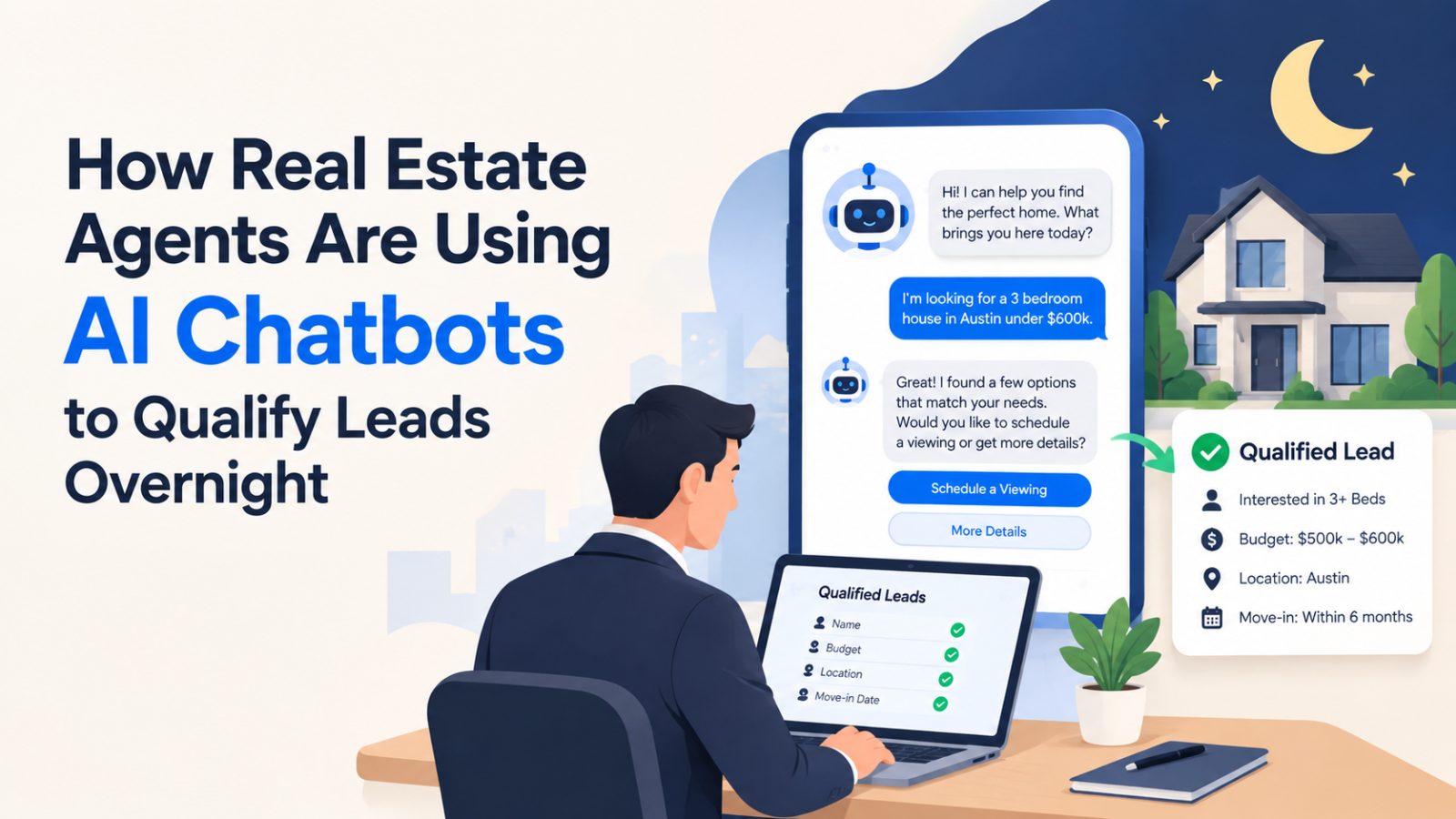
Real estate agencies use WhatsApp chatbots to qualify property inquiries, share listing details and photos, arrange site visit appointments, and follow up with interested buyers — covering the full lead nurturing process on the platform most Indian buyers already prefer.
Education and EdTech
EdTech platforms and coaching institutes use WhatsApp chatbots to handle course inquiries, share admission information, send assignment reminders, and process fee payment queries — automating the administrative communication that consumes faculty time.
Common WhatsApp Chatbot Mistakes to Avoid
Sending unsolicited broadcast messages: WhatsApp has strict policies about messaging users who have not opted in. Only message customers who have explicitly agreed to receive WhatsApp communications from your business. Violating this risks your WhatsApp Business API access being suspended.
Making the bot too scripted: A button-menu WhatsApp bot that cannot handle free-text questions frustrates customers who type naturally. Invest in AI capability so the chatbot handles real conversations, not just scripted flows.
No human handoff for complex issues: 32 percent of clients would leave a brand due to poor user experience. A WhatsApp chatbot that leaves a customer in a dead end for a complex issue is worse than no chatbot at all. Always configure a clear escalation path to a human agent.
Ignoring the website traffic: A WhatsApp chatbot only helps customers who are already in your WhatsApp. It cannot capture new visitors finding you through Google. Pair it with a website chatbot like Glanceia to cover the full customer acquisition funnel.
Not updating content regularly: Pricing changes, new services, updated policies — update your chatbot's knowledge base whenever anything changes. An outdated WhatsApp chatbot giving wrong information actively damages trust.
FAQ — WhatsApp Chatbot for Business
What is a WhatsApp chatbot for business?
A WhatsApp chatbot for business is an automated AI-powered program that interacts with customers through WhatsApp, answering questions, qualifying leads, sending updates, and handling support requests without a human agent needing to be present for every conversation.
Do I need the WhatsApp Business API to use a chatbot?
Yes — automated chatbot functionality on WhatsApp requires the WhatsApp Business API. All WhatsApp chatbot tools require you to register a business account with Meta before you can deploy a bot to WhatsApp. The basic WhatsApp Business App only supports manual messaging.
What is the best WhatsApp chatbot for small businesses in India?
For Indian small businesses, AiSensy is the most relevant choice — priced in INR, built for the Indian market, with strong support for the D2C, travel, real estate, and education sectors that drive most WhatsApp business usage in India.
How much does a WhatsApp chatbot cost for business?
Costs range from $15/month (ManyChat Pro) for social-focused automation to $49+/month for dedicated WhatsApp platforms like WATI and AiSensy (from ₹999/month). Enterprise platforms like Respond.io start from $79/month. All require WhatsApp Business API access, which may carry Meta's per-message conversation fees on top of the platform subscription.
Can a WhatsApp chatbot replace my customer service team?
The right WhatsApp chatbot can automate 75 to 90 percent of routine conversations. The remaining 10 to 25 percent — complex issues, complaints, high-value negotiations — still need human judgment. The goal is freeing your team from routine repetition so they focus on conversations that actually need them.
What is the difference between WhatsApp chatbot and a website chatbot?
A WhatsApp chatbot handles conversations through the WhatsApp messaging app — reaching customers who already know your business and have your number. A website chatbot handles conversations on your website — reaching new visitors who are discovering your business for the first time. Most businesses need both: a WhatsApp chatbot for existing customer communication and a website chatbot like Glanceia for acquiring new customers.
How long does it take to set up a WhatsApp chatbot?
The WhatsApp Business API approval takes 2 to 7 business days. Once approved, building and deploying a chatbot on a no-code platform like ManyChat, WATI, or AiSensy typically takes 2 to 8 hours depending on the complexity of your flows and the amount of content you need to upload.
Final Thoughts
With over 3 billion monthly users, WhatsApp has become the most important messaging platform for business communication. Yet most companies still handle conversations manually, leading to slow response times, inconsistent messaging, and missed opportunities.
A WhatsApp chatbot for business closes this gap — automating 75 to 90 percent of routine conversations, responding instantly at any hour, and giving your team the bandwidth to focus on the relationships and decisions that genuinely need human involvement.
The right tool depends on your primary use case: ManyChat for marketing-led businesses, WATI or AiSensy for dedicated WhatsApp operations, Respond.io for enterprise multi-channel teams, and Chatbase for document-trained AI.
And for the half of the customer journey that WhatsApp cannot reach — the new visitors discovering your business through Google and landing on your website — add Glanceia as your website chatbot. Together, they give you 24/7 AI-powered presence on every channel where customers find and communicate with your business.
Add a website chatbot to complement your WhatsApp strategy — Try Glanceia free →
Published by Laxman- Team Glanceia