Why Your Support Team Is Burning Out on Questions a Bot Could Answer
Support burnout usually isn't caused by difficult customers. It's caused by answering the same simple questions hundreds of times. Here's how to actually fix it.
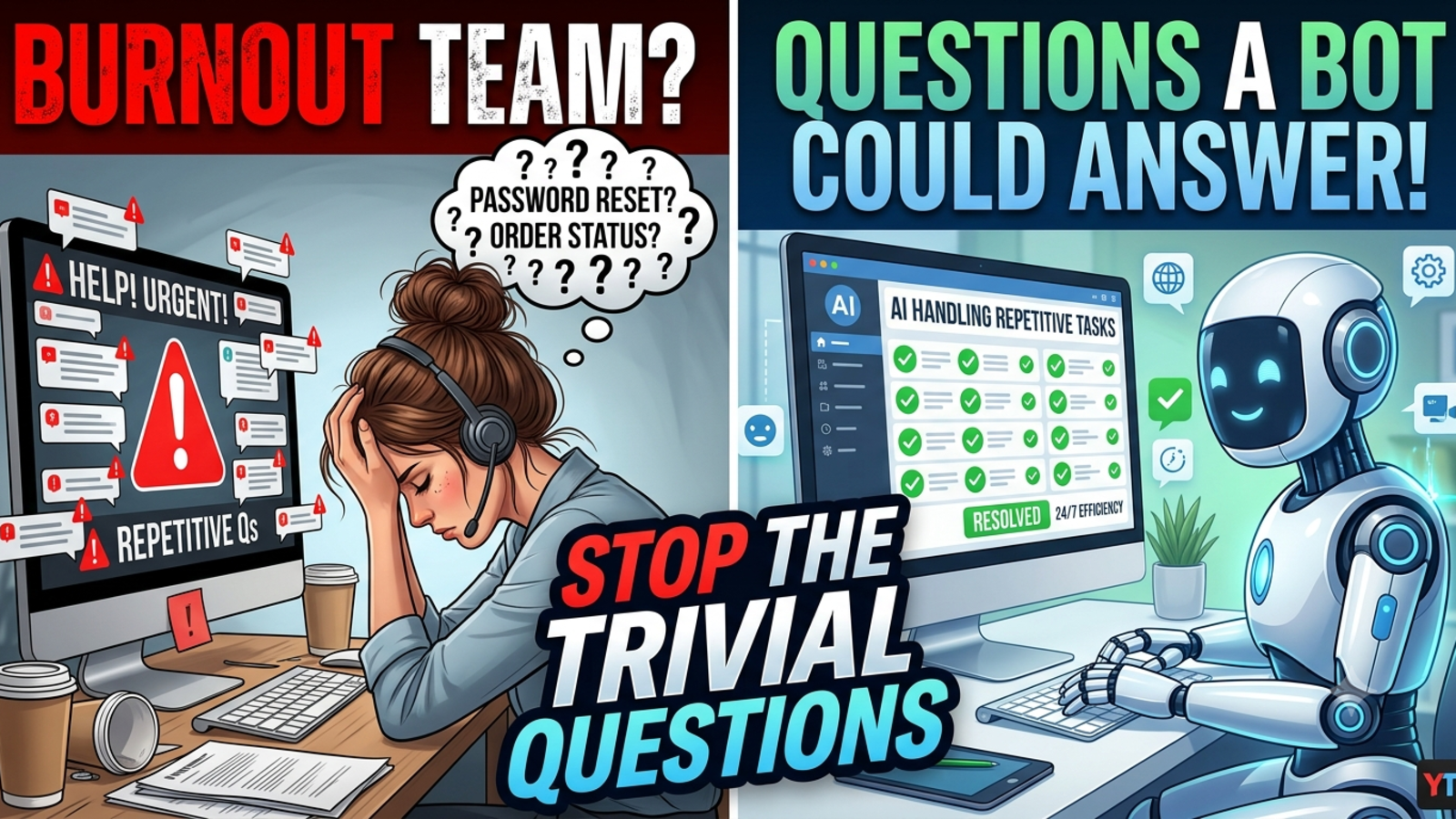
Ask most support teams what's wearing them down, and you'd expect the answer to be difficult customers — the angry emails, the escalations, the people who are genuinely hard to help. That's rarely it.
What actually burns support teams out is quieter and much more repetitive: answering "what are your hours" for the hundredth time this month. Re-explaining the same return policy to a different person every hour. Typing a near-identical reply to "is this in stock" so many times that the words stop meaning anything. It's not the hard conversations that exhaust people — it's the sheer, grinding repetition of the easy ones.
If your team seems tired, disengaged, or slower to respond than they used to be, it's worth actually looking at what they're spending their day on. Odds are, most of it is questions a bot could have answered instantly.
The Real Source of Support Burnout
Burnout research consistently points to a specific combination: high workload, low sense of control, and work that feels meaningless. Repetitive support questions hit all three at once.
High workload because the volume never actually stops — every day brings a fresh batch of the same handful of questions. Low control because a support agent can't opt out of answering "what's your shipping time" for the fortieth time; it's just part of the job, no matter how draining it's become. And meaninglessness because typing the same answer over and over doesn't feel like helping anyone — it feels like being a slower, more expensive version of a search function.
None of this is really about the customers. It's about the fact that a huge share of what a support team does all day genuinely doesn't require a human being — and doing it anyway, hour after hour, is what wears people down.
Why This Keeps Happening
Most businesses don't set out to burn out their support team. It happens gradually: the FAQ page exists, but customers don't read it. The pricing page has the answer, but people ask anyway rather than looking. So every question, no matter how well-documented the answer already is, ends up funneled through a human, because that's the only way anyone's actually replied to.
The result is a support team that's essentially a live search engine for information the business already has written down somewhere — just slower, more expensive, and prone to exhaustion in a way a document never is.
What Actually Fixes This
The fix isn't asking your team to work faster or care less — that just accelerates burnout. The fix is removing the repetitive questions from their workload entirely, so what's left is the smaller set of conversations that genuinely need a person's judgment.
An AI chatbot trained on your own content can take on exactly that layer. Upload your FAQs, pricing sheets, and policies, and a tool like Glanceia answers those repetitive questions instantly, at any hour, without a human ever touching them. It's not a generic bot giving vague replies — it only answers from what you've actually given it, so responses stay accurate to your real business, and customers get real answers instead of a dead end that just creates more work for your team later.
What lands in front of your team afterward isn't "less" — it's different. It's the complicated requests, the upset customers, the genuine edge cases. The conversations that actually use their judgment, instead of just their patience.
What Changes for the Team, Not Just the Metrics
The repetitive questions disappear from their day, not just get answered faster. That's the difference between reducing burnout and just making it more efficient.
What's left actually uses their skills. Support agents spend their time on conversations where empathy, judgment, and problem-solving matter — the reason most of them took the job in the first place.
The after-hours pressure lifts. Questions that used to sit overnight, waiting for someone to log back on, get handled the moment they arrive.
There's finally visibility into the workload. A dashboard showing what's being asked most often tends to reveal something worth fixing on the website itself — not just something for the team to keep absorbing.
This Isn't About Replacing the Team
It's worth saying directly: automating the repetitive 80% isn't a step toward replacing support staff. It's the opposite — it's protecting the people who are good at the parts of the job that actually need a human, instead of burning them out on the parts that never did. Teams that get this right usually see morale and response quality improve on the conversations that remain, because the people handling them aren't running on empty anymore.
Getting Started
Look honestly at your team's ticket volume — how much of it is genuinely repetitive versus how much needs real judgment.
Gather the documents you already have — FAQs, policies, pricing, product info.
Upload them to a chatbot trained on that content, like Glanceia.
Let it take over the repetitive layer while your team focuses on what's left.
Check in on the dashboard regularly — both to see what's improving and to catch new repetitive patterns before they pile up again.
Most businesses using Glanceia are live within minutes, with a free plan to start — no lengthy rollout, no added headcount required.
The Bottom Line
If your support team seems burnt out, look past the assumption that it's difficult customers wearing them down. More often, it's the sheer volume of simple, repetitive questions that never should have needed a person in the first place. Take that layer off their plate, and what's usually left is a team that's not just less exhausted — but doing work that actually matters again.
If this sounds like your team right now, Glanceia sets up an AI chatbot trained on your own data in minutes — free to start. Get in touch if you want help figuring out where to begin.