Stop Hiring for Support. Start Automating the Boring 80%.
Before you post another support job listing, look at what your team is actually spending their day on. Most of it doesn't need a new hire — it needs automating. URL Slug: /blog/stop-hiring-automate-support
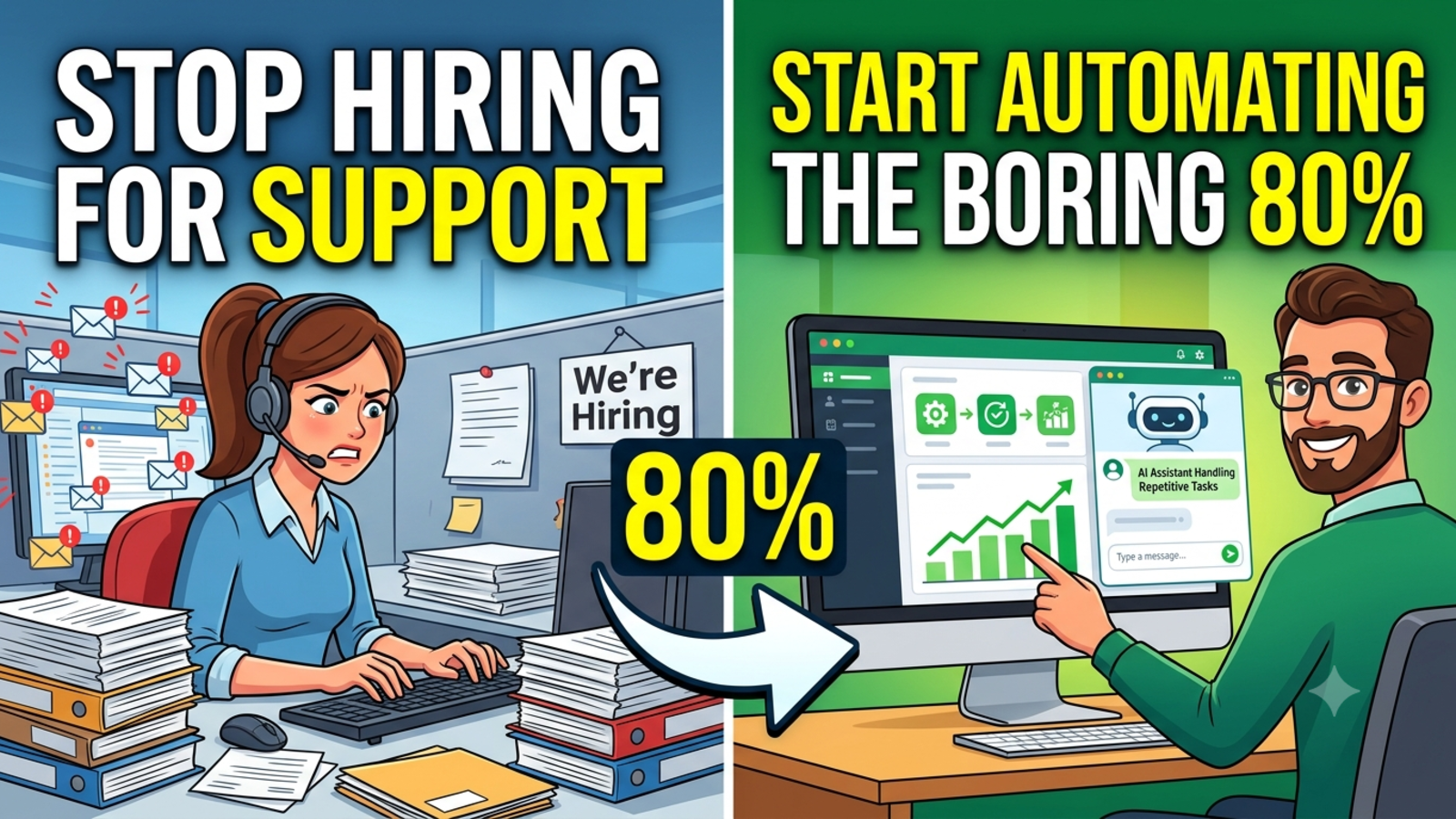
There's a moment every growing business hits: the support inbox is overflowing, the team's stretched thin, and the obvious next move seems to be posting a job listing. Hire someone. Add headcount. Solve people-problems with more people.
Except most of the time, that's solving the wrong problem.
Pull up your last month of support conversations and actually read through them. Not skim — read. What you'll usually find is that a new hire isn't fixing a lack of people. It's fixing a lack of automation you never got around to setting up. Somewhere around 80% of what a support team answers, day to day, is repetitive — the same handful of questions, asked by different people, that don't actually need a human brain behind them.
Hiring for that isn't wrong, exactly. It's just expensive and slow, for a problem that has a faster, cheaper fix.
What the "Boring 80%" Actually Looks Like
Every business's version is a little different, but the shape is almost always the same:
"What are your hours?"
"Is this available for [specific date]?"
"What's your return/refund policy?"
"Do you ship to [location]?"
"How does this work?"
"What's included in this package?"
None of these require judgment. None of them are unique to the person asking. They're the same question, dressed up differently, every single time — and a support team answers them by hand, over and over, because that's just how it's always been done.
The remaining 20% is where an actual person matters: the complicated request, the upset customer, the edge case a document can't cover. That's the part hiring is genuinely good for. The other 80% isn't a people problem. It's a plumbing problem — the questions are flowing through a slow, manual pipe when they don't need to.
Why Hiring Doesn't Actually Fix This
A new hire costs a salary, benefits, training time, and management overhead — and once they're up to speed, what are they mostly doing? Answering the same repetitive questions the last person was answering. You've added cost, not capacity for the work that actually needs a human.
It also doesn't scale. Double your customers, and eventually you need to double your support team again, because the repetitive 80% grows right along with everything else. You end up hiring your way into a bigger version of the same bottleneck, instead of ever actually fixing it.
What Automating the 80% Actually Looks Like
This isn't about replacing your support team — it's about giving the boring, repetitive part of the job to something that can handle it instantly, so the humans on your team spend their time on the 20% that's actually worth their attention.
An AI chatbot trained on your own content — your FAQs, pricing sheets, policies, product info — can answer the repetitive questions the moment they're asked, at any hour, without anyone typing the same reply for the fortieth time. The key difference from older chatbots is that it isn't guessing or following a rigid script — it's pulling directly from what you've actually given it, so the answers are accurate to your real business.
This is exactly what Glanceia is built to do: upload what you already have, and it answers only from that — no hallucinated policies, no generic non-answers, no separate team required to keep it running. It's live on your site within minutes, styled to match your branding.
What Changes Once You Automate Instead of Hire
The repetitive questions stop reaching your team at all. Not faster answers — no manual answer needed in the first place.
Your existing team's time gets freed up for the 20% that matters. Complicated requests, unhappy customers, custom questions — the stuff that actually benefits from a human.
You stop paying for headcount that scales with question volume. The chatbot handles more volume without needing more salary behind it.
Coverage becomes 24/7 without a night shift. The questions that used to go unanswered after hours get handled the moment they arrive.
You get visibility you never had before. A dashboard shows exactly what's being asked most, which usually surfaces something worth fixing on your site, not just in your inbox.
When You Should Still Hire
This isn't an argument against ever hiring for support — it's an argument against hiring for the wrong 80%. If your team is genuinely underwater on complex, judgment-heavy conversations — the kind that need real problem-solving, empathy, or negotiation — that's a real staffing gap, and automating repetitive questions won't fix it. Hire for that.
The mistake is hiring to cover volume that was never actually complex in the first place. Fix that part first, and you might find the staffing gap you thought you had was smaller than it looked.
Getting Started Without a Big Project
You don't need a dev team or a lengthy rollout to automate the repetitive part of support. A realistic first step:
Pull together the FAQs, pricing, and policies your team already answers from memory.
Upload it to a chatbot trained on that content, like Glanceia.
Let it go live and handle the repetitive questions on its own.
Watch what's still landing with your team — that's your real 20%, and it's usually smaller than expected.
Check the dashboard weekly to see what's being asked, and use it to improve both the bot and your site.
Most businesses using Glanceia are live the same day, with a free plan to start — no code, no new hire required.
The Bottom Line
Before you post another support job listing, look honestly at what your team is spending their day on. If most of it is the same handful of repetitive questions on repeat, that's not a headcount problem — it's an automation problem, and it's usually a lot cheaper and faster to fix than hiring. Save the hiring for the 20% that actually needs a person.
If your team is buried in repetitive questions, Glanceia sets up an AI chatbot trained on your own data in minutes — free to start. Get in touch if you want help figuring out where to begin.