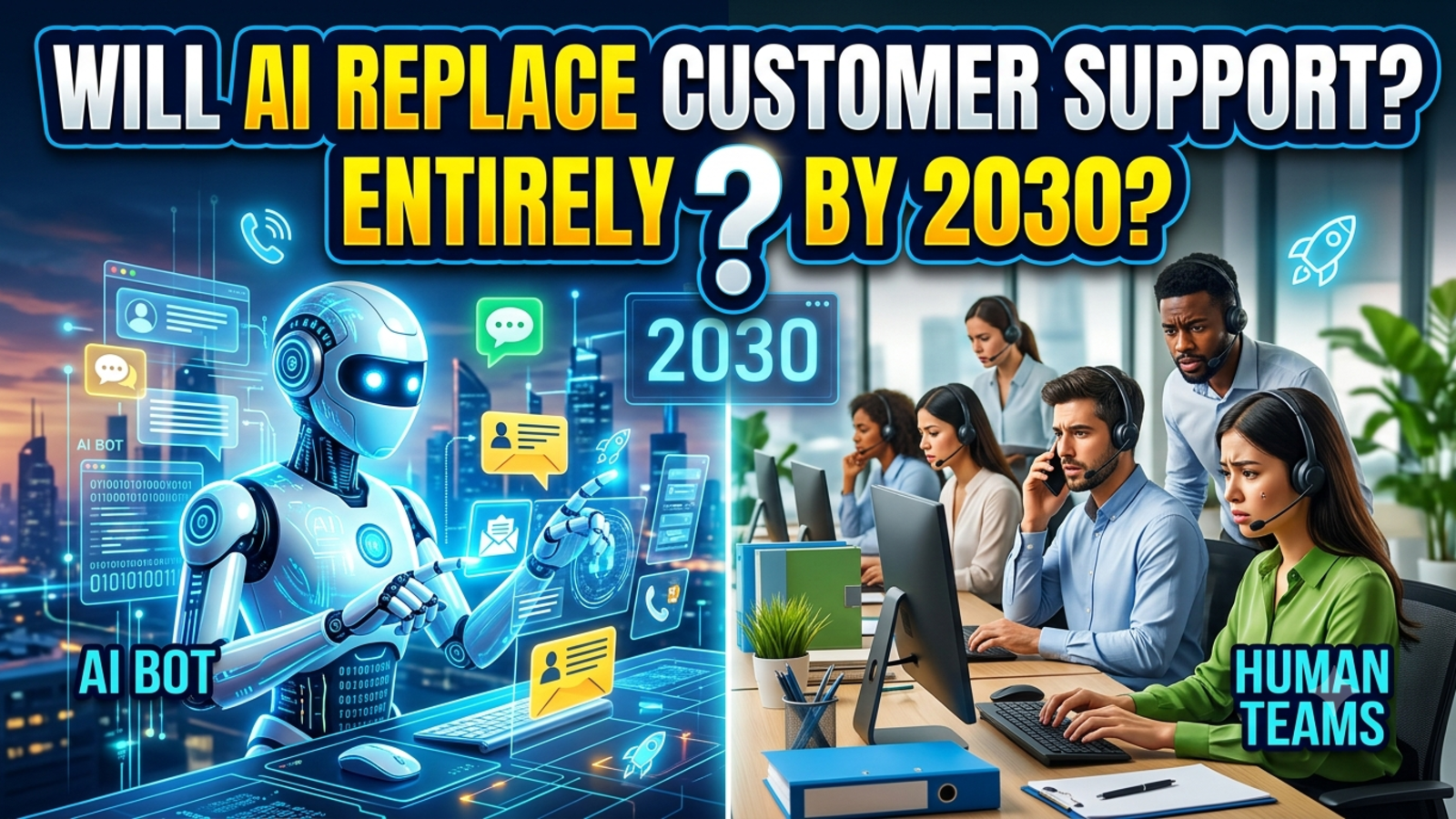
Will AI Replace Customer Support Teams Entirely by 2030?
Everyone is asking the same question. The answer is more complicated — and more interesting — than either side of the debate wants to admit.
The Question Nobody Wants to Answer Honestly
In 2023, a major airline quietly reduced its customer support headcount by 30 percent. They did not announce it. They did not issue a press release about their AI transformation journey. They just hired fewer people than they had the year before, and let the AI handle the difference.
In 2024, a telecommunications company in the UK retrained 200 customer service agents to do other work after their AI deployment handled what had previously required a team of 600.
In 2025, a bank in Singapore reported that their AI handled 74 percent of all customer interactions without any human involvement.
And in 2026, we are still debating whether AI will replace customer support teams.
It already has — partially, selectively, and in ways that do not make headlines because they happen in spreadsheets rather than news cycles. The more useful question for 2030 is not whether AI will replace customer support. It is what will be left after it does, who will be doing it, and whether the humans still in customer-facing roles will be doing better or worse work than the people who came before them.
The honest answer is genuinely complicated. And it is more interesting than the simple version most people are reaching for.
What AI Has Already Taken
Let us be clear about what has already changed, because the 2030 conversation cannot start from a place that pretends 2026 is still in the future.
AI has taken the volume. The sheer number of customer interactions that previously required a human to respond — order status queries, account balance checks, password resets, policy questions, FAQ responses, appointment confirmations — these are largely automated now across every industry that has invested in doing so.
A customer asking where their package is does not need a human. A customer asking what the cancellation policy is does not need a human. A customer asking how to update their billing information does not need a human. These interactions make up somewhere between 60 and 80 percent of the total volume in most customer support operations.
That volume is gone. Not gradually declining. Already gone, in every organisation that has deployed AI seriously.
What remains — the 20 to 40 percent that AI consistently fails to handle as well as a human — is the part worth understanding carefully, because it reveals something important about where the technology is genuinely headed by 2030.
What AI Keeps Getting Wrong
The cases where AI-only customer support fails are not random. They cluster around a specific set of human characteristics that large language models, despite their remarkable capabilities, still struggle to replicate meaningfully.
Emotional recognition with consequential stakes.
A customer whose flight was cancelled on the morning of their daughter's wedding is not interacting with a support system. They are in a crisis. The words they type are technically a service request. What they actually need is acknowledgment, empathy, and a human being who understands that the transaction they are dealing with is wrapped around something that matters deeply.
AI can recognise sentiment signals. It can escalate to a human. But the experience of talking to a machine at the exact moment you need a person is jarring in a way that 2026 AI has not overcome. Customer satisfaction data consistently shows this. For emotionally charged, high-stakes support interactions, human agents outperform AI on every satisfaction metric.
Judgment in genuinely novel situations.
Every company has policies. AI is excellent at communicating and applying those policies consistently. What it handles poorly is the moment when a situation does not fit any policy — when a customer has a legitimate grievance that the rulebook did not anticipate, when the right thing to do is an exception, when the solution requires negotiation rather than lookup.
Human agents make these calls every day. They read between the lines of what a customer is asking. They apply judgment about when a rule should bend. They are accountable for that judgment in a way that creates a meaningful interaction rather than a transaction.
AI in 2026 escalates when it cannot find a policy match. It does not yet exercise judgment. Whether it will by 2030 is the central technical question the industry is divided on.
Relationship continuity over time.
For businesses where customer relationships span years — wealth management, healthcare, high-value B2B, premium hospitality — the value of a customer support interaction is not just the resolution. It is the relationship.
A client who has worked with the same wealth manager for a decade is not interacting with a support system when they call. They are continuing a relationship. The history, the context, the trust accumulated over years of successful interaction — these cannot be replaced by a knowledge base query, however sophisticated.
AI manages this better than it did in 2023. It is not close to human relationship continuity in 2026. Whether it will be by 2030 depends on developments in memory architecture and relationship modelling that are genuinely uncertain.
The Number That Changes Everything
Here is the data point that reshapes this conversation.
In 2019, AI handled approximately 15 percent of customer service interactions without human involvement. In 2023 it was 38 percent. In 2025 it crossed 60 percent. Current projections suggest 2030 at somewhere between 80 and 85 percent.
Eighty to eighty-five percent.
If those projections hold, we are heading toward a world where AI handles the overwhelming majority of customer support volume and a relatively small number of highly specialised human agents handle the remainder.
But here is what that number does not tell you: total customer service interaction volume is growing, not shrinking. As AI makes support more accessible and available — instant responses at any hour, in any language — people are using it more. The total number of support interactions businesses are handling is significantly higher in 2026 than it was in 2019.
Eighty percent of a much larger number is not nothing. The humans still in customer support by 2030 may be handling a similar absolute volume of interactions to 2019, even if they represent a fraction of the overall support operation.
The shape of the work changes. The people doing it change. But the complete elimination of human customer support? The data does not actually support it, even by 2030.
What the Support Agent of 2030 Looks Like
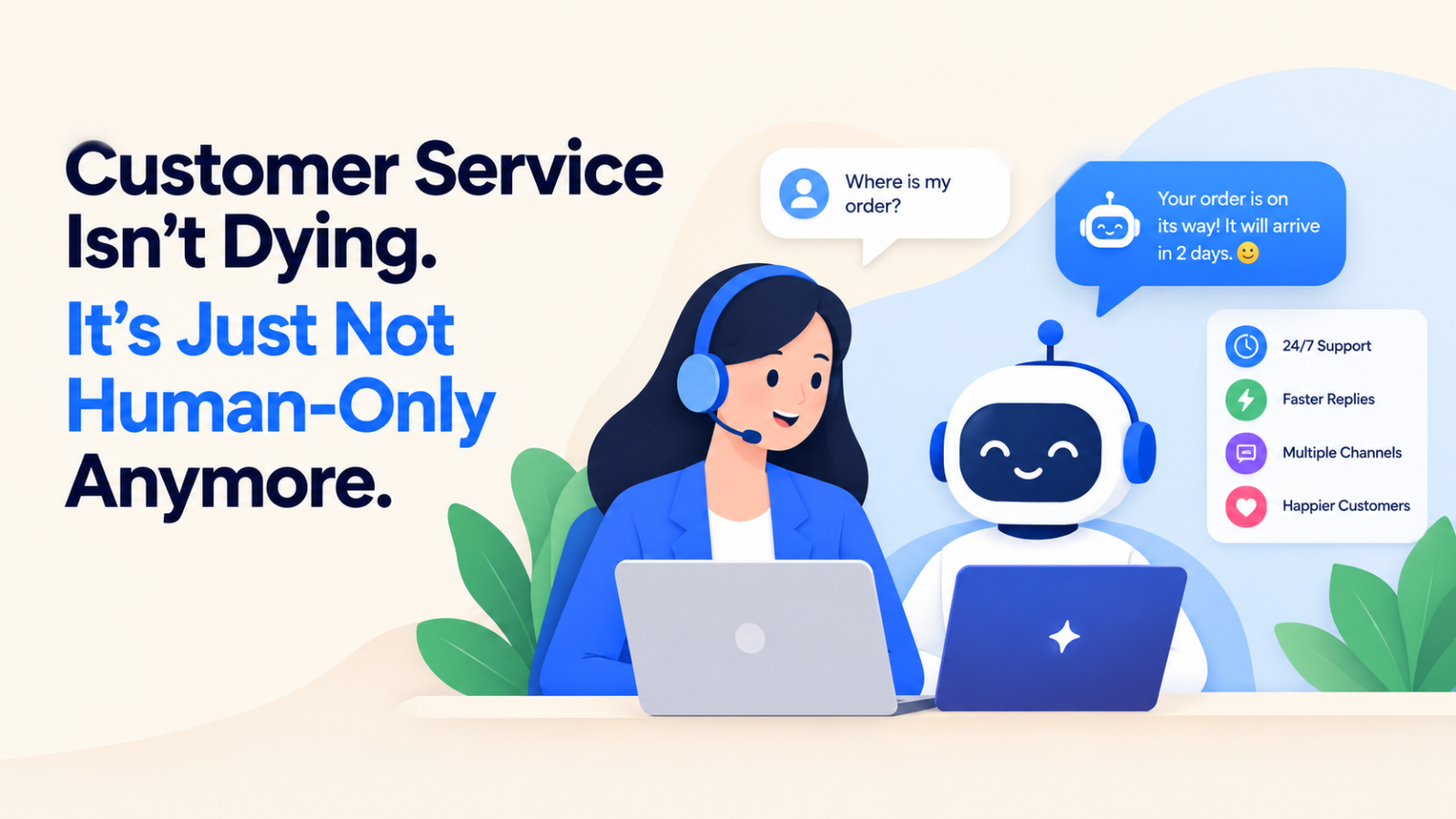
The most useful frame for thinking about 2030 is not replacement. It is redistribution.
The customer support agent of 2030 is not answering the same questions they answered in 2020. Those questions are handled by AI before they ever reach a human queue. The agents of 2030 are handling what AI consistently cannot — and they are doing it with AI as a tool rather than in competition with it.
They are closer to case workers than frontline responders. They handle complex, emotionally charged, genuinely novel situations. They have access to AI that prepares context, suggests resolutions, and summarises interaction history before the human even picks up the conversation. Their time per case is longer. The stakes of each case are higher. The skill required is greater.
Is that a better job than answering repetitive queries all day? For most people who have done both, yes. The repetitive work was not fulfilling for many agents. Being trusted with the cases that genuinely require human judgment, with AI handling the administrative load, is a more meaningful professional role.
The number of those roles will be smaller. That is the uncomfortable truth that has to sit alongside the more optimistic framing.
The Businesses That Will Get This Wrong
There is a version of the AI customer support transition that goes badly. It is already happening in some industries.
A telecommunications company replaces 70 percent of its support team with AI. The AI handles volume well. But the 30 percent of interactions that require human judgment now route to an undersized team with inadequate tools, overwhelmed by complexity and without the institutional knowledge that existed in the larger team. Customer satisfaction falls. Churn increases. The savings from AI deployment are partially offset by customer acquisition costs driven by damaged reputation.
The mistake is treating AI deployment as pure cost reduction rather than as a capability redistribution. The businesses that win this transition are the ones that take the efficiency gains from AI handling volume and reinvest them in training, tooling, and empowering the human agents who handle complexity.
The businesses that treat this as an opportunity to simply cut headcount and pocket the savings will find that the 20 to 40 percent of interactions that AI cannot handle well are also the interactions that most affect customer retention. Failing on those at scale is expensive in ways that do not show up in the support budget.
What This Means for Your Business Right Now
If you run a business with a customer support function — or if you are a customer support professional navigating this shift — the question of what happens by 2030 is not academic. It is operational.
For business owners, the practical answer is straightforward. The interactions that AI handles well should be automated now. Not because 2030 is coming but because the businesses doing this in 2026 are delivering faster, more consistent, more available support than the ones that are not — and customers notice.
An AI chatbot trained on your specific business content — your policies, your FAQ, your product information — handles the volume that currently goes to your team's inbox. Your team handles the complexity that genuinely requires their expertise. The quality of both types of interaction improves.
Tools like Glanceia make this accessible for small and medium businesses without a technology team. Upload your business content. Embed on your website. The AI handles the front line. You handle what matters most.
For customer support professionals, the honest framing is that the skills that will be most valuable by 2030 are the ones AI consistently struggles with — empathy, judgment, relationship management, creative problem-solving in novel situations. The agents who develop those skills are not at risk of replacement. The ones who spend the next four years fighting the automation of tasks that AI genuinely does better are.
The Honest Answer to the Question
Will AI replace customer support teams entirely by 2030?
No. Not entirely.
But it will replace the majority of what most customer support teams currently spend most of their time doing. The volume-based, policy-lookup, FAQ-answering, transactional work that makes up the bulk of most support operations — that will be AI's domain well before 2030 in any organisation that decides it should be.
What remains will be harder work, higher-stakes work, and work that requires human capabilities that AI has not yet meaningfully replicated. Whether there will be more or fewer people doing it depends on factors — total interaction volume, AI capability development, regulatory environment, customer acceptance — that are genuinely uncertain.
The question worth sitting with is not whether this will happen. It is whether your business and the people in it are positioned for the version of 2030 where AI and human support work in combination — each doing what they are best at — rather than the version where the transition was handled badly and both the technology and the people underperformed as a result.
The window to shape which version your organisation ends up in is right now.
The Last Thing Worth Saying
There is a version of this story that gets told as a tragedy. Jobs disappear, human connection is lost, customer experience degrades as machines replace people who cared.
That version is possible. It is not inevitable.
There is another version where AI takes the work that was never human in any meaningful sense — the repetitive lookup, the scripted response, the queue management — and returns time and energy to the humans who handle the moments where human presence genuinely matters.
That version is also possible. It requires deliberate choices by the businesses making these transitions.
The technology does not make those choices. The businesses do.
Published by Suraj - Team Glanceia