Generic Chatbots vs. Company-Trained AI: Why "One-Size-Fits-All" Fails Travel Businesses
Not all AI chatbots are the same. Here's why generic, off-the-shelf bots fail travel businesses — and what actually makes a company-trained AI different.
If you've ever tested a chatbot on your own website and cringed at the answer it gave, you've already met the problem this article is about.
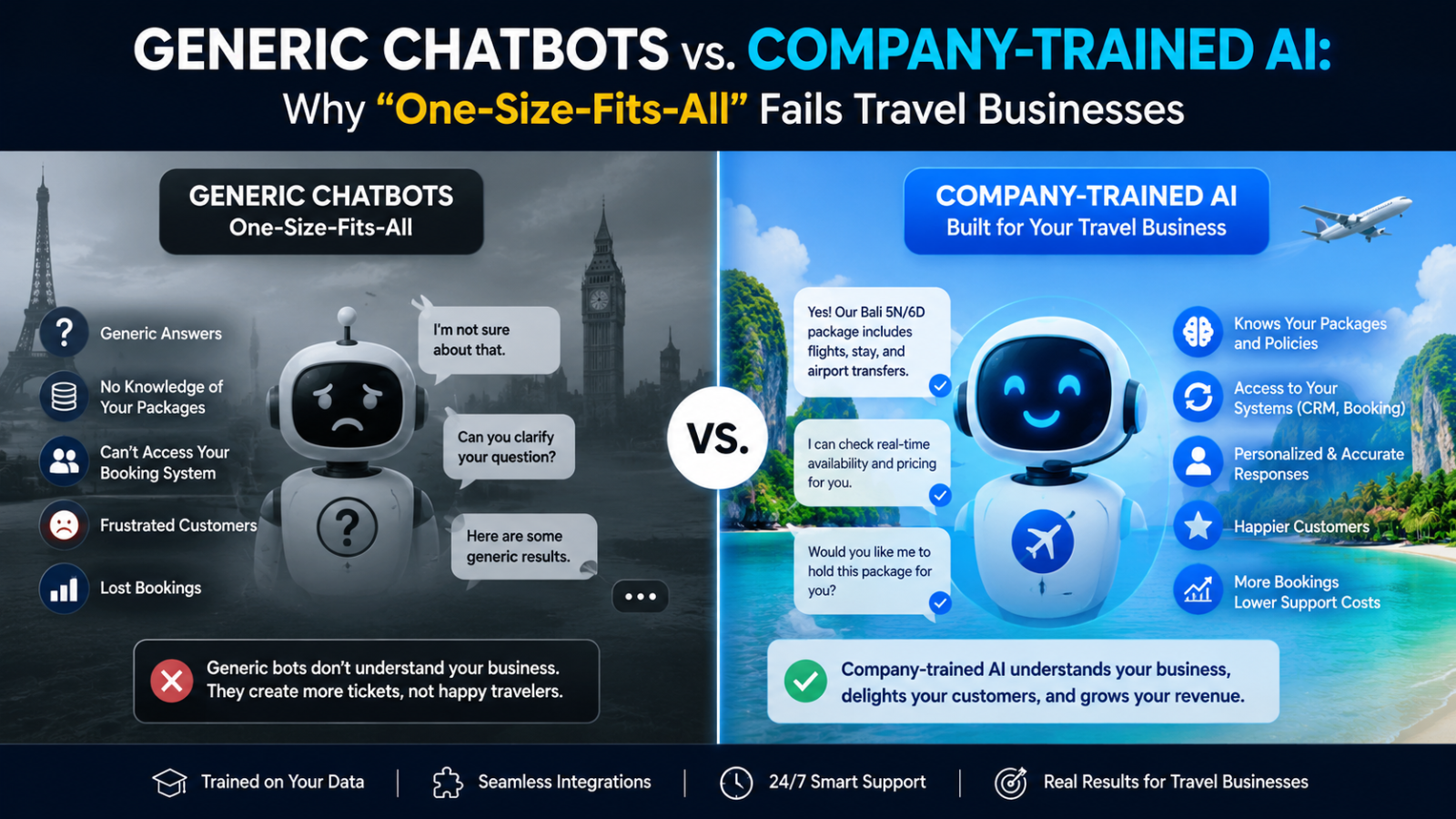
Someone asks "do you have any packages to Bali in December," and the bot replies with something vague like "Bali is a popular destination! I recommend checking with our team for current availability." Technically not wrong. Also completely useless — and worse, it makes your business look like it doesn't actually know its own inventory.
This is the core difference between two very different categories of tools that both get called "AI chatbots": generic, off-the-shelf bots, and AI trained specifically on your business. They look similar on the surface. In practice, they're not close.
What "Generic" Actually Means
A generic chatbot is built to work across thousands of businesses with minimal setup. It's usually powered by a general AI model with little or no specific knowledge of your packages, prices, or policies — sometimes just a scraped version of your website, sometimes nothing at all beyond generic travel knowledge.
That's exactly why it gives vague answers. It genuinely doesn't know your actual availability for December, what's included in your Bali package, or your cancellation policy. So it either makes something up, redirects the customer to "contact our team," or gives a technically-true-but-useless generic answer. All three of those outcomes defeat the purpose of having a chatbot in the first place — the customer still doesn't get an answer, they just got it slower and with extra steps.
What "Company-Trained" Actually Means
A company-trained AI assistant is fed your real data — your packages, current pricing, availability, inclusions, cancellation policy, FAQs, and brand voice. When a customer asks about December availability for Bali, it answers from your actual inventory, not a guess. When they ask what's included, it lists your real package details, not a generic travel description.
The practical difference shows up immediately in conversation quality. A generic bot handles maybe the simplest 20% of questions well — "what are your hours," "how do I contact you" — and falls apart on anything specific. A company-trained AI can handle the questions that actually matter to a customer deciding whether to book: pricing, availability, what's included, and how it compares to what they're looking for.
Why This Gap Matters More in Travel Than in Other Industries
Some businesses can get away with a generic chatbot — simple products, simple questions, low stakes if the bot gets something wrong. Travel isn't one of them, for a few reasons:
Customers ask specific, detail-heavy questions
"Is this available for these exact dates," "does this include airport transfers," "what's your policy if I need to cancel" — these aren't questions a generic bot can answer well, because the answer depends entirely on your specific business, not travel in general.
Wrong answers are costly, not just annoying
If a generic chatbot gives a customer inaccurate information about pricing or availability, that's not a minor inconvenience — it can lead to a booking dispute, a frustrated customer, or a canceled trip. In travel, the cost of a wrong answer is higher than in most industries.
Trust is everything in a high-consideration purchase
Booking a trip is a bigger, more emotional decision than most online purchases. A vague or generic-sounding chatbot response subtly signals "this business doesn't really know what it's doing," right at the moment you're trying to build trust with a potential customer. That's the opposite of what you want a support tool to do.
Your packages are genuinely unique
Two travel agencies can both offer "Bali packages" that are completely different in what's included, pricing, and quality. A generic AI model has no way to know your specific version of that package — only training on your actual data solves this.
How to Tell Which One You're Looking At
If you're evaluating chatbot tools, a few quick tests reveal which category you're dealing with:
Ask it about a specific package you offer. Does it answer with real details, or something generic and vague?
Ask about a policy that's unique to your business (cancellation terms, deposit requirements). A generic bot will either guess or redirect you to "contact us." A trained one should answer directly.
Ask how quickly you can update it when your pricing or packages change. If updating means submitting a support ticket and waiting days, it's not built around your business — it's a shared, generic system with limited customization.
Check if it captures leads with context, not just answers questions. A company-trained assistant should be collecting name, email, and what the customer is interested in — not just responding and letting them leave.
The Real Cost of Getting This Wrong
It's tempting to think "any chatbot is better than none" — some coverage is better than nothing, right? Not always. A generic chatbot that gives vague or wrong answers can actively hurt more than it helps:
Customers get frustrated giving up on a bot that clearly doesn't know their business, and may not bother trying your actual team afterward.
Inaccurate answers about pricing or availability create real problems if a customer books based on wrong information.
A generic-feeling bot signals a generic, low-effort brand — exactly the wrong impression for a business selling personalized travel experiences.
In other words, the wrong kind of chatbot isn't neutral. It's often worse than having a simple contact form, because it creates the appearance of an answer without the substance of one.
What This Looks Like Done Right
Tools like Glanceia are built around this exact distinction — trained specifically on your travel packages, pricing, and policies rather than generic travel knowledge, so the answers a customer gets are actually accurate to your business. It's the difference between a bot that sounds like it's reading from a script and one that sounds like it actually works there — which, functionally, it does.
Bottom Line
"AI chatbot" has become a broad enough label that it covers two genuinely different things: tools that sound helpful but don't actually know your business, and tools that are trained specifically to represent it accurately. For most industries, that gap is a minor quality difference. For travel — where questions are specific, decisions are high-stakes, and trust matters — it's the difference between a tool that converts customers and one that quietly pushes them away.
If you're going to have an AI assistant on your website at all, it's worth making sure it actually knows your business before it starts talking to your customers on your behalf.
Want to see what a company-trained AI assistant sounds like on your own packages and pricing? Try Glanceia free — set it up in under 10 minutes, no credit card required.