Customer Service Isn't Dying. It's Just Not Human-Only Anymore.
Every few years, someone declares customer service dead. It's not dying — it's splitting into two jobs, and most businesses haven't noticed yet.
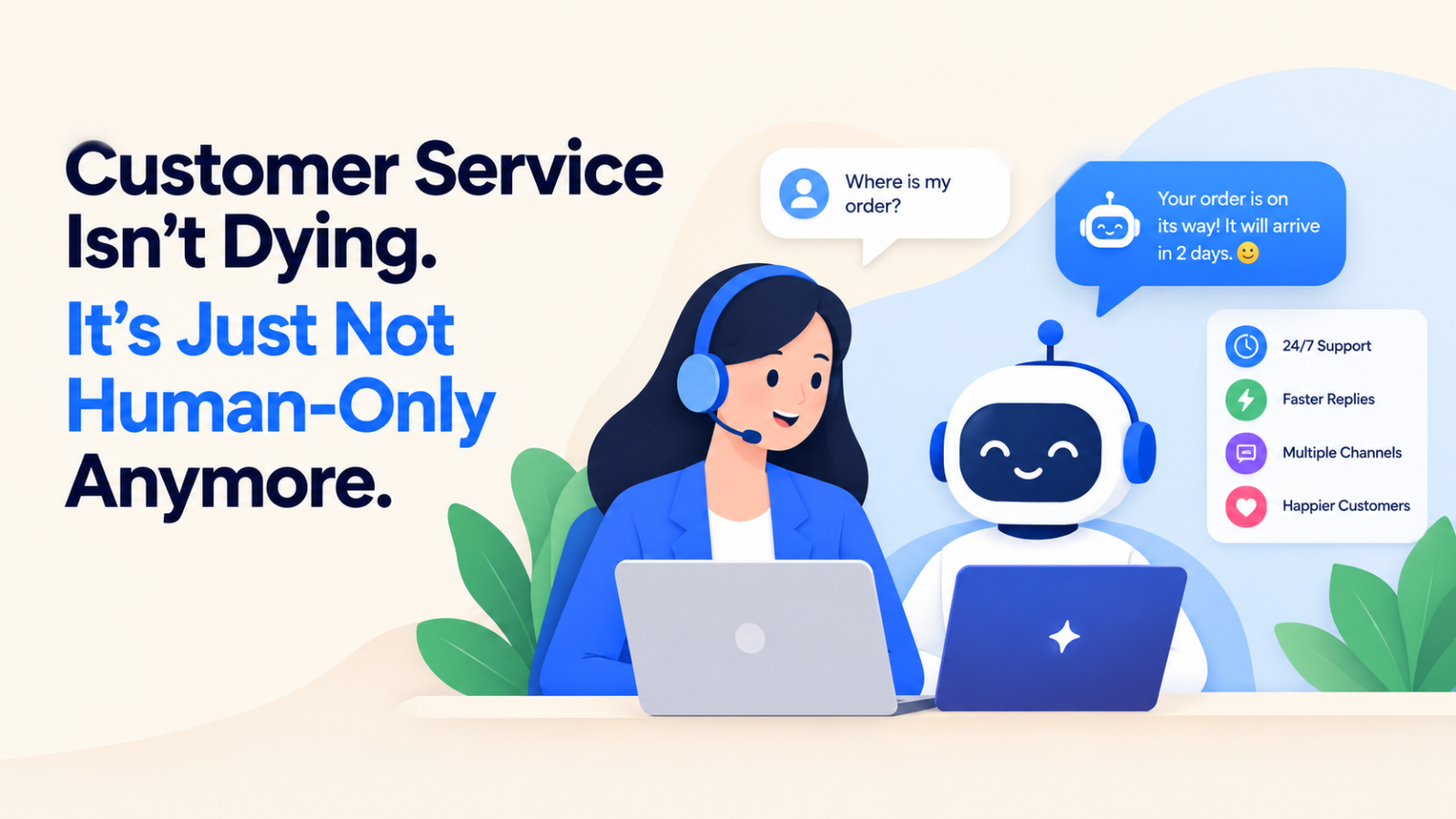
Every few years, someone declares customer service dead — replaced by bots, automated into meaninglessness, stripped of whatever made it human in the first place. It happened with the rise of FAQ pages, again with early chatbots, and it's happening again now with AI. None of those predictions were actually true. What's really happening is quieter and more useful: customer service isn't disappearing, it's splitting into two distinct jobs that used to be forced into one.
The Job That Was Always Two Jobs Pretending to Be One
For years, "customer service" meant one person, or one small team, handling everything — the simple, repetitive questions and the genuinely hard, judgment-heavy conversations, back to back, all day, with no real distinction between them. Answering "what are your hours" took the same queue slot as talking someone through a genuine problem. Both counted as "a ticket." Both took a human's time and attention.
That was never actually one job. It was two very different kinds of work, mashed together because there wasn't a good way to separate them. One is informational — repeatable, factual, the same answer every time. The other is relational — it needs judgment, empathy, and the ability to handle something that doesn't fit a script. Forcing both through the same human pipeline was always inefficient. It just wasn't obvious until there was an alternative.
What's Actually Changing
The informational half of the job — the repeatable questions, the same five things every customer asks — is the part shifting to AI. Not because it's "lesser" work, but because it genuinely doesn't need a human brain behind it, and a well-trained chatbot can answer it instantly, at any hour, without ever getting tired of the four-hundredth "is this available" question of the month.
The relational half — the complicated request, the upset customer, the conversation that needs real judgment — isn't going anywhere. If anything, it's getting more attention than it used to, because the people handling it aren't stretched thin answering everything else at the same time.
This is the actual shift: not "AI instead of humans," but AI absorbing the half of the job that was never really suited to a person in the first place, so the human half finally gets treated like what it is.
Why "Not Human-Only" Isn't a Downgrade
There's an assumption baked into most "customer service is dying" takes: that any AI involvement makes the experience worse, colder, less caring. That assumption made sense when the AI involved was a rigid script that couldn't actually answer anything outside its narrow list of anticipated questions. It makes a lot less sense now.
A chatbot trained on a business's real FAQs, pricing, and policies — like Glanceia — doesn't replace the caring part of customer service. It removes the part that was never really about caring in the first place: repeating the same factual answer for the four-hundredth time. What's left for the human side is exactly the part where genuine care matters — the frustrated customer, the complicated situation, the moment someone actually needs to feel heard, not just informed.
If anything, businesses doing this well end up with more human attention on the conversations that need it, not less — because their team isn't burning hours on the repetitive layer anymore.
What This Looks Like for an Actual Business
A visitor asks a factual question — is this in stock, what's the return policy, is this available in December — and gets an instant, accurate answer from a chatbot trained on the business's real data. No wait, no queue, no human needed. A different visitor has a genuinely complicated situation — a custom order, a real complaint, a question that doesn't fit any FAQ — and that gets routed to an actual person, with full attention, because the team isn't also buried in the repetitive stuff at the same time.
Neither interaction feels like "customer service is dying." Both feel, if anything, more responsive than the old all-human system ever managed to be.
The Businesses Getting This Wrong
Some businesses are approaching this backwards — trying to automate the relational half (the complicated, judgment-heavy conversations) while leaving humans to handle simple repetitive questions manually. That's the exact inversion of what actually works, and it's usually where the "AI killed customer service" complaints come from. The fix isn't reversing which parts get automated — it's recognizing that these were always two different jobs, and matching each one to whoever — human or AI — is actually suited to it.
What This Means Going Forward
Customer service isn't heading toward "no humans." It's heading toward humans spending their time on the conversations that actually need a human, while the repetitive, factual layer gets handled instantly by something that never gets tired of answering it. That's not customer service dying. It's customer service finally being split into the two jobs it always secretly was.
Getting This Right for Your Own Business
Look at your support volume and separate it honestly: what's repetitive and factual, versus what genuinely needs judgment.
Gather the documents that answer the repetitive half — FAQs, pricing, policies.
Upload them to a chatbot trained on that content, like Glanceia.
Let your team's time go entirely toward the conversations that actually need them.
Watch what's still landing with your team — that's the real, smaller, more meaningful version of "customer service" you're left with.
Most businesses using Glanceia are live within minutes, with a free plan to start.
The Bottom Line
Customer service isn't dying — it's being sorted, finally, into the two jobs it always was: the repeatable questions that never needed a human, and the real conversations that always did. Businesses getting this right aren't cutting the human element out. They're putting it exactly where it actually matters.
If your team is still buried in repetitive questions that don't need a human, Glanceia sets up an AI chatbot trained on your own data in minutes — free to start. Get in touch if you want help figuring out where to begin.