The 30-Second Rule: Why Response Time Matters More Than Response Quality
A perfect answer that arrives an hour late loses to a decent answer that arrives instantly. Here's the uncomfortable truth about how customers actually decide. U
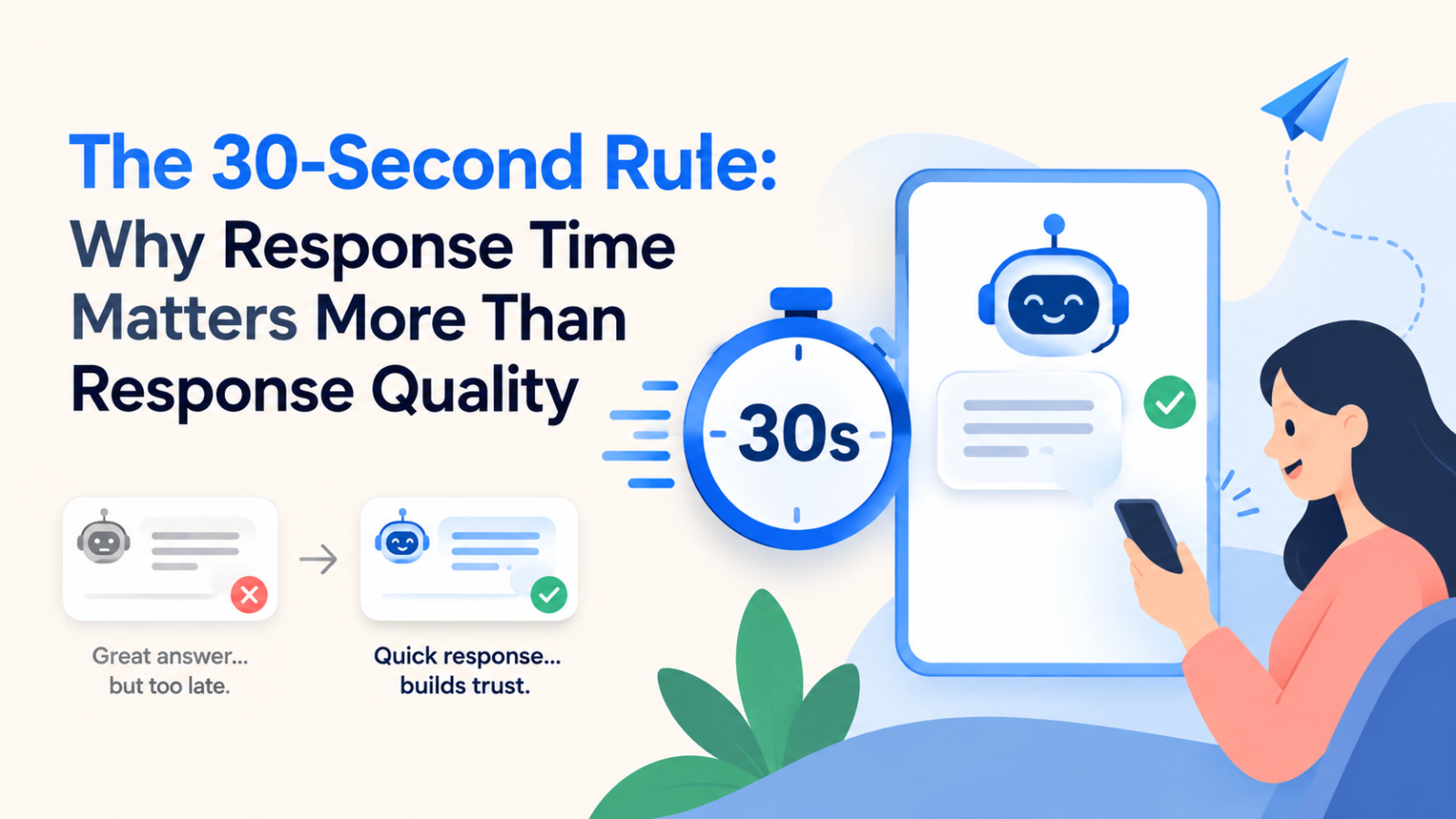
Here's an uncomfortable thing to sit with: the effort you put into crafting the perfect customer response probably matters less than how fast you sent it. Not "doesn't matter at all" — but less than most businesses assume. A decent answer that arrives in thirty seconds beats a great answer that arrives in three hours, almost every time, because by the time the great answer shows up, the customer's already moved on.
Call it the 30-second rule: if you can't answer a question within about thirty seconds of it being asked, you're not really competing on quality anymore. You're competing on whether the customer is still there to read what you eventually send.
Why Speed Beats Quality More Often Than You'd Think
It feels backwards. Businesses spend real effort training staff to give thoughtful, accurate, well-written responses — and that effort matters, right up until the moment the customer has already left. A visitor asking "is this in stock" or "do you deliver to my area" isn't looking for a beautifully composed answer. They're looking for a fast one, because they're usually comparing you against two or three other options at the same time, in the same browser tab, in the same five minutes.
Response quality is a real differentiator — once someone's actually still in the conversation. Response speed decides whether they're still in the conversation at all. Get the second one wrong, and the first one never gets a chance to matter.
What Actually Happens in Those 30 Seconds
Think about what a customer is doing while they wait for a reply. They're not sitting patiently, refreshing the page. They're doing exactly what you'd do — opening a second tab, checking a competitor, moving on to the next thing on their list. The moment they leave that tab, your eventual reply — however good it is — is competing against whatever answered them first.
This isn't a knock on customer patience. It's just how people behave online now. Attention is thin, options are one click away, and "I'll wait for a good answer" has quietly become "I'll take whichever answer shows up first."
Why Most Businesses Get This Backwards
Most support setups are optimized for quality, not speed, because quality is what gets checked and reviewed — a manager reads a reply and judges whether it was well-written, accurate, on-brand. Speed is harder to notice unless you're specifically measuring it, so it quietly slides, even at businesses that genuinely care about customer experience.
The result is a lot of businesses training their team to write great responses, without ever measuring how long a customer actually waits to see one. It's not negligence — it's just that quality is visible and speed isn't, until you go looking for it.
What Actually Fixes This
The honest fix isn't "type faster." A human being, no matter how good, can't be watching a chat window every second the business is open — let alone the hours it's closed. The realistic fix is having something that can answer instantly, for the questions that don't need a person's judgment, so the thirty-second window gets covered without anyone needing to be glued to a screen all day.
An AI chatbot trained on a business's actual FAQs, pricing, and policies can do exactly that — answer within seconds, at any hour, for the repetitive questions that make up most of what a support inbox actually handles. A tool like Glanceia is built for this specifically: the chatbot answers instantly from a business's real content, so the "is this available" question gets a real, accurate answer in seconds, not whenever someone on the team happens to be free.
That doesn't remove the human from the equation — it just makes sure the thirty-second window doesn't depend entirely on someone being available at the exact right moment. The complicated conversations still go to a person. The instant ones stop needing to wait for one.
What Changes When You Actually Close the Gap
Visitors stop leaving before you even see their question. The moment they ask, they get an answer — no gap for them to fill by checking somewhere else.
After-hours questions stop disappearing entirely. The thirty-second window exists at 2 PM and at 2 AM alike, without needing a night shift.
Leads get captured even when a question doesn't lead to an immediate sale. Someone who gets an instant answer is far more likely to stick around long enough to leave their contact info than someone who gets silence.
Your team's "quality" effort finally counts. Once speed is covered, the thoughtful, well-written responses your team is good at actually land — with customers who are still there to read them.
A Simple Way to Check Where You Stand
Try this: message your own business's website or chat widget with a real question, the way a customer would, and time how long it takes to get an actual answer. If it's more than thirty seconds, that's the real number to think about — not how good your best possible response is, but how long it usually takes to send any response at all.
Getting This Right Without Overhauling Everything
Identify the questions that come up most and don't need real judgment — availability, pricing, hours, policies.
Upload the documents that answer them to a chatbot trained on your own content, like Glanceia.
Let it handle the instant layer while your team focuses on the conversations that genuinely need a person.
Check response times before and after — the difference is usually immediate and obvious.
Most businesses using Glanceia are live within minutes, with a free plan to start.
The Bottom Line
Customers don't wait around for the best possible answer — they go with whichever answer shows up first. Thirty seconds isn't an arbitrary number; it's roughly the window before someone's attention moves somewhere else. Closing that gap matters more than most businesses realize, and it's usually a lot more fixable than it feels.
If your response time is longer than thirty seconds right now, Glanceia sets up an AI chatbot that answers instantly, trained on your own data — free to start. Get in touch if you want help closing the gap.