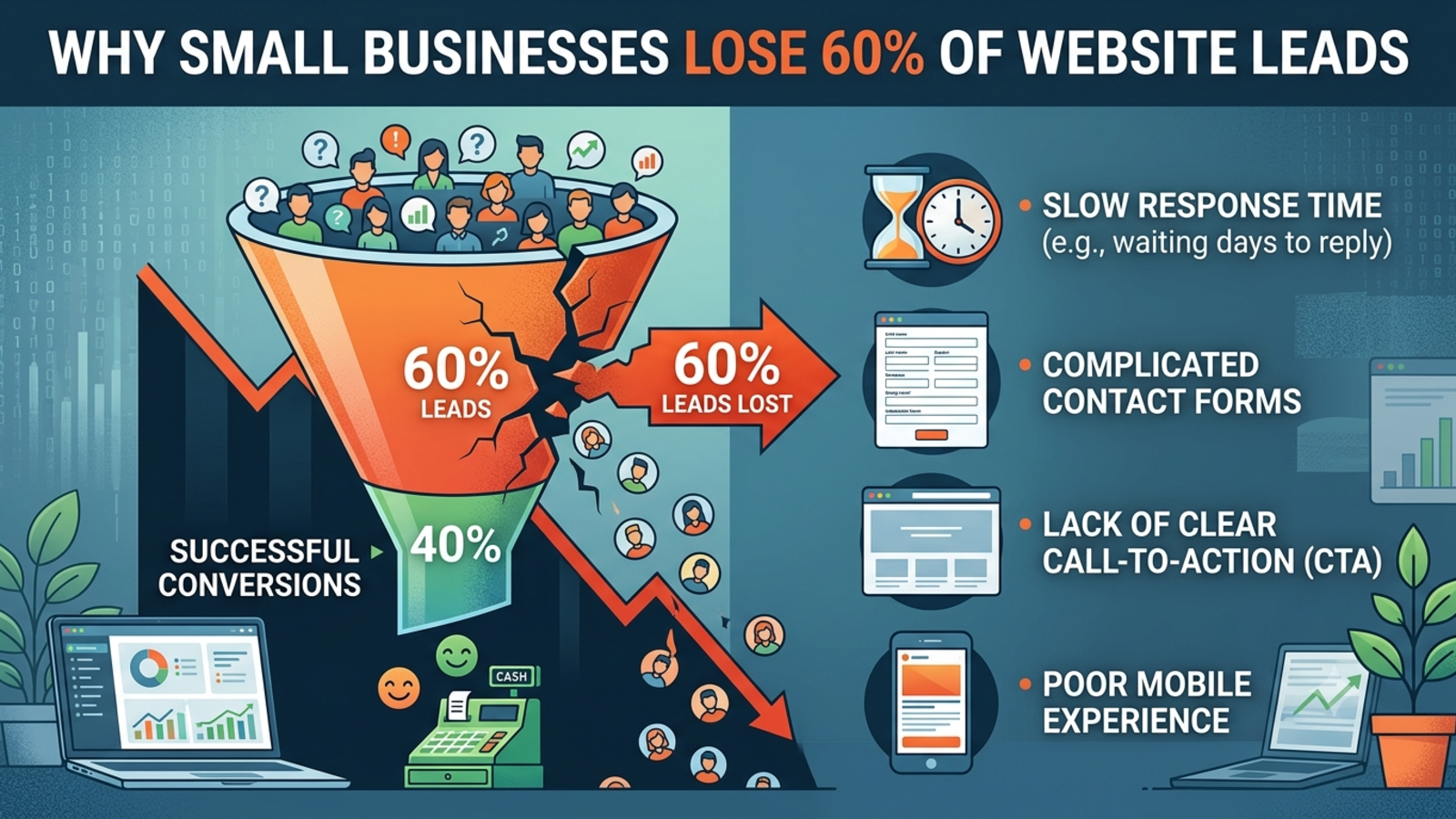
Why Small Businesses Lose 60% of Website Leads
Most small businesses are invisibly bleeding leads from their websites every single day. Here is exactly why it happens — and the surprisingly simple fix that changes everything.
The Invisible Revenue Leak Nobody Talks About
Here is something most small business owners do not know about their own website.
Right now, while you are reading this, visitors are arriving on your site. Some of them are genuinely interested. Some of them are ready to buy. Some of them have already decided they want what you sell — they just need one last piece of information to commit.
And then they leave.
Not because your product is wrong. Not because your price is too high. Not because they found a better option somewhere else.
They leave because nobody answered their question.
Research consistently shows that the average small business website converts between 2 and 5 percent of visitors into enquiries. That means for every 100 people who find your business online, 95 to 98 of them disappear without ever making contact.
That is not a traffic problem. That is a conversion problem. And the cause is almost always the same thing — a gap between the moment a visitor becomes interested and the moment they get the answer they need.
The 9 PM Problem
Picture this scenario.
A potential customer is sitting on their sofa at 9 PM. They have been thinking about getting new flooring installed. They google a local flooring company, land on a website that looks professional, browse the gallery, and start getting excited.
Then they have a question. Does the company work with underfloor heating? What is the lead time for the Brazilian walnut they like? Is there a minimum square footage?
They look for a way to ask. There is a contact form. They fill it in, hit send, and wait.
The next morning, your team arrives at 9 AM, sees the enquiry, and sends a reply.
By then it is too late. That potential customer has already received a callback from the company they messaged on WhatsApp at 9:15 PM last night. They are booked in for a quote next Tuesday.
You never even knew they were there.
This is the 9 PM problem. And it happens on almost every small business website, every single evening, every single weekend, every single bank holiday. The visitors arrive when your business is closed and leave when they do not get an answer.
Why the Gap Is Wider Than You Think
The instinct most business owners have when they hear this is to say: "But we respond to enquiries quickly." And maybe they do — during business hours.
The problem is that business hours and customer decision-making hours are increasingly misaligned.
Most research on online purchase behaviour shows the same pattern. Consumer browsing peaks between 8 PM and midnight. Weekend traffic consistently outperforms weekday traffic for most service businesses. School holidays, bank holidays, and evenings after major marketing pushes are when the highest-intent visitors arrive — and when most business websites are effectively unmanned.
A contact form submission that comes in at 9:30 PM on a Friday gets a reply at 9 AM on Monday. That is a 35-hour response gap. In most markets, that is long enough for a motivated buyer to have already committed elsewhere.
And that is assuming they even filled in the contact form.
Here is the part most analytics dashboards do not show you: the visitors who did not even enquire. They had a question, could not find a fast answer, and left before ever reaching your contact page. Their visit appears in your traffic data. Their almost-enquiry does not.
The Five Reasons Small Businesses Lose Leads Before They Even Land
Understanding the specific failure points is the first step to fixing them.
1. The Unanswered Pricing Question
Pricing questions are the most common reason visitors leave without converting. Not because they cannot afford your service — but because they could not find enough information to feel confident about what they would be paying for.
"Pricing available on request" is not a conversion strategy. It is an invitation to go elsewhere.
Most visitors who hit a pricing wall do not fill in a contact form asking for a quote. They close the tab and move to a competitor whose pricing is either displayed or instantly available when asked.
2. The Single-Channel Contact Problem
If the only way to contact your business is a form or an email address, you are building a conversion funnel with one exit ramp.
Different customers prefer different communication methods. Some want to fill in a form. Some want to call. Some want to message on WhatsApp. Some want to ask a quick question in a chat widget and get an immediate answer. When your website only offers one option — particularly a slow one — you are losing every visitor who prefers any other channel.
3. The After-Hours Cliff
When your team goes home, your website goes dark.
Visitors who arrive after 5 PM find the same information as visitors who arrive at 2 PM — but with one crucial difference. At 2 PM, a form submission might get a response by end of day. At 6 PM, it sits in an inbox until tomorrow morning.
Most small businesses underestimate how much of their potential lead volume arrives after hours. When businesses first install proper tracking on their contact attempts — including chatbot interactions and attempted form submissions — they routinely discover that 35 to 45 percent of all contact attempts happen outside their operational hours.
Those leads were not being dropped. They were never being counted.
4. The Friction Tax
Every step between "interested" and "enquired" has a cost. A contact form with eight fields. A phone number that goes to voicemail. A "request a callback" system that promises a response in two business days. Each one taxes the visitor's motivation.
High-intent visitors — the ones who want to buy today — are the most sensitive to friction. They are also the most valuable. When they hit a barrier between their question and an answer, they do not wait. They try the next result.
5. The Trust Deficit
A visitor who arrives on your website through a Google search knows nothing about you beyond what your site communicates in the first 30 seconds.
A business that appears credible, responsive, and available builds trust faster than one that looks professional but feels inaccessible. A chat widget that opens instantly and answers a specific question about your service is a stronger trust signal than a beautifully designed page that never acknowledges the visitor is there.
First impressions of accessibility matter more to conversion than almost any other design element.
What the Businesses That Do Not Lose Leads Are Doing Differently
The businesses that consistently convert website visitors at 12 to 18 percent — two to three times the average — share a specific set of practices. None of them require large budgets or complicated technology.
They answer questions at the moment they are asked — not when it is convenient.
Every high-converting website in 2026 has a mechanism for instant response. Not a promise to respond within one business day. Not a form that disappears into a queue. An actual immediate answer to the question a visitor is asking right now, at the moment they are asking it.
For most small businesses, this means an AI chatbot trained on the business's specific content — pricing, services, policies, process — that gives accurate, conversational answers at any hour.
They make contact feel effortless, not like a commitment.
The businesses that convert well have reduced the friction between "I have a question" and "I got an answer" to the absolute minimum. A visitor should be able to ask a question and receive a useful response in under ten seconds — without filling in a form, without calling a number, without booking an appointment just to find out whether your service is even relevant to them.
They capture the lead even when the visitor is not ready to buy yet.
A visitor who is not ready to enquire today might be ready next week. High-converting businesses capture email addresses and qualifying information throughout the visit — not just from visitors who reach the contact page. They follow up with those contacts over time rather than treating a non-enquiry as a lost cause.
The Fix Is Simpler Than Most Business Owners Expect
Here is the practical reality: the conversion gap that causes small businesses to lose the majority of their potential leads is almost entirely a response speed and availability problem.
Most of the visitors who arrive on your website and leave without contacting you were not disqualified by price, by portfolio, or by service scope. They were lost to the time gap between their question and an answer.
The fix is not a website redesign. It is not a new marketing strategy. It is not a bigger advertising budget.
It is giving every visitor an instant way to get answers — at any hour, on any page, regardless of whether anyone from your team is available.
An AI chatbot trained on your business content does exactly this. It reads your FAQ documents, your service descriptions, your pricing guide, your policies — and when a visitor has a question at 9 PM on a Sunday, it answers from your actual information. Specifically. Accurately. Immediately.
The difference this makes to conversion rates is not incremental. Businesses that close the after-hours response gap typically see website enquiry rates double within the first 30 to 60 days — not from more traffic, but from converting more of the traffic they already have.
What This Looks Like in Practice
A small travel agency was generating around 150 website visitors per month through organic search and Instagram. Their contact form received an average of 9 to 11 submissions per month — a conversion rate just under 7 percent. Not terrible, but the owner had a nagging sense that a lot of interest was falling through the cracks.
After adding an AI chatbot trained on their package brochures, visa information, and FAQ document, the same traffic — 150 visitors per month — generated 22 to 27 chatbot conversations per month, of which 18 to 20 resulted in a lead captured with name, phone, and destination preference.
Same website. Same traffic. Same business. Enquiry rate went from under 7 percent to over 13 percent in the first six weeks.
The visitors were always there. The interest was always there. What was missing was something to answer their questions when they had them.
The One Change That Makes the Biggest Difference
If there is a single action point from this article, it is this:
Find out how many of your website visitors are arriving after your team's working hours. Check your analytics — filter traffic by time of day and by day of week. Look at when the contact form submissions come in versus when the traffic peaks.
For most small businesses, that comparison reveals a significant gap. The peak traffic window and the peak response window do not overlap.
That gap is your 60 percent.
Closing it does not require a major investment. Glanceia offers a free plan with AI included — upload your FAQ and business content, embed one script on your website, and your business has an instant response capability at every hour without additional staffing.
The visitors are already coming. They just need somewhere to go when they arrive.
Final Thought
The most expensive thing most small businesses do is drive traffic to a website that cannot capture it.
SEO, social media, paid ads, referrals — all of that effort and budget delivers visitors to a page. What happens next is determined by whether that page gives them a reason to stay, a question answered, and a path forward.
Most pages do not. That is why 60 percent of the leads leave.
Fixing that is not complicated. It is just the most important thing on your website to-do list.
Published by Suraj - Team Glanceia