Small Businesses Are Quietly Replacing Live Chat With Something Smarter
Live chat used to be the gold standard for websites. Now it's quietly being replaced — not with less support, but with something that actually works better.
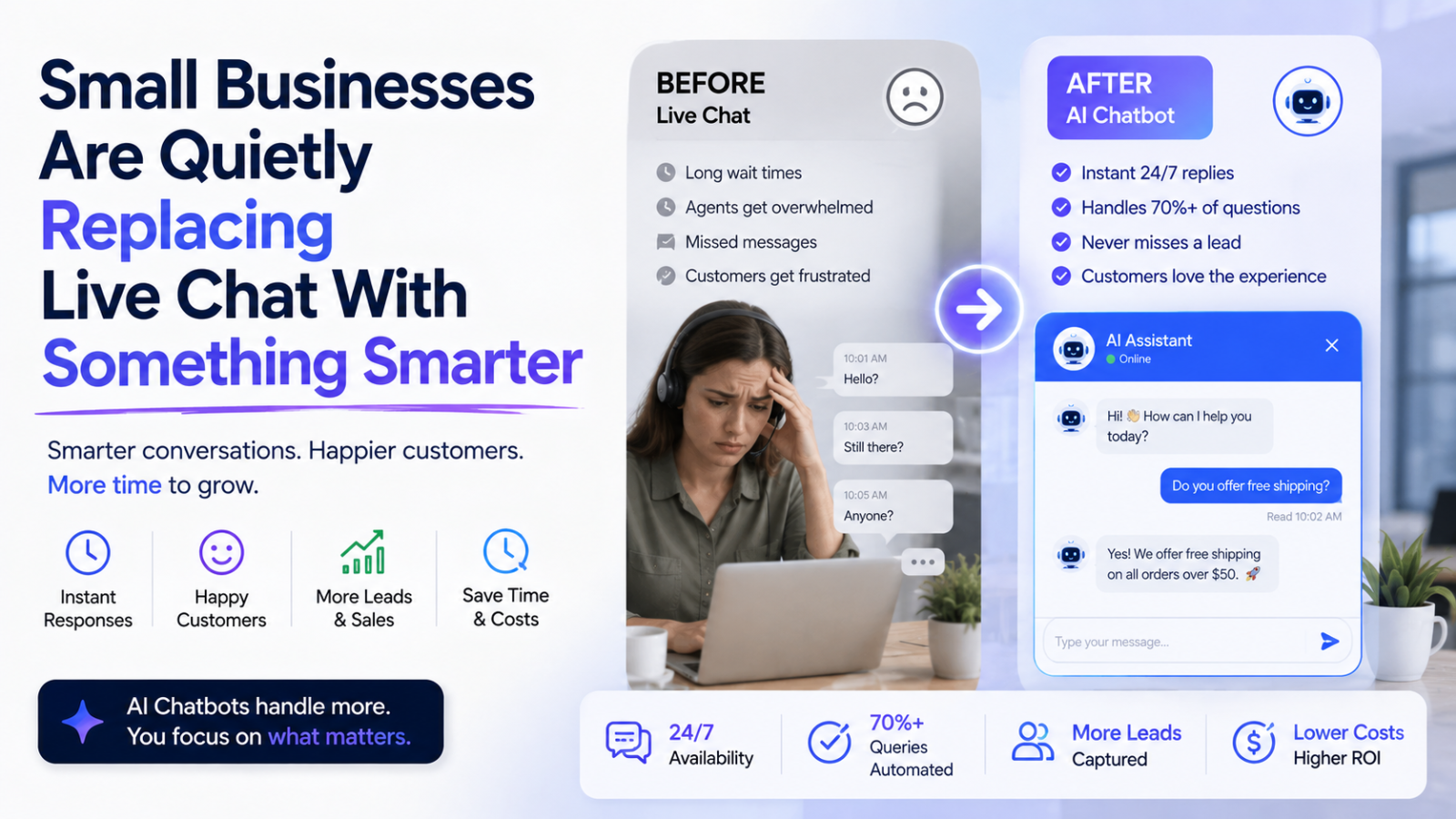
For years, "live chat" was the answer. Every guide on improving website conversions said the same thing: add a chat widget, be there for your customers, respond in real time. Businesses installed it, put "we're online!" in the corner of the screen, and hoped someone on the team was free enough to actually answer.
Except most of the time, nobody was. The little green dot said "online," but the reply came four hours later, if it came at all. Visitors learned to ignore it. Teams learned to dread it — one more inbox to babysit on top of everything else.
Quietly, a lot of small businesses have started replacing that whole setup. Not with less support — with something that actually answers.
The Problem Live Chat Never Really Solved
Live chat promised real-time help. What it actually delivered, for most small teams, was a real-time expectation with no real-time staffing to back it up.
Think about what live chat actually requires: someone watching the chat window, all day, every day the site is live — which, for a website, is always. A two-person team can't do that and also run the business. So the chat widget either goes unanswered, or it becomes one more distraction pulling someone away from actual work every time it pings.
And the moment the business closes for the night, live chat closes with it. The visitor asking a question at 11 PM gets the same silence they'd get from an unstaffed help desk — the widget's just prettier.
None of this is a knock on the businesses that tried it. Live chat was the best available option for a long time. It just was never built to actually be "live" for a small team without dedicating a person to it full-time.
What's Replacing It
The shift happening now isn't away from chat — it's toward a chat that actually works without needing someone glued to it. An AI chatbot trained on a business's own content — its FAQs, pricing, policies, product details — can answer the questions that used to require a human standing by, instantly, at any hour, without anyone monitoring a window.
The difference from the chatbots of a few years ago is trust. Older bots either followed a rigid script ("press 1 for sales") or gave vague, sometimes wrong answers that made customers more frustrated, not less. What's changed is that a chatbot can now be trained specifically on a business's real information, so when someone asks something specific — "is this in stock," "what's your return policy," "do you ship to Canada" — the answer is actually accurate, pulled from what the business itself provided.
That's the model behind tools like Glanceia: upload what you already have, and the chatbot answers only from that — no generic scripts, no guessing, no separate inbox for someone to babysit all day.
Why "Quietly" Is the Right Word
This isn't happening with big announcements. It's happening one small business at a time, usually after someone gets tired of an unanswered chat widget or a support inbox that never empties. They swap it out, and within a week or two, the difference is obvious enough that they don't look back.
A travel agency stops losing midnight browsers to silence. A local service business stops re-answering the same five questions by hand. A boutique online store stops missing sales from visitors who had one quick question and nobody there to answer it. None of these are dramatic transformations — they're just the quiet removal of a gap that used to cost them customers without anyone quite noticing.
What Actually Changes for the Business
Nobody has to "be online." The chatbot answers whether it's 2 PM or 2 AM, without a team member watching a window.
Answers are accurate, not generic. Because it's trained on the business's own content, customers get real answers instead of a script or a dead end.
Leads stop disappearing. Instead of a visitor leaving with an unanswered question, their name and email get captured automatically, even if they don't convert on the spot.
The team gets their attention back. No more constant pings pulling someone away from real work to answer "what are your hours" for the hundredth time.
Is This Actually "Smarter," or Just Different?
It's fair to be skeptical of anything that sounds like a trend. But the reason this one is sticking isn't hype — it's that it solves the actual problem live chat never could: staffing. A chatbot doesn't get tired, doesn't need a shift schedule, and doesn't require a business to choose between "be available" and "get anything else done."
That's the difference between live chat and what's replacing it. Live chat was a promise that depended on a person being free at the right moment. This doesn't depend on anyone being free at all.
If You're Still Running Live Chat
You don't need to rip everything out overnight. A reasonable way to test the shift:
Pull together your FAQs, pricing, and policy documents — whatever you already have written down.
Upload it to a chatbot trained on your own content, like Glanceia.
Set it up alongside your existing chat for a week or two and watch what it handles on its own.
Check the dashboard to see what people are actually asking — it usually tells you as much about your website as it does about your customers.
Most businesses using Glanceia are live within minutes, with a free plan to start.
The Bottom Line
Live chat isn't disappearing because businesses stopped caring about being available — it's disappearing because they found something that's actually available, without needing a person chained to it all day. Quietly, one inbox at a time, that's the shift already underway.
Curious what this looks like for your own site? Glanceia sets up an AI chatbot trained on your own data in minutes — free to start. Get in touch if you want help figuring out where to begin.