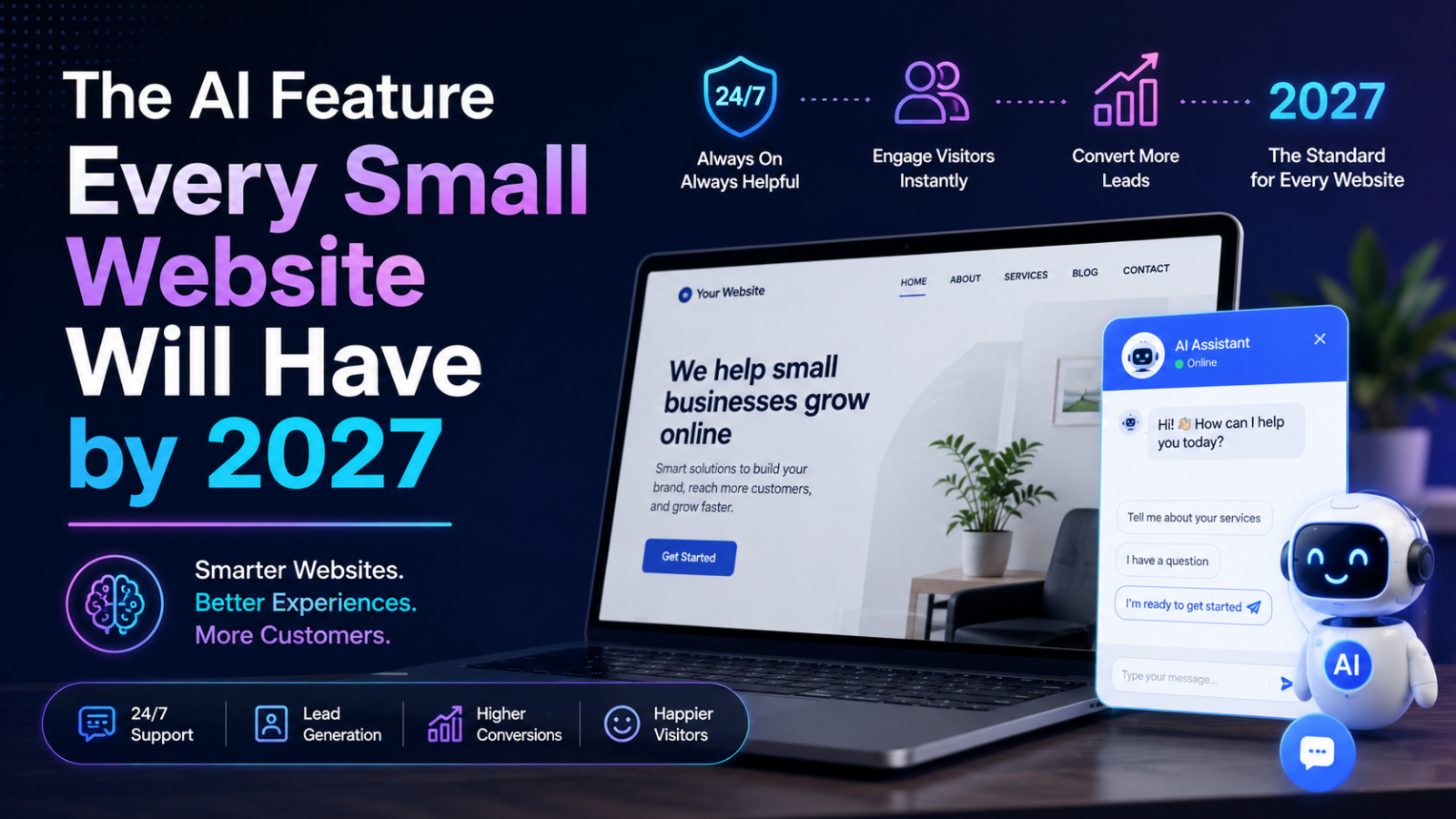
The AI Feature Every Small Website Will Have by 2027
A quiet shift is happening on small business websites. Here's the one AI feature that's going from "nice to have" to standard — and why it's happening faster than expected
A few years ago, a live chat bubble in the corner of a website meant something specific: a small team, somewhere, trying to answer questions in real time. Half the time it worked. Half the time it sat there unattended, ignored, a little embarrassing — a promise of help that wasn't actually there.
That bubble is quietly turning into something else. And by 2027, it's probably going to be one of the most common features on small business websites — right up there with a contact form or a pricing page.
The feature is an AI chatbot. Not the scripted, "click a button to see FAQs" kind from a decade ago — an actual AI that reads a business's own content and answers questions from it, instantly, in a normal conversational way.
Why This Is Happening Faster Than People Expect
A few things are converging at once, and none of them are hype.
Visitors now expect an instant answer. Attention spans on the web have gotten shorter, not longer. A visitor with a question — about pricing, availability, how something works — won't wait for an email reply anymore. If they can't get an answer in the next thirty seconds, they leave and try a competitor instead.
Small businesses can't staff around the clock. A two-person or ten-person team simply can't answer questions at midnight, on weekends, during a rush. That was true five years ago too — the difference is that now there's a realistic way to close that gap without hiring anyone.
AI got good enough to actually be trusted with it. Older chatbots were frustrating because they either followed a rigid script or made things up. What's changed is that a chatbot can now be trained directly on a business's own documents — its FAQs, pricing sheets, policies — and answer only from that, accurately, instead of guessing.
The setup cost dropped to almost nothing. A few years ago, adding a smart chatbot meant a development project. Now it's upload your existing documents, paste one line of code, and it's live. That barrier basically disappeared.
Put those four things together, and it stops being surprising that this is spreading fast. It starts looking inevitable.
What It Actually Looks Like in Practice
The businesses adopting this early aren't doing anything exotic. A travel agency uploads its tour packages and pricing, and suddenly a visitor asking "is this available in December" gets an instant, accurate answer instead of waiting for an email. A hotel uploads its room types and policies, and late-night browsers get real answers instead of an empty chat box. A small service business uploads its FAQ page, and stops answering the same five questions by hand every day.
This is the model tools like Glanceia are built around — a business uploads what it already has, and the chatbot answers only from that, styled to match the site's own branding, live within minutes. No generic scripted responses, no guessing, no separate team required to maintain it.
The visitors experiencing this often don't even register it as "AI." It just feels like the website finally has someone there to answer, whenever they show up.
Why This Isn't Just Another Trend
Plenty of website features come and go — pop-up newsletter forms, chat widgets that nobody staffed, quiz funnels. What makes this one different is that it solves a problem that was never actually optional: someone has to answer visitor questions, and right now, most small businesses can't afford to do that well around the clock.
An AI chatbot doesn't replace that need. It just makes answering it possible without the cost of doing it manually, at scale, at all hours. That's not a trend businesses will move on from once the novelty wears off — it's closer to how spell-check or autofill became invisible parts of normal software. Nobody talks about them anymore. They're just there.
By 2027, a small business website without some form of this probably won't look modern — it'll look like it's missing something visitors have started to expect.
Getting Ahead of It
If you run a small business site, the businesses that adopt this early get an edge that compounds — while competitors are still losing after-hours visitors and manually answering the same questions, early adopters are capturing those leads and freeing up their team's time.
Setting it up doesn't require a developer or a big project. A realistic starting point:
Gather what you already have — FAQs, pricing, policies, product info.
Upload it to a chatbot trained specifically on your own content, like Glanceia.
Match its look to your site's branding.
Add one line of code.
Watch what people actually ask, and use that to improve both the bot and the site itself.
Most businesses using Glanceia go live the same day, with a free plan to start — no dev team, no long rollout.
The Bottom Line
The chat bubble that used to sit empty in the corner of a website is turning into something visitors actually expect to work. It's not a far-off prediction — it's already happening on the businesses paying attention now. The ones who wait until 2027 to add it won't be early. They'll just be catching up.
Curious what this would look like on your own site? Glanceia sets up an AI chatbot trained on your own data in minutes — free to start. Get in touch if you want help figuring out where to begin.