What Nobody Tells You About Running Customer Support Solo
Doing customer support alone looks manageable from the outside. Here's what actually happens once you're the only one answering — and what changes when you stop doing it alone.
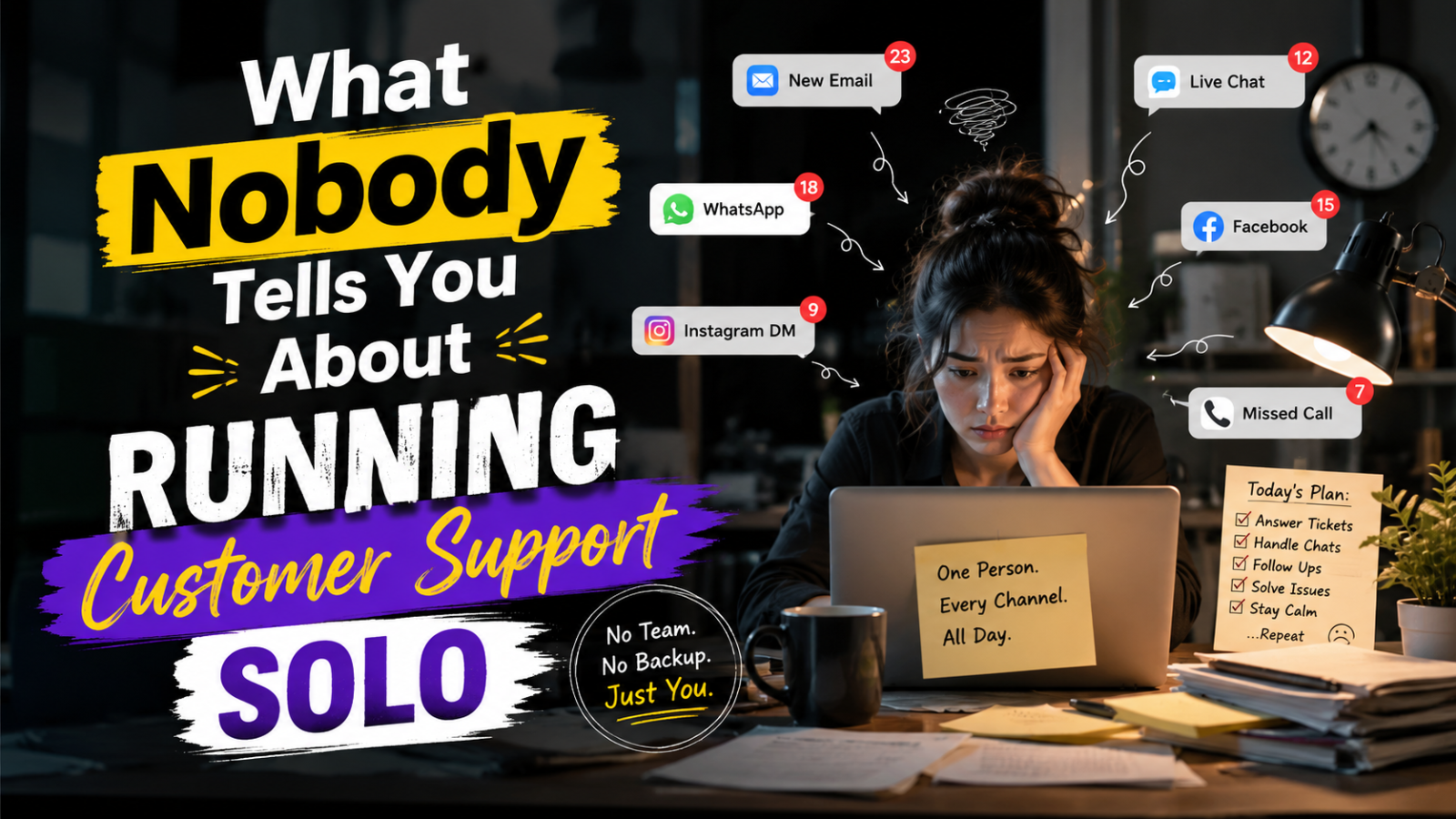
When you're the only one handling support — founder, solo operator, one-person customer service team — nobody warns you about the actual shape the job takes. You picture answering questions here and there between other tasks. What actually happens is different: the questions never stop arriving, and every one of them, no matter how small, needs you, specifically, right now.
Nobody tells you that in advance. You find out by living it.
The Part Nobody Mentions: It's Not the Hard Questions That Wear You Down
You'd think the difficult, complicated customer issues would be what exhausts you. They're not. Those are rare, and honestly, they're often the more interesting part of the job.
What actually wears you down is answering "what are your hours" for the fortieth time this month. It's re-explaining your return policy to someone who could have found it on your site, if they'd looked, if your site made it easy to find. It's the same six questions, in different words, from different people, every single day — and every single one requires you to stop whatever you were doing and type basically the same reply you typed yesterday.
Nobody warns you that the volume of simple questions is what breaks you, not the volume of hard ones.
The Part Nobody Mentions: You're Never Actually Off
When you're the whole support team, there's no such thing as "the support team is closed." Customers don't know or care that you're one person. They message at 9 AM and 11 PM and on Sunday, because from where they're standing, it's just a business with a contact form — how would they know there's only one of you behind it?
So you end up making an impossible choice, over and over: answer the message right now, on your day off, in the middle of dinner, or let it sit and hope the customer doesn't just leave and buy from someone who replied faster. Most solo operators end up doing some version of "always on," because the alternative feels like losing customers. Nobody tells you that this is the actual trade-off — not "will I get support requests," but "will I ever fully switch off."
The Part Nobody Mentions: Every Hour on Support Is an Hour Not Spent Growing the Business
This is the quiet one. Every hour spent answering "is this in stock" is an hour not spent on the parts of the business that only you can do — the strategy, the product, the growth. When you're solo, there's no one else to hand the repetitive stuff to. So it just... eats into everything else, a little at a time, until you notice you haven't touched the actual growth of your business in weeks.
Nobody tells you that the real cost of solo support isn't stress — it's opportunity cost. Every FAQ you answer by hand is time you don't get back for the things that actually move the business forward.
What Actually Changes This
The instinct, when you're drowning in this, is to think the answer is hiring — bring someone else on to share the load. For a lot of solo operators, that's not realistic yet. It's an expense you can't justify for a problem that's mostly repetitive questions, not a genuine staffing shortage.
The actual fix for most solo operators isn't a person. It's removing the repetitive part of the job entirely, so the questions that don't need you specifically stop landing in your inbox at all.
This is where a chatbot trained on your own content changes the math. Upload your FAQs, your pricing, your policies — the same things you'd tell a new hire on day one — and something like Glanceia answers those questions directly, instantly, at any hour, without you touching them. Not a generic bot giving vague non-answers — one that only responds using what you actually gave it, so the answers are accurate to your actual business.
What lands in your inbox after that isn't gone — it's just different. It's the handful of conversations that genuinely need you: the complicated request, the unhappy customer, the custom question a document can't answer. Everything else gets handled before it ever reaches you.
What This Actually Feels Like Day to Day
The 11 PM message gets answered — without it being you answering it. The visitor gets what they need immediately; you get your evening back.
You stop typing the same reply for the fortieth time. The repetitive questions disappear from your day entirely, not just get faster to answer.
You get a real read on what people are actually asking. Instead of vaguely remembering "people ask about shipping a lot," you get an actual list, which usually tells you something worth fixing on your site.
The hours you get back go toward the business, not the inbox. That's the part solo operators notice most — not less stress, necessarily, but time that finally goes toward something that compounds.
If You're Doing This Alone Right Now
You don't need to hire anyone to fix the part of this that's actually breaking you. A realistic starting point:
Write down the questions you answer most — you already know them by heart.
Gather whatever you have written already — FAQs, pricing, policies, product info.
Upload it to a chatbot trained on that content, like Glanceia.
Let it handle the repetitive questions while you handle the ones that actually need you.
Check what it's being asked each week — it'll tell you more about your business than you'd expect.
Most people get this live within minutes, with a free plan to start — no dev team, no hire, no big process change.
The Bottom Line
Nobody tells you, going in, that solo customer support isn't hard because of the hard questions — it's hard because of the sheer volume of easy ones, arriving at all hours, each one quietly costing you time you needed for something else. The fix isn't doing more. It's making sure the repetitive questions stop needing you at all, so what's actually left is the part of the job only you can do.
If this is where you're at right now, Glanceia sets up an AI chatbot trained on your own content in minutes — free to start. Get in touch if you want help figuring out where to begin.